


Have you ever stopped yourself from trying something, not because it was truly impossible, but because a part of you had simply given up hoping? Most of us have been there. We carry invisible walls inside us, built from old disappointments and quiet fears we never fully examined. The idea to think beyond limits is not a motivational slogan. It is a genuine shift in how you see yourself and what you believe is possible. This article explores one of theThink Beyond Limit most revealing stories in human psychology, and more importantly, it shows you how to reclaim the courage you may have quietly set aside.
The Shark Story That Changes Everything
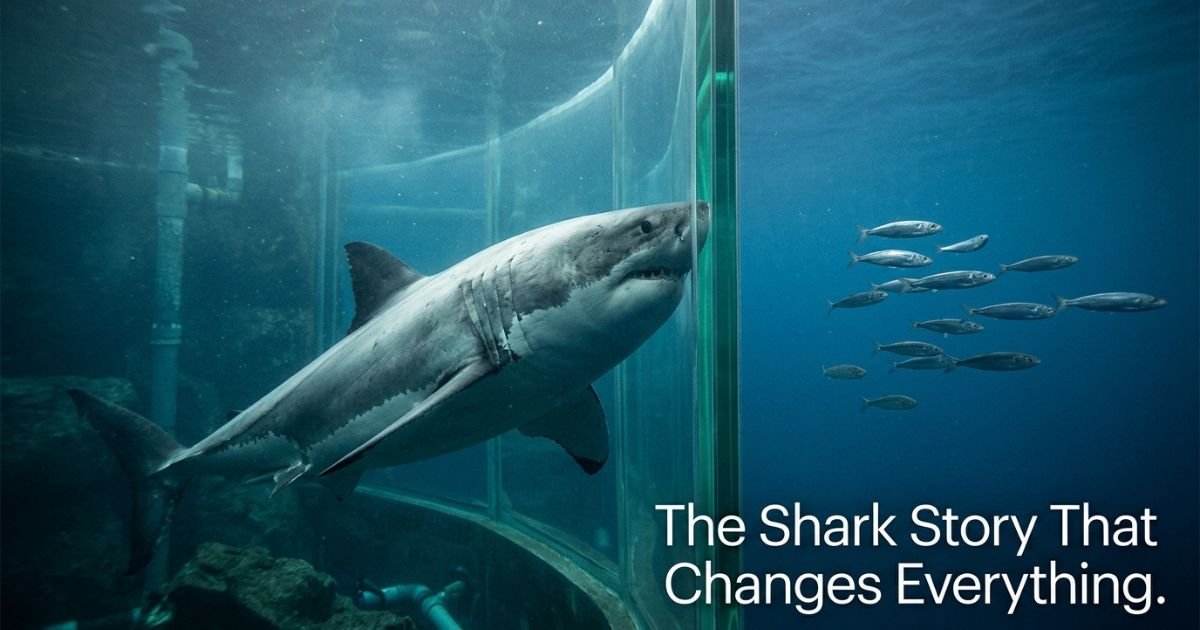
There is a story that has traveled through psychology classrooms, boardrooms, and late-night conversations for decades. It does not involve a hero or a villain. It involves a shark, a glass wall, and a truth that most of us recognize the moment we hear it.
In a research experiment, a marine biologist placed a shark into a large tank, then released several small bait fish. The shark attacked immediately. Meal secured, instincts satisfied.
Then the researcher inserted a clear fiberglass divider into the tank, separating the shark from the fish. The shark attacked again. And again. Each time, it struck the barrier. Each time, it failed. Slowly, after repeated collisions with something it could not see but absolutely felt, the shark began to slow down. It tried less often. Eventually, it stopped altogether.
Here is where the story takes its most important turn.
The researcher removed the barrier entirely. The shark was now in open water with the fish. No obstruction. No wall. Nothing standing between predator and prey.
The shark did not attack. It swam calmly alongside the fish it would have hunted just days before. The barrier had been removed from the tank, but it had taken up permanent residence in the mind of the shark.
That is the story. Simple. Quiet. And if you sit with it for a moment, deeply uncomfortable in the best possible way.
Also Read: A Rose for Mother: A Touching Mother’s Love Story
Why This Story Resonates So Deeply With People
The reason this story moves people is not because of what happens to the shark. It is because of what we recognize about ourselves.
We have all hit invisible walls. We have all tried something, been stopped, tried again, been stopped again, and eventually filed away a belief that said: this is not for me. And the most sobering part? Many of us are still living by that belief long after the wall was removed.
The job market shifted. The relationship dynamic changed. The old fear no longer applies. But the behavior remained. We stopped trying in areas of our lives where effort could absolutely make a difference, because somewhere along the way, we accepted a false ceiling as a permanent truth.
What It Really Means to Think Beyond Limits
The phrase think beyond limits can feel like something stitched onto a motivational poster. But underneath the surface, it describes something far more specific and far more difficult.
It means recognizing that many of the things you believe about what you can and cannot do are not conclusions. They are conditioning. They are patterns your mind formed in response to pain, and they stayed with you long after the pain became irrelevant.
Thinking beyond limits is not about pretending obstacles do not exist. It is not about toxic positivity or dismissing genuine challenges. It is about asking one honest question:
Is this wall still real, or am I swimming around a barrier that was removed years ago?
The Difference Between Caution and Conditioning
Not every hesitation is a limiting belief. Sometimes caution is wisdom. If you put your hand on a hot stove and pull back, that is useful learning. That particular stove is still hot.
But conditioning is different. Conditioning happens when a specific experience in a specific context becomes a global rule for your entire life. One failed business becomes proof that entrepreneurship is not for you. One difficult relationship becomes evidence that vulnerability leads to pain. One public setback becomes a reason to never speak up again.
The shift from healthy caution to limiting conditioning is usually quiet. It rarely announces itself. You just notice, one day, that you no longer try certain things. And when you ask yourself why, the answer feels like logic when it is actually just old fear with a reasonable-sounding voice.
The Psychology Behind Invisible Barriers
Understanding why our minds build these walls does not require a psychology degree. It just requires honesty and a willingness to look a little closer at what drives your hesitation.
How Learned Helplessness Forms
Psychologist Martin Seligman introduced the concept of learned helplessness through his research in the 1960s. The core idea is straightforward: when a living being experiences repeated situations where their actions produce no positive result, they eventually stop taking action altogether, even when circumstances change and action could absolutely produce a result.
In humans, this plays out in profoundly personal ways.
A student receives poor grades despite studying hard. After several semesters, they stop studying as intensely, not from laziness, but from a belief that effort and outcome are no longer connected for them.
An employee applies for promotions multiple times and is passed over. Eventually, they stop applying entirely, not because the promotions stopped existing, but because their mind quietly concluded that advancement simply is not available to someone like them.
A person tries to repair a struggling relationship repeatedly. Each attempt ends in frustration. At some point, they stop attempting repair. Not because the relationship became permanently beyond saving, but because the belief formed that their actions make no difference.
In every one of these cases, something real happened. The failure was genuine. The pain was real. But the conclusion the mind drew, that this is permanent, that effort is pointless, that things cannot change, was an overreach. A generalization. A barrier formed from temporary experience.
How Fear Becomes the New Barrier
Once learned helplessness takes hold, fear steps in to maintain it.
Fear does not always arrive loud and dramatic. Often it shows up as common sense. It tells you that you are just being realistic. It reminds you of what happened last time. It suggests that protecting yourself from another disappointment is the mature, responsible thing to do.
This is exactly how the shark experienced it. After enough collisions, the body learned to stop before the impact. The fear of pain became the barrier, rendering the original physical wall unnecessary.
Humans operate the same way. We begin to avoid the situations that once hurt us, even when those situations have fundamentally changed. The avoidance feels rational. It feels protective. But it is quietly costing us possibilities we cannot see because we stopped looking.
The Hidden Cost of Stopping
One of the subtlest and most expensive patterns in human behavior is the slow, barely noticeable act of stopping. Not stopping dramatically. Not quitting in a single decisive moment. But gradually disengaging. Investing a little less effort. Expecting a little less from yourself. Aiming a little lower.
This is not failure in the traditional sense. Traditional failure is visible. It leaves a mark you can point to. But the cost of invisible barriers is different. It is measured in the things that never happened. The conversations never had. The risks never taken. The version of yourself that never fully emerged.
The Life Lived Below Your Potential
There is a particular kind of quiet sadness that comes from a life where you consistently played it safer than you needed to. Not because the risks were actually that high. But because the fear felt real enough to keep you at the edge instead of in the game.
You may have settled for a role that did not challenge you because seeking something more felt arrogant or unrealistic. You may have held back your authentic voice in a relationship because the last time you were fully honest, it did not go well. You may have let a dream sit quietly in the background of your life for years, visiting it only in private moments, never quite believing it deserved a real chance.
These are the costs that never appear on a ledger but are felt in a hundred small ways every day.
Thinking beyond limits is, at its heart, about reclaiming what quietly slipped away while you were being careful.
Why Fear Feels Like Logic
One of the most important things to understand about self-imposed barriers is that they rarely feel like fear. They feel like clear thinking.
When you talk yourself out of something, the internal monologue sounds reasonable. You tell yourself that now is not the right time. That you need more preparation. That the conditions are not quite right yet. That other people are better positioned. That the risk is too high.
And here is the unsettling part: some of that reasoning may even be partially true. Timing does matter. Preparation does help. Conditions do influence outcomes. Which is exactly why fear disguised as logic is so effective. It borrows real truths and uses them to construct an argument that keeps you exactly where you are.
How to Tell the Difference
The clearest way to distinguish genuine caution from fear-based reasoning is to ask yourself this: if I knew this would work, would I still hesitate?
If the honest answer is no, that the only thing stopping you is uncertainty about the outcome, then what you are experiencing is not wisdom. It is fear. And fear, as a decision-making tool, has a terrible track record.
Fear is extraordinarily good at one thing: keeping you safe from discomfort in the short term. It is spectacularly bad at helping you build a life you actually want to live.
How to Think Beyond Limits in Your Own Life

Understanding the psychology is one thing. Doing something with that understanding is another. Here are some grounded, specific ways to begin testing your own invisible walls.
Start by Identifying Where You Have Already Stopped
Most people, when they reflect carefully, can identify at least one area of their life where they used to try and no longer do. Maybe it is a creative pursuit they abandoned. A professional goal they quietly shelved. A relational pattern they stopped fighting against.
This is not about blame or regret. It is about awareness. You cannot challenge a barrier you cannot see. The first act of thinking beyond limits is simply noticing where you stopped, and asking yourself honestly whether the reason you stopped is still valid.
Redefine What Failure Actually Teaches You
The shark story only ends the way it does because the shark interpreted repeated failure as permanent truth. But failure, properly understood, is information. It tells you what did not work under a specific set of conditions at a specific point in time.
It does not tell you what will never work.
When you begin to treat failure as data rather than verdict, everything changes. You stop fearing it as a final answer and start using it as a navigation tool. You become willing to try again, not because you are reckless, but because you understand that the map of what is possible is drawn through repeated attempts, not a single outcome.
Test the Wall Before You Accept It
One of the most underused strategies for thinking beyond limits is simply testing the assumption. Not dramatically. Not by burning everything down and starting fresh. But gently.
If you believe you are not the kind of person who can speak in public, sign up for one small talk. If you believe you are too old to learn something new, spend thirty minutes on it for two weeks. If you believe a relationship is beyond repair, have one honest conversation.
Often, what you discover is not that the wall was never there. It was. But you will discover whether it is still there now. And frequently, it is not.
The barrier exists in memory. The present moment has not yet confirmed that it still applies.
Take Small, Consistent Action
Growth does not usually require a dramatic leap. It requires a sustained commitment to showing up at the edge of your comfort and taking one step past it, repeatedly, over time.
The confidence you are waiting for before you act is not a prerequisite for action. It is a product of it. You build confidence by acting in the presence of uncertainty, not by waiting until uncertainty disappears.
Small steps compound in remarkable ways. A little effort, applied consistently, rebuilds the belief that your actions and your outcomes are connected. Which is exactly what learned helplessness erases.
Choose Your Environment Carefully
The people around you influence your sense of what is possible more than almost anything else. When you spend significant time with people who have accepted the same invisible ceiling you have, their worldview reinforces yours. It feels normal to stay where you are because everyone around you has stopped too.
Seeking out people who have broken through similar limitations does not mean abandoning the people you care about. It means intentionally exposing yourself to evidence that the barrier is not permanent. Evidence changes belief. And changed belief changes behavior.
Also Read: The True Meaning of Love
Applying This Mindset to Real Areas of Your Life
In Your Career
Career stagnation is one of the most common places invisible barriers take hold. People stay in roles that no longer challenge them, not because better opportunities do not exist, but because they have internalized a story about what they are qualified for, what they deserve, or what is realistic for someone in their position.
Thinking beyond limits in your career begins with questioning that story. What would you pursue if you genuinely believed advancement was available to you? What role would you apply for if you stopped calculating your odds of rejection in advance? What conversation would you initiate if you believed your perspective had real value?
Often, the ceiling is not in the job market. It is in the story you tell yourself about your place in it.
In Personal Growth
Personal development requires something specific: the willingness to be a beginner again. And that willingness tends to diminish as we get older and more invested in our established identity.
We become attached to who we already are, because that identity is familiar and relatively safe. Becoming someone new, even in a direction we genuinely want to go, requires first acknowledging that who we are right now is not a fixed destination. It is a current position. One that can be moved from.
That acknowledgment alone is an act of thinking beyond limits.
In Relationships
Perhaps the most tender place where invisible barriers live is in how we relate to other people.
Past hurt creates patterns of emotional self-protection. We stop being vulnerable because vulnerability once led to pain. We stop expressing needs because our needs were once dismissed. We stop trusting because trust was once misplaced.
These responses made complete sense in the context where they formed. But applied automatically to every new relationship, every new moment, every new person, they become barriers to the very connection we most deeply want.
Thinking beyond limits in relationships means being willing to test whether the past applies to the present. It means offering a small degree of openness and seeing what happens, rather than assuming in advance that the outcome is already determined.
When the Barrier Is Gone But the Behavior Remains
This is the heart of the shark story, and it is worth sitting with fully.
The barrier is removed. The fish are right there. Nothing is in the way. And yet the shark does not move.
Not because it cannot. Because it no longer believes it can.
This is perhaps the most important insight the story offers: the most effective barriers are not the external ones. They are the internal ones formed in response to external ones that may no longer exist.
The question worth asking yourself, with honesty and without judgment, is this: in what areas of your life are you still not swimming, not because a wall is there, but because you stopped believing the wall would ever be gone?
The Moment You Realize the Wall Is Gone
There is a specific kind of realization that changes people. It is the moment they try something they had given up on, expecting the same result as before, and discover that the circumstances have changed.
The person who applies for one more job after years of rejection and gets it. The person who has one more honest conversation in a relationship that had grown silent and finds something new is possible. The person who sits down to write, paint, build, or create after telling themselves for years they were not that kind of person.
These moments do not just change a single outcome. They restructure a belief. They prove, through direct experience, that what felt like a permanent wall was actually a temporary condition that had outlasted its relevance.
You cannot force this realization from the outside. But you can create the conditions for it by being willing to test the wall one more time.
Growth Requires Testing Uncomfortable Edges
Every genuine growth experience involves some degree of discomfort. Not the manufactured suffering of unnecessary hardship, but the natural friction of doing something your nervous system does not yet consider familiar.
The mind resists unfamiliar territory. That resistance is not a sign that you are moving in the wrong direction. It is often a sign that you are moving in exactly the right one.
The shark had become so comfortable in its limited zone that the open water no longer felt like freedom. It felt like threat. The absence of the barrier was more disorienting than the barrier had been, because at least the barrier was known.
Humans experience the same thing. When an old limitation falls away, whether a difficult job ends, a relationship shifts, a fear is finally faced, the first response is often not relief. It is disorientation. What do I do with this open space?
Learning to sit with that disorientation, to let yourself be briefly lost in unfamiliar possibility, is one of the most important skills in thinking beyond limits.
Discomfort Is Not the Enemy
We live in a culture that treats discomfort as a problem to be solved as quickly as possible. But discomfort, in the context of growth, is not a problem. It is a signal.
It signals that you are at the edge of something familiar. And edges are where expansion happens.
The goal is not to eliminate discomfort. It is to stop interpreting it as a reason to retreat. To learn to read it instead as information: you are close to something new. Keep going.
The Deeper Truth Behind Thinking Beyond Limits

The shark story is not, ultimately, a story about a shark. It is a story about belief. About how the mind forms conclusions from experience, how those conclusions calcify into identity, and how that identity then shapes every decision we make without us ever consciously examining it.
To think beyond limits is to interrupt that process. To step between the experience and the conclusion it usually creates and ask: is that conclusion still true? Is it still serving me? Is it actually based on current reality, or is it a memory wearing the mask of wisdom?
Most of the limits that constrain a human life are not laws of physics. They are stories. And stories, unlike physics, can be rewritten.
You Are Not the Same Person Who Failed Before
One of the quiet truths about growth is that by the time you are ready to try again, you are not the same person who failed the first time. You have learned things. You have changed. Your circumstances have shifted. The conditions are not identical.
But the belief system often is.
We carry forward the conclusions of our past self into the present, even when the present self has genuinely changed. The limitations that once reflected reality now reflect only memory.
Recognizing this is not naive optimism. It is accurate accounting. You are not who you were when the wall was built. Which means the wall may not reflect who you are now.
Also Read: The Quiet Power of Compassion
Moving Forward: Choose to Test the Wall
The most powerful take-away from the shark story is not the tragedy of the shark that stopped trying. It is the invitation it extends to every person who reads it.
You have walls. Everyone does. Some of them are recent. Some of them have been there so long you no longer notice them. They feel like the shape of your life rather than a limitation on it.
But here is what is true: some of those walls are no longer there. The circumstances that built them have changed. You have changed. The question is simply whether you are willing to test them.
Not with reckless abandon. Not by ignoring real challenges or dismissing genuine caution. But by approaching the edges of what you have accepted as fixed and asking, gently and honestly, whether they still hold.
Often, they do not.
And in that discovery, something remarkable tends to happen. Not just a new outcome, but a new understanding of who you are and what is available to you. A realization that the limits you lived inside were never quite as solid as they felt.
That is what it means to truly think beyond limits. Not to pretend the walls were never there. But to refuse to let their memory outlast their reality.
The water is open. The fish are right there. All that is left is the decision to swim.
Frequently Asked Questions
What does think beyond limits mean?
It means challenging mental barriers created by fear and past failures. It is about realizing that many limits exist only in your mind, not in reality.
How to think beyond limits?
You start by identifying self-imposed fears and testing them with small actions. Growth happens when you question whether old limitations still apply today.
What does “beyond limits” mean?
It refers to going past self-created mental barriers and beliefs that restrict growth. It is about expanding what you think is possible.
Can humans go beyond their limits?
Yes, many limits are psychological, not physical. When beliefs change, people often discover they were capable of more than they thought.
How do I go beyond my limits?
By taking small actions outside your comfort zone and treating failure as feedback, not a final result. This slowly rewires limiting beliefs.
How to break past your limits?
You break limits by challenging fear-based thinking and repeatedly testing what you believe you cannot do. Consistency is key.
Can we go beyond our limits?
Yes, especially mental and emotional limits. Most barriers are learned, not fixed, so they can be unlearned.
What do limits mean in a relationship?
Limits in relationships are emotional boundaries formed from past experiences or fears. Sometimes they protect us, but sometimes they block real connection.

Welcome to Blessing Bloom. I’m Ahsan Ali, founder of BlessingBloom.com a faith-based website dedicated to sharing prayers, blessings, and heartfelt wishes. Based in Islamabad, Pakistan, I created Blessing Bloom to help people find the right words during life’s most meaningful moments. With a background in Information Technology, I combine a passion for digital content with a genuine love for faith-inspired writing.