


There are moments when words feel too small for what your heart is carrying. Maybe it is a hospital waiting room, a quiet drive home after hard news, or a worry that will not let you sleep. This is often where people first encounter the Sacred Heart of Jesus prayer, not in calm, peaceful seasons, but in the raw and unsteady ones. For centuries, believers have leaned on this devotion as a way to hand their fear, grief, and hope to someone steadier than themselves. If you have ever wondered what this prayer truly means, where it began, or how to make it part of your own life, this guide will walk you through it gently, one piece at a time.
What Is the Sacred Heart of Jesus Prayer?
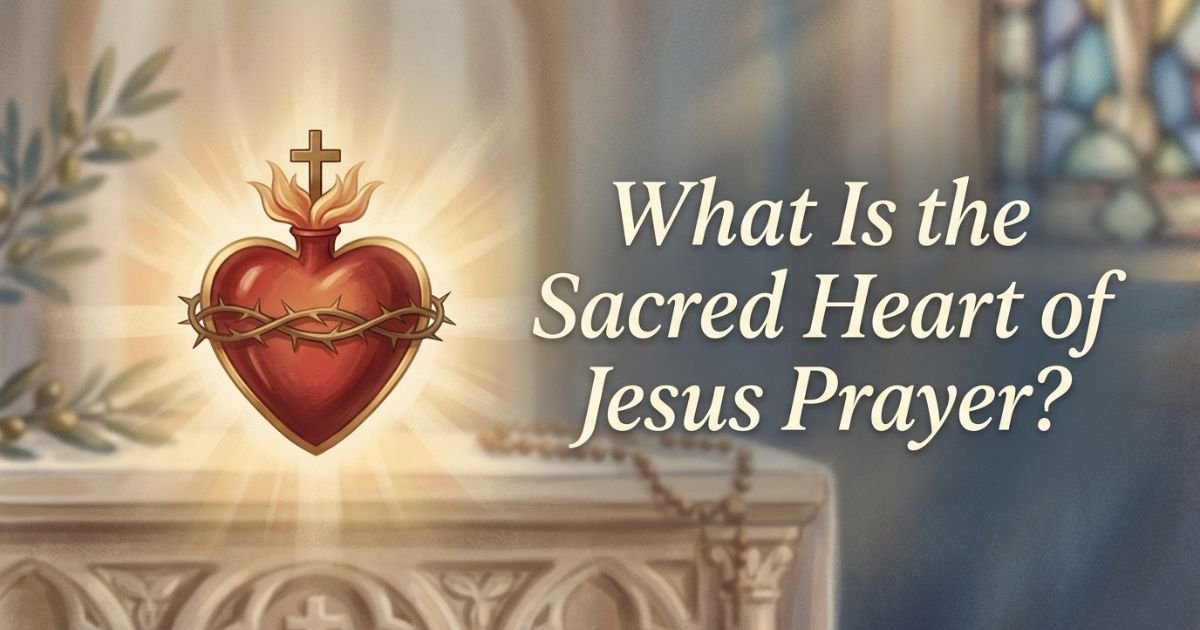
Some prayers are long. This one barely takes a breath, yet it can hold an entire lifetime of struggle inside it.
The Sacred Heart of Jesus prayer is a devotion centered on the heart of Christ as a living symbol of love that does not run out. It is not a stiff, ceremonial phrase recited out of habit. It is a way of speaking directly to God about the things that are hardest to carry alone.
The heart, in this devotion, is not just a physical image. It represents Christ’s compassion, His suffering, and His unwavering closeness to people who feel forgotten or unworthy. When someone prays this devotion, they are not performing a ritual. They are choosing, in that exact moment, to trust something bigger than their own fear.
The most familiar version of the prayer is short:
O Most Sacred Heart of Jesus, I place all my trust in You.
It does not need extra words to carry weight. In a moment of panic, grief, or exhaustion, this single sentence becomes an anchor. It is less about reciting something perfectly and more about surrendering honestly.
Also Read: The Best Prayer for Souls in Purgatory
The History Behind the Sacred Heart Devotion
To understand why this prayer feels so personal even today, it helps to know where it came from.
Where the Devotion First Took Root
Long before this prayer had a formal name, early Christians were already meditating on the suffering of Christ, especially the moment His side was pierced during the crucifixion. For them, this was never just a historical detail. It was a picture of love poured out without holding anything back.
Theologians and saints reflected on this image for generations. They saw Christ’s wounds not as a symbol of defeat, but as proof of a love that goes further than human love usually can. Still, for a long time, these reflections stayed quiet and personal rather than becoming an organized devotion that ordinary believers could practice.
Saint Margaret Mary Alacoque and the Visions That Changed Everything
The devotion as most people recognize it today traces back to the seventeenth century and a French nun named Saint Margaret Mary Alacoque.
She described receiving visions of Jesus in which He revealed His heart burning with love for humanity, yet also grieving over how often that love was ignored or pushed aside. These were not abstract images meant only for reflection. According to her account, Jesus asked for a deeper, more intentional devotion to His heart, including frequent Communion and quiet hours of prayer offered in His honor.
At first, people were skeptical. Visions like hers were not easy to accept without question. But over time, as her experiences were studied and supported by trusted spiritual leaders, the devotion slowly gained acceptance among the faithful.
How the Church Embraced This Prayer
What began as one woman’s private experience eventually grew into something the wider Church recognized and encouraged. A feast day was established in honor of the Sacred Heart, giving the devotion a permanent place in the rhythm of the Christian calendar.
Missionaries carried the practice far beyond its European roots, and over the following centuries it became one of the most widely embraced devotions in Christianity. Today it is prayed by people across very different cultures and backgrounds, yet it still carries the same simple invitation it always has: trust the love that does not give up on you.
What the Sacred Heart of Jesus Prayer Really Means
Knowing the history is helpful, but the deeper question is what this prayer is actually asking of you when you pray it.
A Love That Does Not Depend on You Getting It Right
At the center of this devotion is the belief that God’s love is not a reward for good behavior. It does not wait for you to clean yourself up first.
This matters more than it might seem. So many people carry a quiet fear that they have messed up too much to be loved well. The Sacred Heart devotion pushes back gently against that fear. It says love was already given, fully, before you ever earned it.
An Invitation to Trust, Even When Trust Feels Risky
Saying the words I place all my trust in You is not always easy to mean. Trust can feel dangerous, especially after disappointment or loss.
That is exactly why this prayer matters. It does not ask for blind optimism. It asks for a decision, made again and again, to choose faith over fear in the middle of uncertainty. That decision is not passive. It takes courage to keep saying it on the days when trust feels like the hardest thing in the world.
A Quiet Reminder That Mercy Is Still Available
The heart of Jesus is often pictured as wounded, yet still glowing with love. That image carries a message worth sitting with: pain and love are not opposites here. Even when someone has failed, badly, that love has not packed up and left.
For many believers, this becomes the most comforting part of the devotion. It opens a door back to God without shame standing in the way. It also gently challenges the one praying to offer that same mercy to others, even when it is hard to give.
The Spiritual Benefits People Experience Through This Devotion
People rarely describe this prayer as something flashy or dramatic. Instead, they describe it as something quiet that slowly changes how they carry their days.
A sense of calm is often the first thing people notice. Repeating a short, honest line like I place all my trust in You interrupts the spiral of anxious thoughts, even if just for a moment. That pause adds up over time.
Faith tends to grow alongside that calm. Each time someone prays this devotion, they are reinforcing a simple truth: they are not facing their struggles completely alone. That belief does not arrive all at once. It builds slowly, through repetition rather than a single dramatic experience.
Many people also describe a kind of emotional release. Grief, anxiety, and old wounds do not vanish after one prayer, but they often feel lighter to carry when brought honestly into this devotion instead of held silently inside.
There is also a felt sense of protection, not necessarily from hardship itself, but from facing hardship completely alone. And perhaps most powerfully, many believers describe a renewal of hope, even in situations that have not changed yet. The hope does not come from certainty about the outcome. It comes from trusting that the situation is not unseen.
How to Pray the Sacred Heart of Jesus Prayer Step by Step
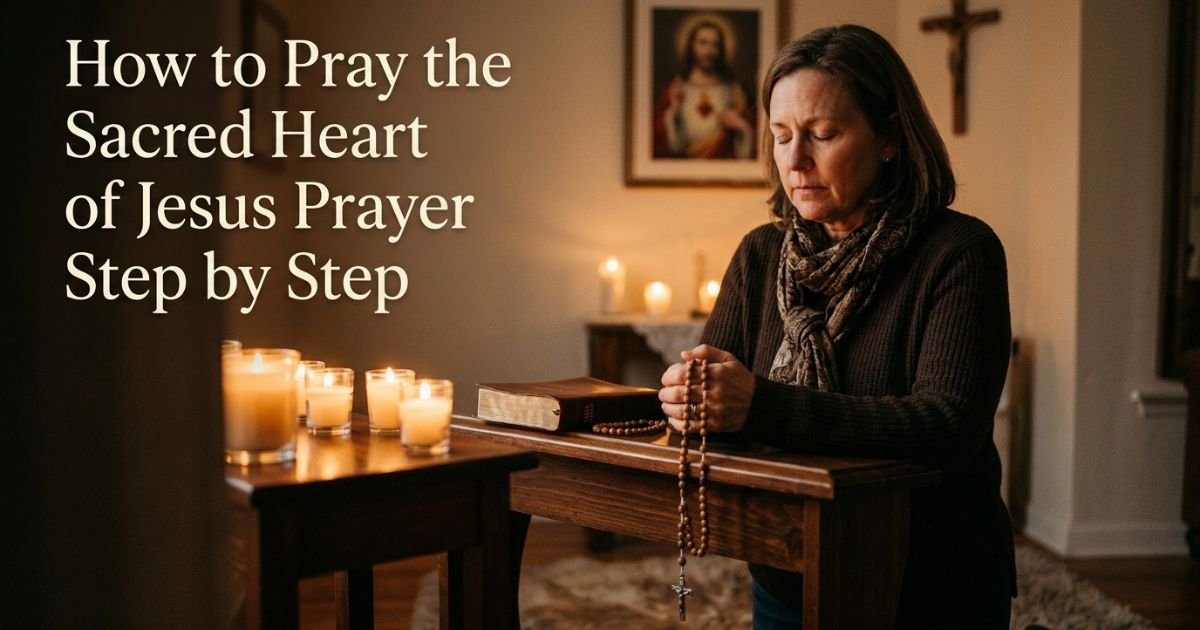
This devotion does not require special training or perfect words. It simply asks for honesty and a little bit of stillness.
Start With Stillness
Find a place where you can slow down, even briefly. It does not need to be a church or a formal prayer corner, although both can help. A quiet room, a parked car, or a few minutes before bed can work just as well. What matters is choosing stillness on purpose in a world that rarely offers it freely.
Bring Your Real Life Into the Prayer
Before saying anything, pause and notice what you are actually carrying. Is it stress from work, tension with someone you love, or a fear you have not said out loud yet? Naming it honestly, even silently, prepares your heart for the words that follow.
Speak It Slowly and Let It Breathe
Say the prayer without rushing. There is no benefit to speeding through it. A single sentence, spoken with attention, holds more weight than the same words said quickly out of habit. If your mind drifts, simply come back to the words without judging yourself for wandering.
Sit With What You Just Prayed
After saying the prayer, stay a little longer in the silence that follows. Let the meaning settle instead of immediately moving on with your day. This is often where the deepest part of the prayer happens, in the quiet after the words rather than the words themselves.
Let It Become a Daily Rhythm
You do not need long stretches of time for this devotion to matter. Even a minute, repeated daily, can shape how you respond to stress over time. Many people connect it to a specific moment, like the start of the morning or the last few minutes before sleep, so it becomes part of the natural rhythm of their day rather than something extra to remember.
Also Read: 35 Heartfelt Prayers for Police Officers on Duty
Popular Ways to Pray This Devotion
While the heart of the message stays the same, there is more than one way to express it.
The short version, Sacred Heart of Jesus, I trust in You, is often the easiest to carry through a busy day. Its brevity is part of its strength. There is nothing complicated to remember, just a direct, honest line you can return to in seconds.
For those wanting something deeper, the Act of Consecration to the Sacred Heart of Jesus offers a fuller expression of devotion. This longer prayer involves dedicating one’s daily life and choices to Christ, and it is often prayed during meaningful moments like feast days or personal milestones.
The Litany of the Sacred Heart takes a more communal, structured form. It moves through a series of invocations that each reflect a different side of Christ’s love and mercy. Many people find its steady, repeated rhythm calming, whether prayed alone or with a group.
When Is the Best Time to Pray the Sacred Heart of Jesus Prayer?
There really is no wrong time, but some moments tend to draw people back to this devotion more naturally:
During seasons of stress, anxiety, or fear
When facing a decision and seeking clarity
In quiet moments of gratitude
On First Fridays, which carry a traditional connection to this devotion
During family difficulties or personal hardship
If you find yourself reaching for this prayer outside of these moments too, that is not unusual. Many people simply pray it whenever the weight of the day catches up with them.
Living the Sacred Heart Devotion Beyond the Words

This prayer was never meant to stay confined to a few quiet minutes. Many believers describe it slowly shaping how they move through ordinary life.
Showing patience with someone who is difficult to love becomes a quiet extension of the devotion. So does choosing forgiveness, even when it is not deserved by the usual standards. Acting with compassion toward a stranger, or simply trusting God through a hard decision, becomes a living version of the same prayer spoken earlier that morning.
In this way, the Sacred Heart devotion stops being only words and becomes something closer to a way of living.
Also Read: 30 Heartfelt Prayers for Doctors
Gentle Mistakes to Watch For
Even simple, beautiful prayers can lose their meaning if approached carelessly. A few things worth being mindful of:
Rushing through the words without letting them land
Treating the prayer as a repeated ritual rather than a real conversation
Expecting quick or visible results from spiritual growth
Saying the words without pausing to reflect on what they mean
None of these mistakes are failures. They are simply invitations to slow back down and return to the heart of what this devotion was always meant to be.
A Final Word of Encouragement
If you came to this page looking for more than information, you are not alone. The Sacred Heart of Jesus prayer has carried people through fear, grief, uncertainty, and quiet seasons of doubt for hundreds of years, and it continues to do the same today. It does not ask for perfect words or flawless faith. It asks for honesty and a willingness to trust, even when trust feels difficult. Whether you whisper it in a hospital hallway, in your car, or in the stillness before sleep, this devotion offers something steady to hold onto. Love that does not run out is still being offered, gently and without conditions, to anyone willing to receive it.
Frequently Asked Questions
How to pray the Sacred Heart of Jesus prayer?
To pray it, first find a quiet moment and reflect on what you are feeling or carrying in your heart.
Then slowly say: “O Most Sacred Heart of Jesus, I place all my trust in You.” with sincerity.
Stay in silence afterward and allow the words to settle in your heart.
What should Catholics do before bed?
Before bed, Catholics often reflect on their day through prayer and ask for forgiveness and peace.
Many also recite short prayers like the Our Father or personal prayers for protection and rest.
It is a moment to thank God and surrender worries before sleeping.
How often should I say the Sacred Heart prayer?
There is no strict rule for frequency; it can be prayed anytime you feel stress, fear, or need comfort.
Many people repeat it daily as a short spiritual habit.
The key is sincerity, not how many times you say it.
What is the 3 day miracle prayer to the Sacred Heart of Jesus?
The 3-day prayer is a short devotional practice where the Sacred Heart prayer is repeated for three consecutive days.
It is often done with deep faith, asking for urgent help or guidance.
It is not about magic, but about focused trust and devotion.
How to pray a novena by yourself to the Sacred Heart of Jesus?
A novena is a 9-day prayer practice where you pray daily with a specific intention.
You can recite Sacred Heart prayers each day while reflecting on your request.
It is important to stay consistent, patient, and faithful throughout the 9 days.
What is the meaning of the Sacred Heart of Jesus prayer?
It represents Jesus’ unconditional love, mercy, and compassion for humanity.
The prayer expresses total trust in God, especially in difficult times.
It reminds believers that they are never abandoned, even in suffering.
What is the morning prayer for the Sacred Heart of Jesus?
In the morning, this prayer is often used to dedicate the day to Jesus’ guidance and love.
A simple version is: “Sacred Heart of Jesus, I trust in You and offer my day to You.”
It helps set a peaceful and faithful mindset for the day ahead.

Welcome to Blessing Bloom. I’m Ahsan Ali, founder of BlessingBloom.com a faith-based website dedicated to sharing prayers, blessings, and heartfelt wishes. Based in Islamabad, Pakistan, I created Blessing Bloom to help people find the right words during life’s most meaningful moments. With a background in Information Technology, I combine a passion for digital content with a genuine love for faith-inspired writing.