


There is a quiet kind of courage that lives inside every person. It does not announce itself. It simply shows up the moment you choose to try something hard instead of something easy. That courage has a name. It is called self-confidence. And if you have ever wondered why some people seem to move through life with direction and purpose while others stay stuck at the starting line, the answer almost always comes back to this one thing. The power of self-confidence is not about being fearless. It is about being willing. Willing to face the unknown. Willing to grow. Willing to try.
The Story That Changes How You See Yourself

Some lessons arrive quietly, and you only understand them much later. Others hit you like a sudden flash of truth, the kind that rewrites the way you see everything.
Mr. Peter’s math class was the second kind.
On the very first day, before anyone had a chance to settle into their seat, he handed out three different versions of a test. The first test was challenging, with both easy and hard questions, and it carried a perfect score of 10 points. The second test was moderate, offering up to 8 points. The third was straightforward, capping out at 6 points. Then he said something that stunned the room: every student was free to choose whichever version they wanted.
The room went quiet. Then, one by one, nearly every student reached for the second test. Nobody chose the first.
When Mr. Peter returned the papers a week later, the real lesson landed. Every student had received the maximum score for whatever test they had chosen, regardless of how they actually answered. Then he explained why.
He had not been testing their math skills at all. He had been testing their belief in themselves.
His words stayed with the room long after the class ended: some things look difficult at first glance and make us want to quit before we even start. But if we never confidently face a challenge, we will never know what we are truly capable of, and we will always fall short of the peak we were meant to reach.
That story is not just about a math class. It is about every moment in life when you stand at a crossroads between the safe choice and the meaningful one.
Also READ: The True Meaning of Love: A Short Story About Sacrifice and Devotion
What the Power of Self-Confidence Actually Means
A lot of people misunderstand confidence. They think it means having all the answers. They think it means never feeling scared or uncertain. But that is not what confidence really is.
The power of self-confidence is the quiet, steady belief that you are capable of learning, adapting, and improving. It does not require perfection. It does not require certainty. It only requires one thing: the willingness to take the next step even when you cannot see the full path yet.
In Mr. Peter’s classroom, every student wanted 10 points. The desire was there. But desire without confidence stays frozen. It dreams without doing. Confidence is what turns a wish into a decision, and a decision into action.
Think about the last time you hesitated before doing something difficult. Maybe you knew the answer in class but kept your hand down. Maybe you had a great idea at work, but stayed quiet in the meeting. Maybe you wanted to apply for something better but talked yourself out of it before you even started. That hesitation was not a lack of talent. It was a confidence gap.
Closing that gap changes everything.
Why Most People Choose the Easier Path
It would be easy to judge the students who chose the second test. But the truth is, most of us would have done the same thing.
Human beings are wired to protect themselves from pain. Failure feels painful. Embarrassment feels painful. Uncertainty feels deeply uncomfortable. So when we are given a choice between something that might hurt and something that feels safe, we almost always reach for safety.
The problem is not that we want to protect ourselves. That instinct is natural. The problem is when protection becomes a habit so strong that it starts making our biggest decisions for us. When fear chooses our paths, we end up on roads that are comfortable but short. Roads that keep us right where we are.
The students in that classroom did not fail because they lacked ambition. They failed to reach their potential because, in that one moment, fear spoke louder than faith in themselves.
This happens every day. A young professional does not apply for the promotion because she is afraid of rejection. A student avoids the advanced class because he does not want to be the one who struggles. A parent pushes a dream aside for years because starting feels too risky.
Fear is persuasive. It always makes the easier road look smarter. But the easier road rarely leads anywhere new.
Challenges Are Not Obstacles. They Are Invitations.
Here is something most people never stop to consider: the challenge itself is not the enemy. The challenge is actually the invitation.
When something difficult shows up in your life, it is asking you a question. The question is not, can you survive this? The question is, who will you become on the other side of this?
Growth does not happen in comfort. It happens in resistance. A muscle grows when it is pushed past what it has already handled. A mind sharpens when it wrestles with problems it has not solved before. A person becomes stronger not by avoiding hard things but by walking through them.
Mr. Peter’s first test was not impossible. It was just harder than the others. But that extra difficulty held something the other tests could not offer: the highest score available, and more importantly, the experience of choosing courage over comfort.
The students who avoided it did not just miss 2 extra points. They missed the chance to discover what they were capable of when they pushed themselves. That discovery, the moment you realize you can handle more than you thought, is one of the most powerful things a person can experience.
Challenges give you that discovery. They are not punishments. They are proof that you are being asked to grow.
Self-Confidence Is Not Arrogance. Here Is the Difference.
One of the most common reasons people hold back from building confidence is a quiet, lingering worry: what if I come across as arrogant?
This confusion is worth clearing up, because arrogance and confidence are not the same thing. They are not even close.
Arrogance says: I am better than everyone else, so I do not need to listen, learn, or adjust. It comes from insecurity wearing a loud disguise. Arrogant people do not handle failure well because their identity is built on the idea that they are already at the top.
Self-confidence says: I do not know everything, but I believe I am capable of learning. It comes from a grounded sense of inner worth that does not depend on always being right. A confident person can receive feedback without falling apart. They can admit mistakes without losing themselves. They can try something and fail and still show up the next day.
Choosing the hardest test in that classroom would not have been arrogance. It would have been courage. There is a profound difference between saying, I am better than everyone here, and saying, I believe I can try.
One closes people off. The other opens them up to everything they have not yet become.
Also READ: A Short Story That Teaches Us the Value of Sharing
The Hidden Cost of Playing It Safe
There is a cost to always choosing the easy path. People rarely talk about it because it is not dramatic. It does not arrive all at once. It is slow and quiet, and by the time you notice it, years have passed.
The hidden cost of playing it safe is a life that feels smaller than it should.
When you avoid challenges consistently, you protect yourself from failure. But you also protect yourself from discovery. From growth. From the particular kind of joy that comes when you do something you were not sure you could do.
The students who chose the easier test got their 6 or 8 points. But they never found out what they were made of. They never got to feel the particular satisfaction of attempting the hardest thing in the room. And in Mr. Peter’s own words, that meant they would always struggle to reach the peak of success.
This is the real cost. Not a bad grade. Not a single failed attempt. But a habit of avoiding difficulty that, over a lifetime, keeps you from the places only hard choices can take you.
You deserve more than a life lived inside your comfort zone.
How Self-Confidence Shapes Your Education
Students with strong self-confidence experience school differently. They ask questions when they are confused rather than silently falling further behind. They volunteer answers even when they are not 100 percent certain. They sign up for the harder class because they trust their ability to figure it out.
This is not a small difference. Over time, it compounds into a dramatically different academic path.
A student who avoids the hard questions stays comfortable but does not stretch. A student who raises their hand and says, I am not sure but here is what I think, builds something far more valuable than any single correct answer. They build the habit of engaging with difficulty, and that habit carries them much further than natural talent alone ever could.
Mr. Peter understood this deeply. He did not give his test to determine who was smartest. He gave it to see who believed in themselves enough to choose the bigger challenge because he knew that the students who could make that choice would also be the students who kept growing long after the test was over.
Self-confidence in education is not about being the best student in the room. It is about being the most willing.
How the Power of Self-Confidence Shapes Your Career
The workplace rewards confidence in quiet but consistent ways.
An employee who speaks up in meetings, volunteers for difficult projects, and takes ownership of mistakes without crumbling is someone people trust. That trust leads to opportunities. Those opportunities lead to growth.
But it starts with belief. It starts with the willingness to say, I may not have done this before, but I am capable of figuring it out.
Many people carry skills and ideas that their companies genuinely need. But fear keeps those skills hidden. Fear of being wrong. Fear of being judged. Fear of standing out in the wrong way.
The students in Mr. Peter’s class had the same ability as each other. The test was not designed to measure intelligence. It was designed to measure willingness. And in a career, willingness is often worth more than natural ability. The person who tries, adjusts, and keeps going will eventually outpace the person who waits until they feel perfectly ready.
Confidence in a career does not mean charging forward without preparation. It means preparing thoughtfully and then actually moving, instead of preparing indefinitely and never beginning.
Challenges Reveal Strengths You Did Not Know You Had

One of the most beautiful things about hard experiences is what they uncover.
You have strengths right now that you have not discovered yet. Not because they are not real, but because the situations that would reveal them have not arrived. Or because you have been avoiding those situations.
A challenge creates the pressure that surfaces capability. Under that pressure, people find the patience they did not know they possessed. They find creativity that they never had a reason to appear before. They find a quiet resilience that surprises even them.
The students who avoided the difficult test never got to discover what they were capable of. That is the quiet tragedy of the story. Not that they got a lower score, but that they walked away without knowing something true and important about themselves.
When you face a challenge and come out the other side, even if you stumble along the way, you carry something back with you that no easy experience could have given you. You carry the knowledge that you can handle more than you thought. And that knowledge becomes the foundation of deeper, more lasting confidence.
Self-Confidence and Resilience: Why They Go Together
Confident people still fail. They still face rejection, setbacks, and days when nothing goes the way they planned. What is different is not the failure itself. It is what they do with it.
A person who lacks confidence sees failure as confirmation of their worst fear: that they were never capable in the first place. Each setback feels final. Each mistake feels like proof.
A person with real self-confidence sees failure as information. It tells them what did not work, what to adjust, and how to approach things differently next time. They feel the disappointment, and then they decide to keep going.
This is resilience. And self-confidence is what makes resilience possible.
The power of self-confidence does not promise a path with no stumbles. It gives you something more valuable: the inner steadiness to stand back up after you fall, look clearly at what happened, and choose to try again.
That steadiness is built one honest attempt at a time. Every time you face something difficult, every time you choose the harder path instead of the easier one, you are depositing something into your inner reserves. And when the really hard moments arrive, you will have something to draw from.
Also READ: The Ripple Effect: How One Simple Act of Kindness Changes the World
How to Start Building Real Self-Confidence
Confidence is not a personality type you either have or do not have. It is a skill, and like every skill, it grows through practice.
Here are the foundations of building it in a real and lasting way.
Start Smaller Than You Think You Need To
The brain builds confidence through evidence. Every time you do something slightly beyond your comfort zone and survive, your brain updates its picture of what you are capable of. You do not need to start with the biggest challenge available. You need to start with one step just slightly harder than what feels completely safe.
Answer one question you are not sure about. Apply for one opportunity you feel underprepared for. Speak up once in a meeting when you have held back for weeks. Small actions build genuine belief.
Stop Waiting Until You Feel Ready
Confidence is not a prerequisite for action. For most people, it is actually the result of action. You do not feel confident and then try. You try and then, slowly, begin to feel confident.
Waiting until you feel fully ready is one of the most effective ways to make sure you never begin at all. Preparation matters. But at some point, preparation has to become movement.
Learn to Sit With Discomfort Instead of Running From It
Discomfort is not a warning sign that something is wrong. In most situations, it is a signal that something is new. New things feel uncomfortable. That feeling is not a reason to stop. It is simply information that you are in unfamiliar territory, which is exactly where growth lives.
The next time you feel that tightening discomfort around something you want to try, pause before pulling back. Ask yourself: is this actually dangerous, or does it just feel hard? Most of the time, the answer will be the second one.
Recognize Your Strengths Honestly
Many people know their weaknesses intimately. They have reviewed them, critiqued them, and replayed their failures in vivid detail. But they are far less familiar with what they actually do well.
Take time to notice your strengths, not in a vague, feel-good way, but with real specificity. What do you do that helps other people? Where do you show up with care and consistency? What comes naturally to you that other people find difficult? Recognizing your genuine strengths is not arrogance. It is accuracy. And accuracy is essential for real confidence.
Surround Yourself With People Who Believe in Growth
The voices around you shape your inner voice more than most people realize. If the people in your life consistently model fear, avoidance, and cynicism, that worldview gradually starts to feel like truth.
Seek out people who try things. People who fail and talk about it openly. People who encourage you to reach higher rather than warn you against trying. You do not need to cut everyone out of your life. But you do need to be intentional about who you spend the most time listening to.
Confidence, Preparation, and the Balance Between Them
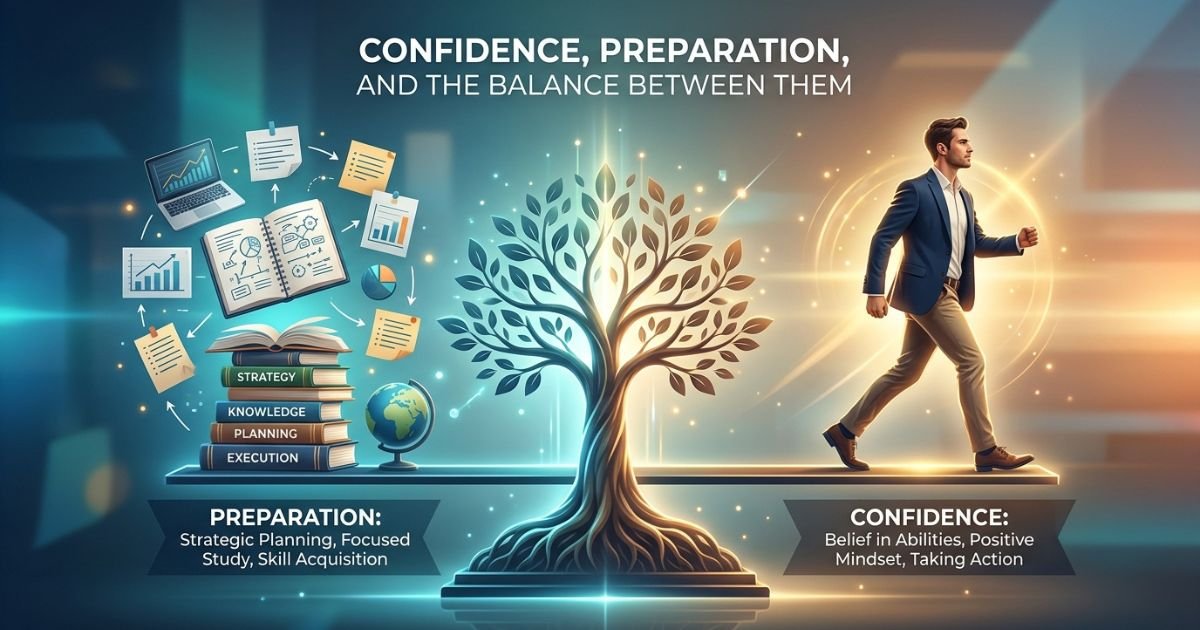
There is an important nuance worth saying clearly: self-confidence and preparation are not opposites. The healthiest form of confidence is grounded confidence, the kind that says, I have done the work, and now I am ready to step forward.
Confidence without preparation can tip into recklessness. Preparation without confidence leads to indefinite waiting. The combination of the two is where real growth lives.
In the story, the students who avoided the first test might have been more willing to choose it if they had reviewed more math beforehand. Preparation builds a platform from which confidence can launch.
But here is the critical point: at some moment, preparation has to give way to action. There is always more you could learn, always more you could practice. At some point, you have to decide that you have prepared enough and take the step.
The balance looks like this: prepare thoroughly, and then trust yourself to handle whatever comes next.
What Success Actually Requires
It is tempting to believe that success is mostly a talent question. That the people who make it are simply the ones who were born better at the right things.
But a more honest look at how people achieve meaningful things tells a different story. Talent matters, but it is far from the whole picture. Discipline matters. Persistence matters. The willingness to fail publicly and try again matters enormously.
And underneath all of those things, holding them together like a spine, is self-confidence.
The students in Mr. Peter’s class all had the same 15 minutes and the same mathematical education. The difference between the 10-point result and the 6-point result was not intelligence. It was a belief. The students who chose the easier test told themselves, before they had seen a single question on the harder one, that they were not capable of handling it.
In life, we do this constantly. We tell ourselves a story about our limitations before we have even tried. We make the decision for ourselves that the harder path is not meant for us.
But sometimes, the only real barrier between you and the thing you want is the assumption that you cannot have it.
Also READ: Think Before You Judge: The Beautiful Truth Hidden Behind a Child’s Simple Act
A Message for Anyone Who Has Been Playing It Safe
If you recognize yourself in the students who reached for the second test, please hear this: you are not alone, and you are not broken.
Playing it safe is not a character flaw. It is a deeply human response to the fear of failure and the fear of being seen to fail. Most people live their entire lives making choices that protect them from discomfort rather than choices that stretch them toward their potential.
But you are reading this for a reason. Something in you is asking whether there is more. Whether the dreams you have set aside are still worth reaching for. Whether the path you have been avoiding might actually be the one meant for you.
The answer is yes. The path is still there.
You do not have to make one enormous leap. You do not have to choose the hardest version of everything all at once. You just have to make one choice today that is slightly more courageous than the choice you would have made yesterday.
Choose the harder question. Apply for the thing. Raise your hand. Start the thing you have been waiting to feel ready for.
And then do it again tomorrow.
That is how the power of self-confidence is built. Not in a single dramatic moment, but in a thousand small decisions to choose growth over comfort, one quiet act of courage at a time.
Frequently Asked Questions
What are the 3 C’s of confidence?
The 3 C’s of confidence are Clarity, Competence, and Consistency. Clear thinking, skill-building, and repeated action build strong self-belief. Confidence grows when you know what you’re doing and keep doing it.
What are the 4 P’s of confidence?
The 4 P’s are Preparation, Practice, Patience, and Positivity. Confidence develops when you prepare well and practice regularly. Patience and positive thinking help you stay steady during challenges.
What are the 5 pillars of self-confidence?
The 5 pillars include Self-awareness, Skill, Experience, Positive mindset, and Action. When you understand yourself and keep improving through action, confidence naturally grows. Experience strengthens belief in your abilities.
What are the 7 C’s of success?
They are often listed as Clarity, Competence, Confidence, Consistency, Commitment, Courage, and Creativity. These qualities support success by helping a person take action and handle challenges effectively.
Conclusion
The power of self-confidence is one of the most transformative forces in a human life. Not because it protects you from failure, but because it gives you the courage to risk it. Mr. Peter did not give his class a math test. He gave them a mirror, and in that mirror, every student saw how much their belief in themselves was either opening or closing the door to their own potential.
You have that same mirror in front of you right now.
Every challenge you face is an invitation. Every difficult choice is a chance to discover something you did not yet know about yourself. Every moment you choose courage over comfort is a deposit into the confidence you are still building.
You were not made for the easier test. You were made for the one who asks everything of you and gives back everything in return. Trust yourself enough to choose it. The score waiting on the other side is worth far more than the comfort of playing it safe.
Step forward. Try. Grow. The highest version of your life begins the moment you believe you can reach it.

Welcome to Blessing Bloom. I’m Ahsan Ali, founder of BlessingBloom.com a faith-based website dedicated to sharing prayers, blessings, and heartfelt wishes. Based in Islamabad, Pakistan, I created Blessing Bloom to help people find the right words during life’s most meaningful moments. With a background in Information Technology, I combine a passion for digital content with a genuine love for faith-inspired writing.