


There is a moment most of us have lived through. Someone does something that catches us off guard, something that looks wrong at first glance, and before we even realize it, we have already made up our minds about them. The verdict comes fast. It feels certain. And sometimes we act on it before we ever learn the truth. If you have ever needed a reason to think before you judge, one quiet little story about a child and two apples might just be the thing that stays with you longest.
The Story That Stops You in Your Tracks
Some stories do not need elaborate setups. They just arrive, small and honest, and land somewhere deep.
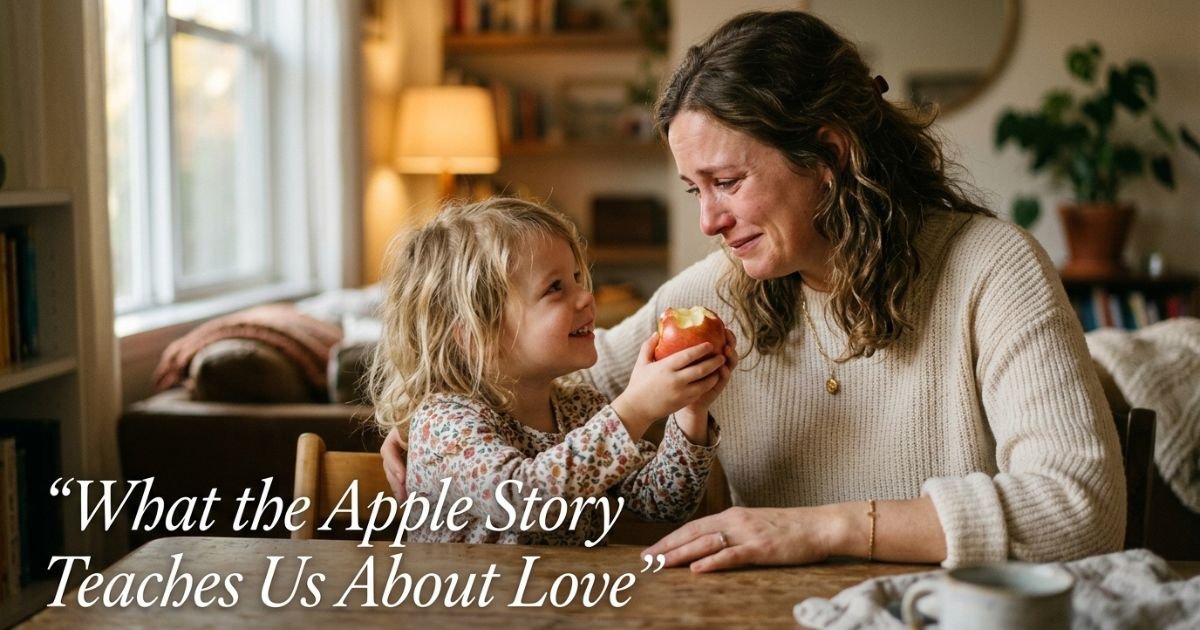
A sweet little girl was holding two apples in her small hands. Her mother came into the room, smiled warmly, and asked, “Sweetheart, could you give Mommy one of your apples?”
The little girl looked up at her mother for a quiet moment. Then she looked back down at each apple. Without a word, she lifted the apple in her right hand and took a bite. Then she lifted the apple in her left hand and took a bite from that one too.
The mother felt the smile fade from her face. She tried hard not to let her disappointment show. Her heart sank a little.
Then the little girl held one apple out toward her mother and said brightly, “Here, Mommy. This one is for you. It is the sweeter one.”
Go back and read that again if you need to, because everything changes in that last line.
The little girl had not been greedy. She had not been selfish. She had been doing something quietly generous and deeply loving. She had tasted both apples so she could give her mother the better one. The act that looked like selfishness from the outside was actually one of the most selfless things a child can do.
And most of us, in the mother’s place, would have judged before we understood.
What looks wrong from where you are standing may be the most loving thing happening right in front of you.
Also READ: The Beauty of Humility: A Lesson from the Clever Woodcutter
Why We Judge So Quickly and Why That Is So Human

Before we are too hard on ourselves, it helps to understand why this happens at all.
Our minds are built for speed. Somewhere deep in our nature, we developed the habit of reading situations fast and making decisions before all the information is in. For most of human history, that was a matter of survival. The brain that hesitated too long sometimes did not get a second chance.
But the world most of us live in today is not a place where survival depends on split-second judgment calls. It is a world of relationships, conversations, children, and quiet moments that need more than a quick read. When we carry that old wiring into those tender places, things go wrong.
The mother in the story did what every parent, spouse, friend, and colleague has done at some point. She saw an action, skipped straight to an explanation, and felt the sting of what she assumed was betrayal before she had the full picture. That is not a character flaw. That is just what happens when we stop ourselves from asking one simple question: why?
The Cost of the Half-Story
Most of the time, when we judge too fast, we are working with half a story. We see the bite taken out of the apple. We do not yet know what comes next. We see the silence. We do not yet know what it is holding. We see the behavior. We do not yet know the heart behind it.
Half a story is the most dangerous thing in any close relationship. It feels complete. It has the shape of an explanation. But it is missing the part that makes sense of everything.
Choosing to think before you judge means choosing to wait for the rest of the sentence before you respond to the first word.
What the Apple Story Reveals About Us
Stories like this one have a way of turning into mirrors. The reflection is not always comfortable.
When we read about the mother’s quiet disappointment, most of us recognize something familiar. Not because we are bad people, but because we are honest ones. We have all stood in that place where someone we love did something that hurt us before we understood what they were actually doing.
We project. That is the honest word for it. We take what we already believe about people, or what we fear about a situation, and we lay it over what we are seeing. The mother did not see the child testing the fruit. She saw the story she already knew about children and sharing, the one where children choose themselves first. She filled in the meaning before the meaning was given.
We do this with strangers. We do it with coworkers. We do it with old friends. And sometimes, with a kind of particular heartbreak, we do it with the people we love most.
Children Have a Language We Have to Learn to Read
There is something especially important in the fact that this story involves a child. Children are not simply small adults. They do not yet have the vocabulary to explain every intention, the emotional regulation to preface every action with a calm explanation, or the experience to know how an act might look from the outside.
What they do have, often in abundance, is love. Big, instinctive, unedited love that finds its own forms of expression. That little girl knew she wanted to give her mother the best apple. She just did not know how to say it first. She went straight to the doing, the way children do, and trusted that the outcome would speak for itself.
When we judge a child by adult standards of communication, we miss so much. We see the bite and not the gift. We hear the silence and miss the care that is living inside it.
Being in a child’s life is one of the great privileges of being human. But it asks something of us: that we stay curious, stay patient, and look a little longer before we decide we understand what we are seeing.
The Real Cost of Judging Before You Understand
Quick judgments carry weight that lasts longer than the moment they are made.
Imagine the mother in the story had reacted in that moment of disappointment. A sigh. A sharp word. A look that said, “I expected better from you.” The little girl would have been confused in the deepest way a child can be confused. She had done something loving and been corrected for it. That gap, between intention and reception, is where trust quietly erodes.
Children remember those moments. Not always consciously. But somewhere inside them, they file it away: when I tried to love in my own way, it was not accepted. Over time, those experiences shape how freely a person offers love, how much they trust that their good intentions will be understood, and how willing they are to try again after being misread.
This is not just true for children. It is true in every close relationship we carry through life.
The Beautiful Moments We Miss
When we judge too fast, we do not just risk hurting someone else. We also rob ourselves of something.
The mother almost missed one of the most purely loving things her daughter had ever done for her. She almost let it pass by, clouded by what she assumed she had seen. How many moments like that have slipped past us because we did not wait long enough to see them clearly?
A partner who seemed distant but was quietly carrying something heavy. A friend who seemed cold but was protecting you from the worst of their mood. A coworker who seemed disengaged but was hanging on by a thread at home. The world is full of people doing their best in ways that do not always look like what we expect love or effort to look like.
Thinking before we judge is not just an act of kindness toward others. It is how we stay open to the beauty that is already around us, quietly waiting to be seen.
How to Actually Practice Thinking Before You Judge
Knowing this lesson and living it are two very different things. But the distance between them is smaller than it feels.
The gap between observation and conclusion is where everything happens. Creating that gap on purpose is the whole practice. Here is what it actually looks like in daily life.
Pause Before You Interpret
The moment you feel a reaction rising, that tightening in the chest, that flicker of disappointment or irritation, that is your signal to slow down, not speed up. You do not have to suppress the feeling. You just do not have to immediately act on it as though the story is already finished.
Try saying to yourself quietly: I see what happened. I do not yet know why. That single reframe shifts you from judge to witness. And witnesses tend to learn a lot more than judges do.
Ask Instead of Assume
In the story, one gentle question from the mother would have dissolved everything in seconds. “Sweetheart, did you just bite both apples?” And the daughter’s answer would have arrived, bright and simple and full of love.
Asking is not a weakness. It is respect. It says: I believe you are more than what I can see from where I am standing right now. Tell me more.
Most conflict that feels enormous in the moment turns out to be misunderstandings that a real question would have unraveled quickly. The assumption we do not question becomes the wound we cannot explain.
Also READ: The Ripple Effect: How One Simple Act of Kindness Changes the World
Hold Space for More Than One Explanation
Before you land on your first interpretation of someone’s behavior, practice offering yourself at least two alternatives. Not to excuse anything. Not to avoid accountability. But to remind yourself that you are working with incomplete information.
She did not respond right away. That could mean she is ignoring you. It could also mean she is overwhelmed, or scared, or carefully choosing her words, or simply did not see the message yet.
He seemed short with you. That could mean frustration. It could also mean exhaustion, or a bad day, or something that has nothing to do with you at all.
The point is not to let people off the hook for real harm. The point is to stay humble about how much you actually know before you have heard the whole story.
Give Children Even More Grace
Children deserve a particular kind of patience when it comes to being understood. Their inner life is rich, and their intentions are often far better than their behavior suggests. They are still learning to translate what they feel into forms that adults can read.
The little girl in the story had a beautiful intention and a method that looked all wrong. What she needed was a grown-up who could hold space for both of those things at once, who could see past the bite and wait for the offering.
That is the gift we can give the children in our lives. Not just praise when they get it right, but patience when the love they are carrying has not yet found a form we recognize.
What the Apple Story Teaches Us About Love
The most profound lessons sometimes arrive in the smallest packages.
We carry ideas about what love is supposed to look like. It is supposed to be clean, readable, and offer the right words at the right time in the right way. We have templates for it. And when love does not follow the template, we sometimes do not recognize it at all.
The little girl’s love did not follow the template. It looked like selfishness. It looked like a child putting herself first. But it was the opposite. She was putting her mother first in the only way she knew how, through action rather than announcement, through testing rather than telling, through the simple logic of someone who wanted to be sure the person she loved got the best thing available.
Real love, especially the kind that has not yet been shaped by adult expectations, often arrives in unconventional forms. It bites both apples. It goes quiet when it wants to be understood. It does something that looks wrong on the outside because it is following an internal compass that points toward care.
When we think before we judge, we keep ourselves open to receiving love in the forms it actually comes in, not just the forms we expected.
Also READ: 120 Heartfelt Thinking of You Messages for Her
Quiet Goodness Does Not Always Announce Itself
Notice that the little girl did not explain herself. She just did what love told her to do and then held out her hand.
There is something deeply true in that about how genuine kindness works. It does not usually come with an announcement. It just happens, quietly, in the private language of someone who loves you, and it trusts that you will be there to receive it when it arrives.
If we judge before we wait, we often miss exactly this kind of goodness. The kind done without fanfare. The kind that asks nothing in return. The kind that tastes both apples first.
A Reflection Worth Sitting With

Every one of us has been on both sides of this story at some point.
There are moments we can look back on where we were the mother. Where we read a situation quickly, felt certain of our interpretation, and later found out we were wrong. The feeling that comes with that realization is hard to name. Something like regret, something like humility, something like a quiet resolve to do better next time.
And there are moments when we were little girls. Where we were doing something with entirely good intentions and had it read wrong by someone we loved. We offered the sweeter apple and watched the person we offered it to mistake the gesture entirely. That kind of misunderstanding is its own particular loneliness.
Both of those experiences live inside this little story. And both of them are calling us toward the same thing: more patience, more curiosity, more willingness to wait for the rest of the sentence before we decide we know how it ends.
The person in front of you is almost always doing more than you can see. Give them the grace of one more moment before you decide, you know the whole story.
Also READ: The Quiet Power of Compassion: How Understanding Others Brings Peace to Your World
When You Have Already Judged Too Fast
If you are reading this and thinking of a specific moment, a specific person, a specific apple you misread, that recognition is not a reason for shame. It is an invitation.
You can go back to that person if they are still in your life. You can ask the question you skipped. You can say, plainly and without making it bigger than it needs to be: I think I misunderstood what you were doing. Can you help me see it the way you saw it?
That kind of conversation takes courage. But it almost always leads somewhere better than where you were before you had it.
And if the moment has passed, the lesson is still available to you. You carry it forward. You use it the next time. You become, slowly and with real effort, the kind of person who waits for the sweetest apple before drawing a conclusion.
Frequently Asked Questions
What does the Bible say about judging?
The Bible teaches not to judge others harshly or hypocritically. It says we should first examine ourselves before criticizing others. Judging should be fair, humble, and based on truth, not assumptions.
What did Pope Francis say about judging others?
Pope Francis often said that we should avoid judging others because only God truly knows a person’s heart. He emphasized mercy, compassion, and understanding instead of quick condemnation. He encouraged people to focus on their own mistakes first.
What should we do before judging someone?
We should pause, observe carefully, and try to understand the full situation. Asking questions instead of assuming helps avoid misunderstanding. Patience and empathy are key before forming any judgment.
What is the root cause of judging others?
The main root cause is incomplete information combined with quick assumptions. Human ego, bias, and past experiences also influence judgment. Often, we project our fears or beliefs onto others without knowing the full truth.
What does John 7:24 say about judging?
It says, “Do not judge by appearances, but judge with right judgment.” This means we should not rely on surface-level observations. Instead, we must seek truth and fairness before concluding.
What are the two types of judging?
One type is quick, superficial judgment based on appearance or assumptions. The other is fair, thoughtful judgment based on facts and understanding. The Bible encourages the second type, not the first.
Wait for the Sweetest Apple
The little girl in this story did not explain herself. She just did what love told her to do and then held out her hand. And everything, the entire meaning of what she had done, depended on whether the person watching her could hold on for one more moment before deciding what it all meant.
We live in that gap every single day. The gap between what we see and what is actually happening. Between the first reading and the true one. Between the judgment that comes quickly and the understanding that asks us to stay a little longer.
Thinking before you judge is not about being naive. It is not about letting things go that genuinely matter. It is about staying humble enough to remember that you are almost never working with the whole picture, and generous enough to wait until you have a little more of it before you act.
The people in your life, especially the ones who love you in their own quiet and sometimes confusing ways, are offering you apples every day. Some of those offerings look wrong before they reveal themselves as the sweetest thing you have ever been given.
Wait for it. Stay curious. Ask the gentle question. And when the answer comes, let it change you.

Welcome to Blessing Bloom. I’m Ahsan Ali, founder of BlessingBloom.com a faith-based website dedicated to sharing prayers, blessings, and heartfelt wishes. Based in Islamabad, Pakistan, I created Blessing Bloom to help people find the right words during life’s most meaningful moments. With a background in Information Technology, I combine a passion for digital content with a genuine love for faith-inspired writing.