


There is something quietly powerful about holding a string of beads in your hand. For thousands of years, people across nearly every faith have turned to prayer beads to slow their breathing, steady their hearts, and draw closer to something greater than themselves. If you have ever wondered why a simple strand of beads carries so much meaning, you are in the right place. Prayer beads explained simply, this guide walks through their history, their many forms across world religions, and how they fit naturally into modern life today.
What Are Prayer Beads?
Pause for a moment and picture someone sitting quietly, eyes closed, fingers moving slowly from one bead to the next. There is a stillness in that image that feels almost universal, because it is.
Prayer beads are strands of beads used to count prayers, mantras, or sacred phrases during devotion or meditation. They give the hands something gentle to do while the mind settles into rhythm. Most strands follow a similar pattern. There is a series of evenly spaced counting beads, a larger marker bead that signals the start or end of a cycle, and sometimes a tassel, cross, or pendant attached for symbolic reasons.
What makes prayer beads so enduring is that they work on two levels at once. They support the spirit through repetition and reflection, and they support the body through touch and motion. This combination is part of why the practice has survived, almost unchanged in purpose, for so many centuries and across so many cultures.
The History of Prayer Beads
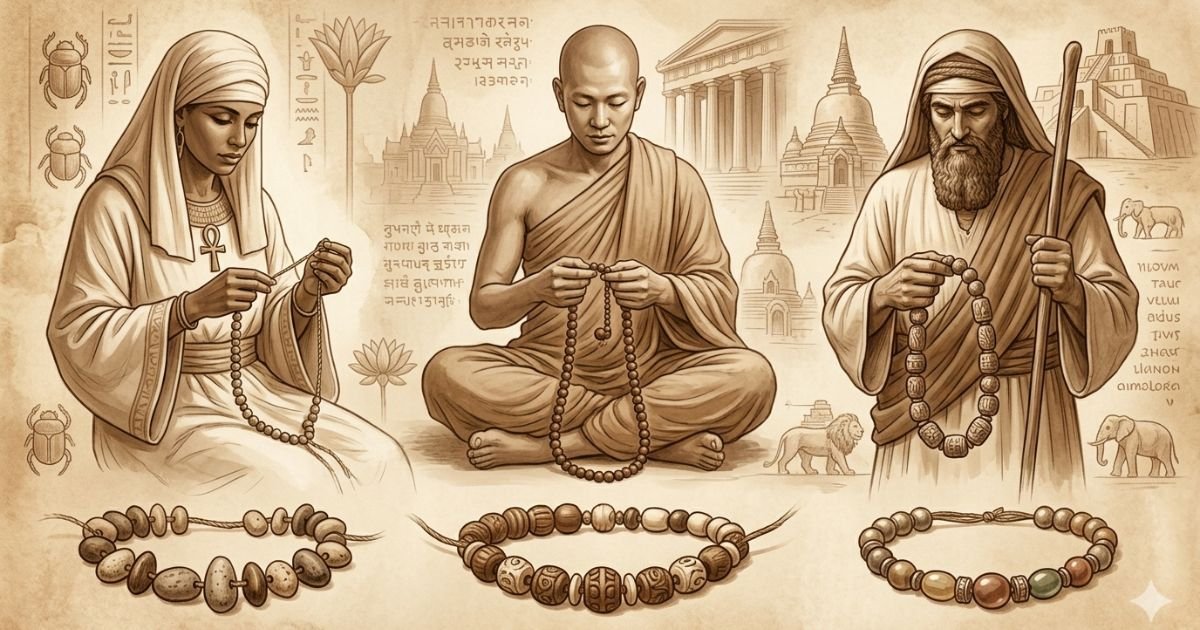
History has a way of revealing what truly matters to people, and prayer beads show up again and again across very different civilizations.
Ancient Origins
Long before beads were carved or polished, people used whatever was on hand. Knots tied into rope, small stones, dried seeds, anything that could be counted with the fingers. These early tools were not decorative. They existed for one simple reason, to help someone keep an accurate count during repeated prayer or chant without losing focus.
As communities grew and spiritual traditions became more structured, these simple counting tools evolved alongside them. Beads began carrying symbolic numbers, specific materials, and intentional designs. What started as a practical workaround slowly became sacred.
Also Read: The Best Prayer for Souls in Purgatory
Prayer Beads in Hinduism and Buddhism
In both Hindu and Buddhist practice, prayer beads are known as mala. A traditional mala usually contains 108 beads, a number considered spiritually complete in many Eastern traditions. Practitioners move through the mala while silently or aloud repeating a mantra, one bead per repetition.
The material often carries meaning, too. Sandalwood is prized for its calming scent, while rudraksha seeds hold deep significance in Hindu spiritual life. The mala is not just a tool here, it becomes part of the meditation itself.
Prayer Beads in Christianity
Within Christianity, the rosary is the most recognized form of prayer beads. Catholics use the rosary to walk through a structured sequence of prayers, including the Hail Mary and the Our Father, often while reflecting on specific moments from the life of Christ.
The rosary typically includes a crucifix and beads grouped into sets called decades. It is less about counting for its own sake and more about using repetition to settle the mind so that reflection on faith can deepen naturally.
Prayer Beads in Islam
In Islamic tradition, prayer beads are called tasbih or misbaha. They are used during dhikr, which means the remembrance of Allah. Many tasbih sets contain 99 beads, representing the 99 names of Allah, and are sometimes divided into smaller sections by marker beads.
Common phrases recited while moving through a tasbih include SubhanAllah, Alhamdulillah, and Allahu Akbar, often repeated after the five daily prayers. The beads help maintain consistency and focus, though many Muslims also practice dhikr using their fingers alone when beads are not available.
A Thread That Connects Every Faith
Despite very different theology, language, and ritual, every tradition that uses prayer beads is reaching for the same thing. A way to bring the wandering mind back to something sacred, one small movement at a time.
Types of Prayer Beads
Not all prayer beads look or function the same way, and understanding the differences can help you appreciate the tradition behind each one.
Mala Beads
Mala beads come from Hindu and Buddhist roots and are widely used today in yoga studios and meditation spaces around the world. A larger guru bead marks the start and end of each cycle, gently reminding the practitioner to stay present rather than rush through the count.
Rosary Beads
Rosary beads guide Catholic believers through a fixed sequence of prayers. The structure itself becomes a form of comfort. There is no guessing what comes next, only the steady, familiar rhythm of moving from one prayer to the other.
Tasbih Beads
Tasbih beads are compact, portable, and built for daily remembrance. Many Muslims carry them throughout the day, using quiet moments, after prayer, during a commute, while waiting in line, as opportunities to recite dhikr.
Anglican and Protestant Prayer Beads
Protestant prayer beads, often called the Anglican rosary, contain 33 beads representing the years of Christ’s life on earth. Though newer than the Catholic rosary, this practice has grown steadily among Protestants seeking a more structured, contemplative way to pray.
Komboloi, the Worry Beads
Komboloi are Greek worry beads, and unlike most other prayer beads, they are not tied to a specific religious practice. People use them simply to ease tension, the steady click of bead against bead offering a small, grounding comfort during a stressful day.
Modern Meditation Beads
Today, many people use beads with no fixed religious tradition attached at all. These modern meditation strands are often chosen for the way they feel in the hand or the meaning a particular gemstone holds for the wearer, offering a flexible entry point into mindful practice.
What Are Prayer Beads Made From?
The material a strand is made from shapes both its feel and its meaning.
Wooden beads feel warm and light, and are common in traditional designs across several faiths. Seeds such as rudraksha carry deep spiritual symbolism in Hindu practice. Gemstones are popular in modern meditation beads, often chosen for personal or symbolic reasons. Glass and metal beads tend to be heavier and more durable, frequently used in rosaries meant to last a lifetime.
There is no single right material. What matters most is how the beads feel in your hand, and whether that feeling helps you settle into stillness.
How Are Prayer Beads Used Today?
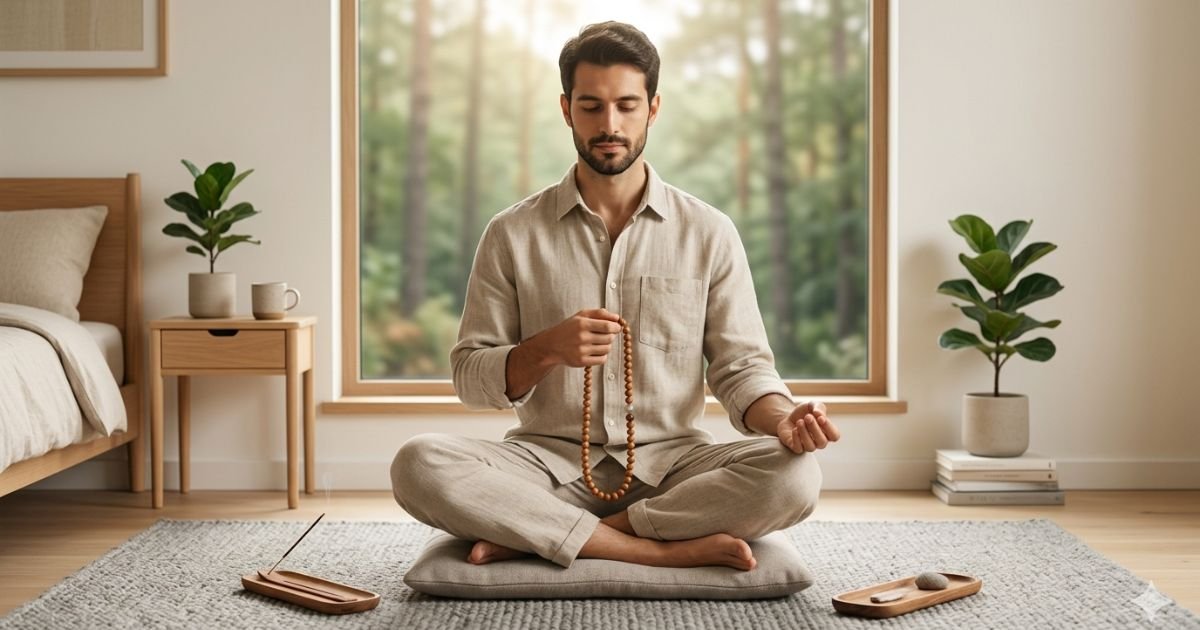
Prayer beads have moved well beyond temples, mosques, and churches, finding a quiet place in everyday modern life.
Meditation and Mindfulness
Many people now use beads simply to anchor their attention during meditation. Instead of fighting a wandering mind in silence, the bead becomes a small, physical checkpoint to return to, again and again.
Stress and Anxiety Relief
The repeated motion of moving through a strand has a soothing effect on the nervous system. As the hands slow down, breathing tends to follow, and the body begins to release the tension it has been holding all day.
Setting and Reinforcing Intentions
Repeating a word, phrase, or short prayer while moving through the beads helps that intention settle into the mind more deeply. Over time, this small daily repetition can quietly shape how a person thinks and feels.
A Meaningful Accessory
Many people now wear prayer beads simply as a reminder. A glance down at the wrist or a hand reaching into a pocket becomes a small nudge back toward calm, faith, or intention, even in the middle of a busy day.
How to Use Prayer Beads in Daily Life
You do not need formal training or a particular religious background to begin. What matters is intention and a willingness to slow down.
Choose a quiet moment in your day, even a few minutes works. Hold the beads gently rather than gripping them. Notice their weight and texture for a moment before you begin. Pick a simple focus, this could be a breath, a single word like peace, or a short phrase that feels meaningful to you.
Move one bead with each breath or repetition, slowly and without rushing. Your mind will wander, and that is completely normal. Each time you notice it drifting, gently guide it back to the bead beneath your fingers. That small act of returning is, in many ways, the entire point of the practice.
Consistency matters far more than length. A few quiet minutes each day, repeated steadily, will do more for your sense of peace than an occasional long session ever could.
The Benefits of Using Prayer Beads

Used regularly, prayer beads offer more than a passing moment of calm.
They sharpen focus by giving the mind a clear, simple point of return. They support emotional steadiness, helping create a small but meaningful gap between a feeling and a reaction. They reinforce personal intentions through gentle repetition. And for many, especially within faith communities, they deepen a sense of closeness to God, becoming far more than an object. Over time, the beads themselves can carry memory, holding quiet traces of every difficult day, every grateful moment, and every prayer spoken while holding them.
Also Read: Prayers for Discernment in Relationships, Career and Life Choices
Common Mistakes to Avoid
A few simple habits can quietly reduce how meaningful this practice feels.
Moving through the beads on autopilot, without real attention, turns the practice mechanical rather than mindful. Rushing to finish the count defeats the purpose entirely, since the value lies in presence, not speed. Overcomplicating things with strict rules about posture or technique can also get in the way, when really the practice is meant to simplify, not add pressure. And using the beads only occasionally, rather than building a steady rhythm, limits how deeply the benefits can take root.
Choosing Prayer Beads That Feel Right for You
If you are drawn to prayer beads but unsure where to start, let your faith tradition, if you have one, guide the basic structure, and let your senses guide the rest. Notice how a strand feels between your fingers. Notice whether the material, scent, or weight brings you a sense of calm. There is no need to overthink this choice. The beads that feel most natural in your hand are usually the ones that will support your practice best.
Frequently Asked Questions
What is the meaning behind prayer beads?
Prayer beads are used to help focus the mind during prayer or meditation by counting repeated phrases or mantras. They symbolize mindfulness, devotion, and spiritual connection across many religions.
What do Christians say when using prayer beads?
Christians, especially Catholics, often say prayers like the Hail Mary and Our Father while using rosary beads. These prayers are repeated in a structured sequence for reflection and devotion.
How do prayer beads work?
Prayer beads work by giving a physical guide for repetition—each bead represents one prayer or mantra. Moving bead by bead helps maintain focus, rhythm, and a calm meditative state.
Is it okay for Christians to use prayer beads?
Yes, in Christianity, the rosary is widely used as a traditional prayer tool. It is considered a way to deepen faith and support structured, reflective prayer.
Why do we say “hail Mary” 10 times?
In the rosary, the Hail Mary is repeated in groups of ten beads, called a decade. This repetition helps create focus and guides meditation on specific spiritual themes.
Conclusion
Across centuries and continents, prayer beads have quietly carried the same simple purpose, helping the human heart find stillness through rhythm and repetition. Whether you come to them through faith, through a need for calm, or simple curiosity, they offer something steady in a world that rarely slows down. Each bead is small on its own, yet together they form a path back to presence, gratitude, and connection. However you choose to use them, let the practice remain gentle, unhurried, and personal. In time, even a few quiet minutes with prayer beads in hand can become one of the most grounding parts of your day.

Welcome to Blessing Bloom. I’m Ahsan Ali, founder of BlessingBloom.com a faith-based website dedicated to sharing prayers, blessings, and heartfelt wishes. Based in Islamabad, Pakistan, I created Blessing Bloom to help people find the right words during life’s most meaningful moments. With a background in Information Technology, I combine a passion for digital content with a genuine love for faith-inspired writing.