


There is a quiet kind of exhaustion that comes from fighting battles nobody else can see. Maybe it shows up as anxious thoughts at midnight, or the pull to give up on something that still matters to you. The Armor of God prayer exists for moments exactly like that. Rooted in Ephesians 6, this prayer has steadied believers for centuries by reminding them they were never meant to face life alone. Below, you will find the Armor of God prayer explained piece by piece, along with the meaning behind it, the real power it carries, and a simple way to start practicing it today.
What Is the Armor of God Prayer, and Where Does It Come From?
Before this prayer became something believers speak each morning, it was a letter. The apostle Paul wrote it from a prison cell, and near the end of that letter, in Ephesians 6:10 through 18, he reached for an image his readers would instantly understand: a Roman soldier preparing for battle.
Paul was not describing a literal war. He was pointing to something quieter and harder to see, the daily spiritual struggle that shows up as fear, temptation, discouragement, and doubt. He told believers to put on the full armor of God so they could stand firm against it.
Over time, that image grew into a practice. Instead of only reading about the armor, people began speaking it over themselves, piece by piece, almost like getting dressed for the day ahead. That practice is what we now call the Armor of God prayer. It is not a magic formula, and there is no single correct script. It is a way of asking God for protection and clarity before the day has a chance to throw anything at you.
Also Read: 30 Prayers That Rout Demons Shield Your Home Heart and Spirit
The Six Pieces of the Armor of God and What Each One Means
Each piece Paul described carries its own meaning, and understanding them is what makes the prayer feel like more than repeated words. Think of these less as symbols and more as honest descriptions of what your heart and mind actually need on a hard day.
The Belt of Truth
A soldier’s belt held everything else in place. In the same way, truth is what holds your whole inner life together. This piece is about refusing to live by lies, whether those lies come from other people or from the quiet, discouraging voice in your own head.
The Breastplate of Righteousness
This piece protects the heart, the place where guilt and shame like to settle in. It is a reminder that you are made right with God, not through your own perfection but through grace, and that this righteousness is something to walk in rather than something to earn.
The Shoes of the Gospel of Peace
Shoes were for movement, for going somewhere steadily, even on rough ground. This piece represents a peace that does not depend on your circumstances being calm. It is the kind of peace that lets you walk through a hard day without being knocked off balance by every difficult moment.
The Shield of Faith
A shield was raised the moment an attack came. Faith works the same way against doubt, fear, and discouragement. It does not pretend those feelings are not real. It simply gives you something to hold up when they arrive so they cannot fully overwhelm you.
The Helmet of Salvation
The mind is often where battles are won or lost first. This piece protects your thoughts, especially the ones that whisper you are not enough or that your mistakes define you. It anchors your identity in being saved and loved rather than in how you feel on any given day.
The Sword of the Spirit
Unlike the other pieces, this one is meant to be used, not just worn. It represents scripture itself, something you can actually reach for in a hard moment instead of only defending against. It turns the prayer from passive protection into something you can act on.
Why the Armor of God Prayer Holds So Much Power
People who pray this regularly often describe a shift that is hard to put into words until you have felt it yourself. It is not that problems disappear. It is that you start meeting them differently.
One of the first things that changes is mental clarity. When you begin your day naming truth, righteousness, and faith on purpose, your thoughts have less room to spiral into worry before you have even left the house.
There is also a deepening sense of dependence on God rather than constant self-reliance. Many of us were taught to handle everything ourselves, and that habit is exhausting. This prayer gently interrupts that pattern and reminds you that carrying everything alone was never the plan.
Consistency builds something, too. Spiritual discipline rarely feels dramatic in the moment. It feels like showing up again, the same way you would with any relationship that matters to you. Over weeks and months, that quiet consistency becomes a kind of strength you can feel even on the days prayer itself feels difficult.
Finally, there is a noticeable filter that develops. You start recognizing which thoughts, conversations, or influences pull you away from peace, and you get a little better at setting those things down instead of carrying them all day.
How to Pray the Armor of God: A Step-by-Step Practice
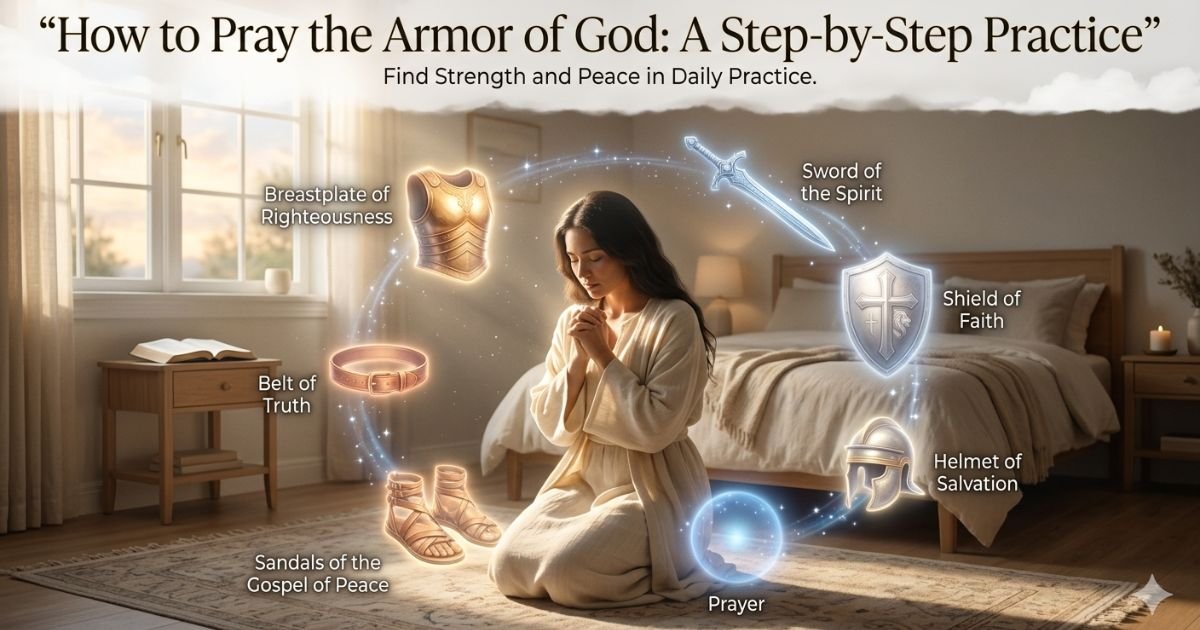
You do not need formal language or perfect wording for this prayer to matter. What matters is sincerity and a willingness to slow down for a few minutes. Here is a gentle way to walk through it.
- Start with gratitude. Before asking for anything, thank God for the day ahead and acknowledge that you are not facing it alone.
- Put on the belt of truth. Ask for the ability to see your day clearly and to resist any lie, especially the ones you tell yourself.
- Put on the breastplate of righteousness. Ask God to guard your heart against guilt, jealousy, or anger before they take root.
- Put on the shoes of peace. Ask for a steady, unshaken way of walking through whatever the day brings, even the parts you cannot control.
- Take up the shield of faith. Name the specific fears or doubts you are carrying and ask for the strength to hold faith up against them.
- Put on the helmet of salvation. Ask God to protect your mind from negative thought patterns and to remind you who you are.
- Take the sword of the Spirit. Bring to mind even one verse or truth you can return to if the day gets hard.
- Close with surrender. Hand the day over, admitting you cannot control everything, and ask for help standing firm anyway.
None of these steps needs to take long. Even a slow, honest two-minute version of this prayer is far more meaningful than a rushed, mechanical one.
Also Read: 35 Heartfelt Prayers for Police Officers on Duty
A Simple Armor of God Prayer You Can Pray Today
If you are not sure where to begin, you might pray something close to this, in your own words and your own pace.
Lord, thank You for this day. I put on the belt of truth, and I ask You to keep me honest with myself and with others. I put on the breastplate of righteousness, and I ask You to guard my heart from guilt and bitterness. I put on the shoes of peace, and I ask for a steady spirit no matter what today holds. I take up the shield of faith against every fear trying to take root in me right now. I put on the helmet of salvation, and I ask You to protect my mind and remind me who I am in You. I take up the sword of Your Spirit, ready to lean on Your truth when I need it most. Lead me today, Lord. Help me stand firm. Amen.
There is no perfect version of this prayer. The version that matters most is the one you actually return to.
When Is the Best Time to Pray the Armor of God?

For most people, mornings work best, simply because they set the tone before the day’s noise begins. There is something powerful about choosing readiness instead of waiting for a crisis to force your hand.
That said, this prayer is not limited to mornings. Many people return to it right before a hard conversation, a stressful meeting, or a decision that feels heavy. Others lean on it during a season that already feels uncertain, when daily prayer becomes less of a routine and more of a lifeline.
The honest truth is that timing matters far less than consistency. A short version prayed daily will shape you more than a long version prayed once a month.
Also Read: 50 Prayers for Financial Blessing to Overcome Financial Struggles
Living the Armor of God Beyond the Prayer Itself
Praying this prayer in the morning is only half of it. The real shift happens in how you carry it through the rest of your day.
Living in truth means catching yourself when it would be easier to exaggerate, avoid responsibility, or believe something false about yourself. Guarding your thoughts means noticing what you let into your mind through scrolling, conversations, or worry, and choosing to step back when something is doing you more harm than good. Walking in peace means responding instead of reacting, especially with the people closest to you. Practicing faith in real situations means moving forward even without every answer, trusting that you are not handling things entirely on your own.
A few honest mistakes are worth watching for. Treating this prayer like a checklist drains it of meaning. Rushing through it without reflection makes the words feel hollow. And praying it faithfully while ignoring how you actually live during the day weakens its impact. None of this requires perfection. It simply asks for honesty and a willingness to keep showing up.
Frequently Asked Questions
Is the Armor of God prayer actually in the Bible?
The imagery comes directly from Ephesians 6:10 through 18, written by the apostle Paul. The prayer itself is not a fixed biblical script, but a practice many believers have built around that passage.
How often should I pray the Armor of God?
Daily is ideal for most people, especially in the morning, though many also return to it before stressful moments or during difficult seasons of life.
Can I write my own version of this prayer?
Yes. There is no single correct wording. What matters most is that each piece, truth, righteousness, peace, faith, salvation, and the word of God, is genuinely present in your heart as you pray.
What if I miss a day or forget to pray it?
Missing a day does not undo the practice. This is meant to be a rhythm you return to, not a record you have to keep perfectly.
Conclusion
At its heart, this prayer is not about reciting the right words. It is about remembering, every single day, that you were never asked to carry everything alone. Truth, righteousness, peace, faith, salvation, and the word of God are not abstract ideas. They are real support for real days, the ones filled with pressure, doubt, and quiet fear that nobody else can see.
When you choose to pray the Armor of God, you are choosing readiness over panic and trust over self-reliance. Some days, that prayer will feel powerful right away. Other days it will simply feel like showing up. Both matter. Keep returning to it, keep speaking it honestly, and let it slowly become less of a routine and more of who you are. You are not standing in this alone, and you never were.

Welcome to Blessing Bloom. I’m Ahsan Ali, founder of BlessingBloom.com a faith-based website dedicated to sharing prayers, blessings, and heartfelt wishes. Based in Islamabad, Pakistan, I created Blessing Bloom to help people find the right words during life’s most meaningful moments. With a background in Information Technology, I combine a passion for digital content with a genuine love for faith-inspired writing.