


Anger has a way of showing up uninvited. It rises in the middle of an ordinary day, in a small disagreement, in a moment when you feel unheard or disrespected, and before you know it, words come out that you never meant to say. If you have ever wished you could take back something you said in a flash of frustration, you already understand why learning to control your anger matters so deeply. There is an old story about a boy, a hammer, and a fence full of nails that captures this truth better than almost anything else. It is simple, it is gentle, and it leaves a mark on the heart that lasts far longer than the few minutes it takes to read.
The Story of the Boy and the Nails

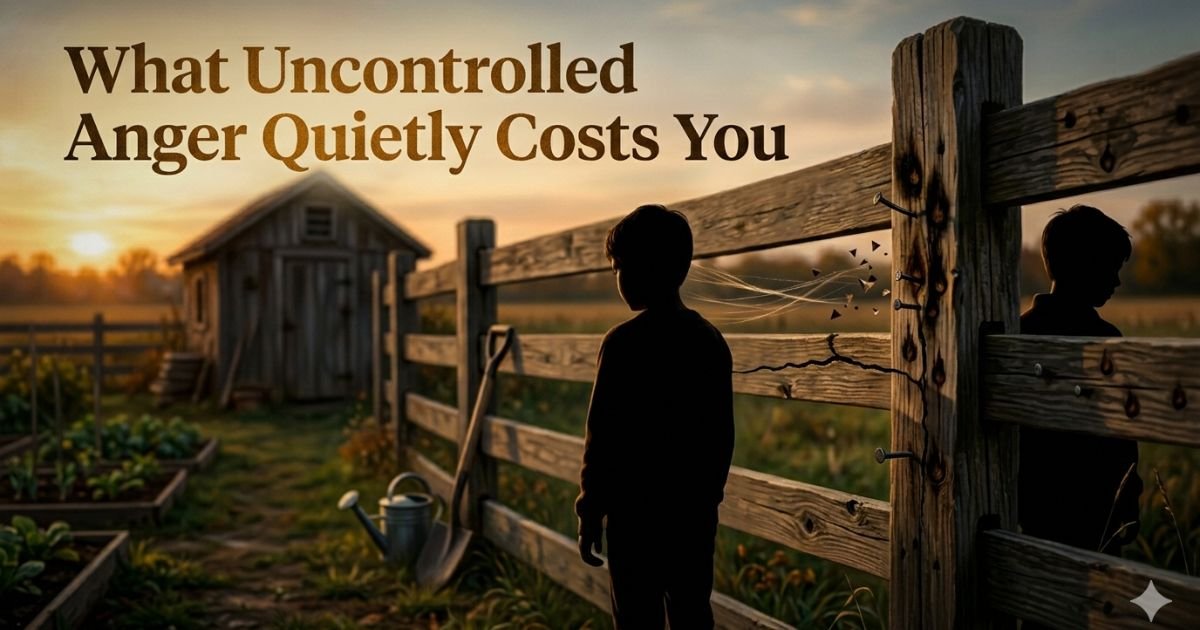
There was a boy with a fiery temper. He did not mean to hurt the people around him, but his words came out sharp before he had time to think them through. His father, wanting to help him without lecturing him, handed him a small bag of nails one afternoon and gave him a simple task.
Every time he lost his temper, he was to hammer one nail into the wooden fence behind their house.
On the very first day, the fence collected twelve nails. The boy was surprised by how often his anger flared once he started paying attention to it. As the days passed, though, something shifted. He began to notice the moment right before his temper took over, and slowly, the number of nails dropped. Some days there were five. Then two. Then, finally, a day came when he did not hammer a single nail.
Proud of himself, he ran to tell his father. His father smiled and gave him a new task. For every day he managed to stay calm, he could pull one nail out of the fence.
Weeks later, the boy returned with the empty bag in his hands. Every nail was gone. He expected his father to be just as proud as he was, and his father was. But then his father walked him over to the fence and asked him to look closely.
The nails were gone, but the holes remained.
His father knelt down beside him and said something the boy never forgot. He explained that the fence would never be the same again, no matter how many nails were removed. The wood still carried the marks of every angry moment, even after the nails were pulled free. He told his son that words spoken in anger leave the same kind of marks on people. An apology can remove the nail, but it cannot smooth the wood back to what it once was.
Also Read: A Silent Message of Compassion
Why This Simple Story Still Means So Much
It is easy to read a story like this and nod along, but the real power of it sits in something most of us already know in our bones. We have all said something in anger that we wish we could erase. We have all been on the other side too, holding onto a sentence someone else said long after they probably forgot they ever said it.
The fence in this story is not really about wood and nails. It is about every relationship you have ever cared about, and how fragile trust can be once anger gets involved.
Words Leave Marks That Outlast the Moment
Anger itself burns fast. It rises, it peaks, and within minutes or hours, it usually fades. But what you say while you are angry does not fade at the same pace. A sharp comment to your spouse, a cutting remark to your child, an unkind word to a friend who was only trying to help, these things tend to stay lodged in someone’s memory long after your own frustration has cooled.
This is the heart of why learning to control your anger is not just good advice. It is protection for the people you love most.
Forgiveness Does Not Erase the Hole
The father in the story did not say forgiveness was pointless. He said the opposite, that forgiveness matters deeply, while also being honest that it does not undo the past completely. This is something worth sitting with rather than rushing past. When someone forgives you, they are choosing to stay in the relationship despite the hole that is still there. That is a gift, not a guarantee that the hole disappears.
Understanding this can change how you treat your own outbursts. Instead of thinking, I apologized, so it is fine now, you start to think, I am loved enough to be forgiven, and that is exactly why I should try harder not to create more holes.
What Makes Controlling Your Anger So Hard in the First Place
If staying calm were easy, nobody would need a story like this one. So it helps to understand what is actually happening underneath your anger before you can hope to manage it.
Your Brain Reacts Before You Can Think
When anger spikes, your body moves into a kind of survival mode. Blood rushes toward action, your heart speeds up, and the slower, more thoughtful part of your brain temporarily steps back while a faster, more reactive part takes over. In that split second, logic loses to instinct. This is why people so often say things in anger that they would never plan to say if they had time to think it through.
Knowing this is not an excuse, but it is useful. It means controlling your anger has less to do with willpower alone and more to do with learning how to slow your body down before the reactive part of your brain takes the wheel.
Old Habits Make Anger Feel Automatic
For a lot of people, anger is not really a choice in the moment. It is closer to a habit that has been practiced for years, sometimes since childhood. If raising your voice or shutting down has worked before, even in small ways, your mind quietly files that away as the default response. Like the boy reaching for a nail without thinking, you may find yourself reacting before you even realize you are upset.
The good news is that habits can be retrained. It takes patience, but every time you choose a calmer response instead of the old automatic one, you are weakening that pattern a little more.
Built-Up Stress Finds the Smallest Excuse to Erupt
Anger rarely comes from nothing. More often, it is the last straw on a pile that has been building for days, weeks, or longer. Work pressure, tiredness, unspoken hurt, financial worry, these things accumulate quietly in the background until something small, like a dish left in the sink, becomes the spark for something much bigger.
If you have ever overreacted to something tiny and wondered why it hit you so hard, this is usually the answer. The anger was never really about the dish.
What Uncontrolled Anger Quietly Costs You
It can be tempting to think of an angry outburst as a one-time event that gets resolved once everyone calms down. But anger that goes unmanaged tends to leave a longer trail than people expect.
In relationships, people who are repeatedly on the receiving end of anger often begin to pull back emotionally, not because they stopped caring, but because they are trying to protect themselves. Over time, this distance can grow into real disconnection.
In trust, safety is the foundation that lets people be open and honest with each other. Once anger becomes unpredictable, that safety erodes, and people start holding back instead of sharing freely.
In your own health, chronic anger has been linked to higher blood pressure, increased anxiety, sleep problems, and a general wear and tear on the body that builds quietly over the years.
In your sense of self: the regret that follows an angry outburst, especially when it becomes a pattern, can chip away at your own self-respect, leaving you feeling like you are not living up to the person you want to be.
Also Read: The Kite and the String
How to Control Your Anger in Real, Practical Ways
Knowing why anger is hard to manage is only half the picture. The other half is having something you can actually do the next time you feel your temper rising.
Give Yourself a Pause Before You Speak
The single most useful habit you can build is a pause, even a short one. When you feel anger rising, try taking one slow breath before you respond. This tiny gap between feeling and reacting gives the calmer part of your brain a chance to catch up. It will feel awkward at first, but a few seconds of silence has saved more relationships than people realize.
Learn What Sets You Off
Spend a little time noticing the situations that consistently make you angry. Maybe it is feeling interrupted, feeling unappreciated, or feeling like you are not being listened to. Once you can name your triggers, you stop being caught off guard by them, and you can prepare yourself ahead of time instead of reacting in the moment.
Ask Yourself One Honest Question
Before you say something sharp, try asking yourself a simple question. Will I still feel good about saying this an hour from now. This one question creates just enough distance from the heat of the moment to help you choose your words more carefully.
Speak From Your Own Feelings, Not Their Faults
There is a real difference between saying you never listen to me and saying I feel unheard right now. The first puts the other person on the defensive immediately. The second invites them into a conversation instead of a confrontation. This small shift in language can soften almost any difficult moment.
Take Care of the Things That Feed Your Anger
Lack of sleep, ongoing stress, and physical tension all lower your patience without you even noticing. Regular movement, a consistent bedtime, and a few quiet moments built into your day are not unrelated to anger management. They are part of it. A well-rested, less-stressed version of you simply has more room to stay calm.
What the Fence Really Teaches Us About the People We Love

The wooden fence in the story is never really just a fence. It is every person who has ever trusted you enough to stay close, even after you have hurt them. Every board represents a connection built on safety and warmth. Every nail represents a moment where anger got the better of you. And every hole that remains after the nail is pulled out represents the quiet, lasting reminder that words and actions cannot always be fully undone.
This is not meant to make you afraid of your own anger. It is meant to help you treat it with the respect it deserves. The people closest to you are not fences to be tested. They are the ones who have chosen, again and again, to stay close to you despite the marks that anger has left behind.
Also Read: Think Before You Judge
Turning This Lesson Into a Daily Practice
Real change rarely happens in one dramatic moment. It happens in the small, unremarkable instances where nobody is watching, and the stakes feel low. The next time someone cuts you off in traffic, or a coworker takes credit for something you did, or your child spills something for the third time that day, that is the practice ground. Choosing calm in the small moments builds the strength you will need for the bigger ones.
An apology still matters, and it should never be skipped when you have hurt someone. But an apology paired with real change means far more than an apology alone. People notice when your effort to control your anger is sincere, even when progress is slow and imperfect. Consistency, not perfection, is what rebuilds trust over time.
A Gentle Reminder for the Days Ahead
You do not have to be perfect to be someone who is learning to control their anger. The boy in the story did not become calm overnight, and you will not either. What matters is the willingness to notice your own reactions, to pause before you speak, and to choose kindness even when frustration is asking you to choose something else. Every fence has the chance to hold fewer nails tomorrow than it did yesterday. Every relationship you care about deserves that same patience and grace.
Be gentle with yourself as you grow in this. Healing and change take time, and every small step toward calm is a step worth being proud of. The people in your life are not asking for a perfect version of you. They are simply hoping for one who keeps choosing to try.

Welcome to Blessing Bloom. I’m Ahsan Ali, founder of BlessingBloom.com a faith-based website dedicated to sharing prayers, blessings, and heartfelt wishes. Based in Islamabad, Pakistan, I created Blessing Bloom to help people find the right words during life’s most meaningful moments. With a background in Information Technology, I combine a passion for digital content with a genuine love for faith-inspired writing.