
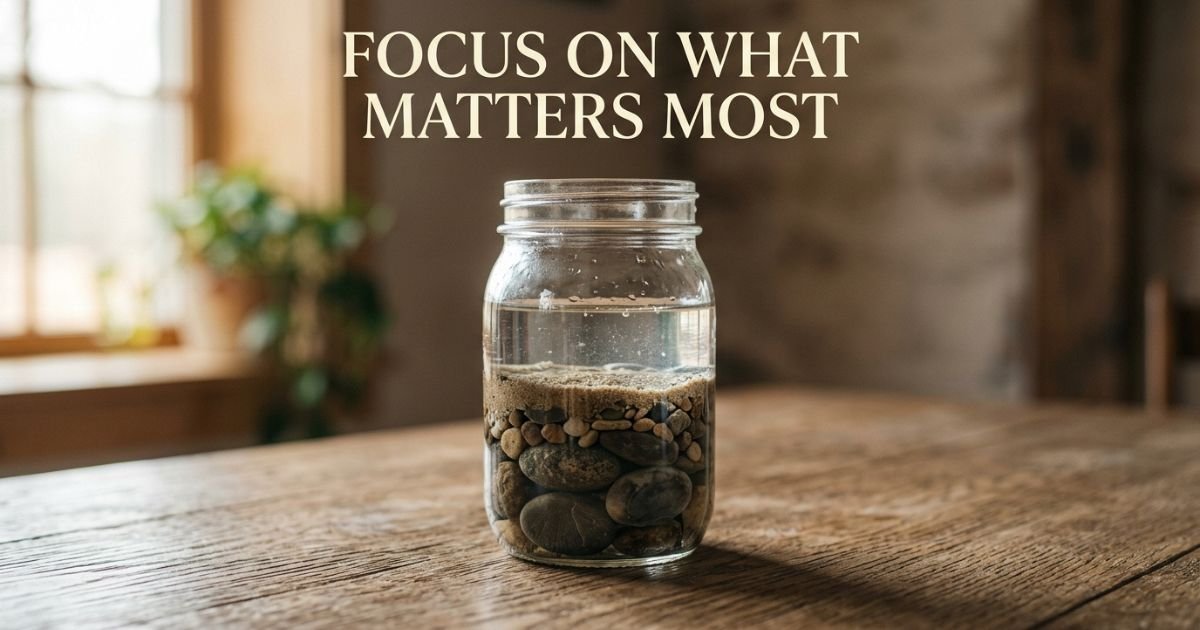

There is a story that takes less than two minutes to hear but can change the way you live for the rest of your life. It involves a jar, some stones, and a question so simple it almost feels too obvious. Yet somehow, that question cuts straight through the noise of modern life and lands somewhere quiet and deep. If you have ever felt stretched thin, overwhelmed, or quietly unsatisfied despite being constantly busy, this story was written for you. It is time to focus on what matters most before life fills up in the wrong order.
The Story of the Jar and Stones (And Why It Still Moves People Today)
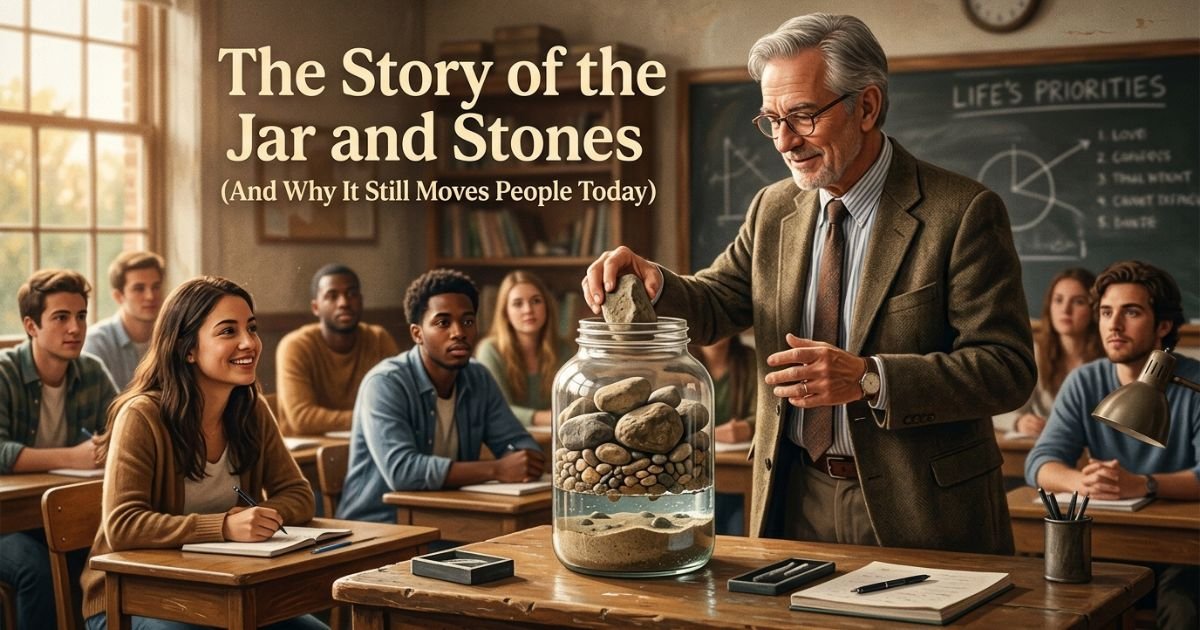
Some lessons stay with us not because they are complicated, but because they are true. The jar and stones story is that kind of lesson.
A professor places a large glass jar on a table in front of his students. He fills it with big rocks until no more can fit inside. Then he asks the class a question.
“Is the jar full?”
The students look at it and say yes.
He smiles and reaches for a container of small pebbles. He pours them in, and they tumble into the spaces between the rocks. He shakes the jar gently. The pebbles settle.
“Is it full now?”
The students hesitate this time. “Yes,” most of them say.
He picks up a bag of sand and begins to pour. The sand slips into every tiny gap remaining between the rocks and the pebbles. The jar looks completely full now.
Then he pours in water. It fills whatever space is left.
He sets the jar down and speaks.
“This jar is your life. The big rocks are the things that matter most: your faith, your family, your health, your love, your peace, and your purpose. The pebbles are important but secondary things like your career, your finances, and your responsibilities. The sand is everything small and distracting. The water is everything else.”
Then he says the part that changes everything.
“If you had put the sand in first, there would have been no room for the rocks. Always put the big rocks in first.”
That is the whole lesson. And yet, most of us are living in reverse.
Also READ: Complaining vs. Contributing: Which One Actually Gets You Ahead in Life?
What Does It Really Mean to Focus on What Matters Most?
This phrase gets used a lot. It shows up in productivity books, graduation speeches, motivational posts, and life coaching sessions. But what does it actually mean to focus on what matters most in a real, lived way?
It does not mean ignoring everything else. It does not mean abandoning responsibility or pretending that work and bills and obligations are not real. The pebbles and sand in the story still go into the jar. They still have a place.
To focus on what matters most means that before you let the small and medium things flood your days, you have deliberately made space for the things you cannot replace. It means that your most important relationships receive your best energy, not just your leftover energy. It means that your health gets protected before stress destroys it. It means that your faith is not squeezed into the margins of a day that already ran out of room.
It is a practice of ordering, not eliminating.
And when you get the order right, something remarkable happens. You feel less rushed. You feel more present. You feel less empty at the end of a long day. That is not an accident. That is what happens when a life is built around its actual priorities.
The Big Rocks: Identifying the Things That Cannot Be Replaced
The most important step in this whole conversation is figuring out what your big rocks actually are. Not what they should be according to someone else. Not what looks impressive from the outside. What they truly are for you in this season of your life.
For most people, the big rocks fall into a few consistent categories.
Faith and spiritual life. For millions of Americans, faith is the foundation beneath everything else. It is the thing that gives meaning to hard times and depth to good ones. When faith gets pushed to the edges of a busy life, something goes quiet that should not go quiet. The soul has a way of signaling when it is being neglected, even if the calendar looks full.
Family and the people you love most. These are the relationships you would grieve losing the most. A parent is getting older. A child who needs your presence more than your productivity. A spouse who needs to feel chosen, not managed. A friendship that has meant more than words can say. These people do not always make noise when they are being overlooked. That is why they are so easy to take for granted.
Your health, both physical and emotional. A body that is consistently exhausted cannot love well, think clearly, or show up fully. Emotional health works the same way. When mental weight goes unaddressed for too long, it begins affecting every other area of life. Health is not a reward you earn after finishing your to-do list. It is the foundation that the whole list rests on.
Purpose and meaningful work. There is a difference between staying busy and doing something that matters. When your work connects to something larger than a paycheck or a deadline, it feeds you rather than draining you. That kind of purpose is a big rock.
Inner peace. This one is underrated. Real peace does not mean the absence of problems. It means having something steady inside you, even when life is unsteady around you. That kind of peace takes time and intention to build. It cannot be found in a notification or a distraction. It lives in the quiet moments that most people stop giving themselves.
Why Most People Put the Sand in First (Without Realizing It)
Nobody wakes up and decides, today I will neglect what matters and give all my energy to what does not. That is not how it works. The sand creeps in slowly. It is quiet, harmless-looking, and relentless.
Here is how it usually happens.
The morning starts, and the phone is already in hand. A message needs a response. A news headline demands attention. An email arrived overnight and now feels urgent. By the time breakfast is finished, the jar already has sand in it.
Then come the small worries. The comparison to someone else’s life that appeared on a screen. The replaying of a conversation that did not go well. The anxious spinning about something that may not even happen. More sand.
Then the tasks that feel urgent but are not actually important. The meeting that could have been an email. The favor said yes to because saying no felt uncomfortable. The hour spent doing something that someone else should have handled. More sand.
By evening, the jar is full. And the big rocks are still sitting outside it, waiting for time and space that never came.
This is not a character flaw. It is a design problem. Modern life is engineered to produce urgency. Notifications are designed to feel pressing. Social media is built to capture attention and hold it. The world is very good at filling jars with sand. You have to be equally intentional about protecting space for your rocks.
The Pebbles: Honoring What Is Important Without Letting It Dominate
Work matters. Money matters. Responsibilities matter. These are not things to dismiss or spiritualize away. A job that provides for a family is a meaningful thing. Financial stability is not shallow, it is real. Planning for the future, meeting obligations, and being dependable are all genuine forms of care.
The problem is not the pebbles themselves. The problem is when pebbles are treated like big rocks.
When work becomes the defining center of a person’s identity, other things begin to suffer. Relationships get scheduled around work rather than the other way around. Health gets sacrificed on the altar of productivity. Rest feels like guilt. And somewhere in the background, a quiet sense of emptiness grows.
Work can also become a place to hide. Some people stay constantly busy because slowing down would mean sitting with feelings they are not ready to face. Busyness can look like ambition when it is actually avoidance. A full calendar is not the same thing as a full life.
The practice of putting big rocks first is not about working less or caring less about responsibility. It is about being honest about the order. Give your best to what matters most. Then bring the same care and discipline to your work and obligations. Both things can coexist. In fact, they coexist better when the order is right.
The Sand: Why Small Distractions Carry Such a Big Cost
Sand is sneaky. It enters without permission, one grain at a time, and before long, it has taken over.
Think about the things in your daily life that qualify as sand. Scrolling through a feed without any real purpose. Checking a phone more times than can be counted. Worrying about what someone thought of something you said three days ago. Saying yes to social obligations out of obligation rather than genuine desire. Getting pulled into low-grade drama that has nothing to do with your actual life.
None of these things feels catastrophic in the moment. That is exactly what makes them so powerful. They are individually harmless but collectively overwhelming.
The real cost of sand is not the time it takes. The real cost is the attention it consumes. Attention is not an unlimited resource. What you give your attention to shapes your emotional state, your relationships, your creativity, and your sense of meaning. When attention is scattered across dozens of small, low-value inputs all day, there is almost nothing left for the things that require depth.
Deep conversation requires attention. Deep prayer requires attention. Deep work requires attention. Deep presence with a child or a spouse, or a friend requires attention. When sand has taken over the jar, depth becomes nearly impossible.
This is why protecting your attention is one of the most spiritual and practical things you can do.
Also READ: Think Before You Judge: The Beautiful Truth Hidden Behind a Child’s Simple Act
Social Media, Urgency, and the Modern Jar Problem
The jar and stones story was written before smartphones existed. But it has never been more relevant than it is right now.
Social media, constant connectivity, and the culture of urgency have made it easier than ever to fill a life with sand. The average American checks their phone dozens of times a day. Notifications interrupt focus constantly. The pressure to respond immediately to messages, emails, and social posts creates an atmosphere where nothing can ever fully wait.
This is not entirely the fault of the individual. These platforms are designed by teams of engineers specifically to capture and hold attention. The scroll never ends. The notifications are timed to pull you back in. The comparison engine runs constantly in the background. It takes real effort to step back from all of that.
But stepping back is exactly what the jar and stones lesson asks us to do. Not permanently, and not dramatically. Just deliberately. Ask yourself before opening a screen: Is this one of my big rocks? Is this a pebble? Or is this sand?
That question does not have to eliminate social media from your life. It just asks you to be intentional rather than automatic. And intentionality, practiced over time, changes everything.
Urgency Is Not the Same as Importance
This may be the single most important distinction in the jar and stones conversation.
Urgency feels pressing. Urgency feels immediate. Urgency creates a sense of duty and responsiveness. But urgency has almost nothing to do with importance.
A ringing phone is urgent. But it may not be important. A new notification is urgent. But it may not be important. A request from someone who needs an immediate answer may feel urgent. But attending to your child’s emotional state tonight may be far more important.
The trap of urgency is that it trains us to respond rather than choose. When we live reactively, always answering the loudest thing in the room, we never get to decide what actually enters the jar first. Urgency makes that decision for us. And urgency does not care about your big rocks.
To focus on what matters most, you have to learn to pause before responding. Even a small pause creates enough space to ask: is this a rock, a pebble, or sand? That question is the beginning of real intentionality.
A Spiritual Reading of the Jar and Stones Story
For people of faith, the jar and stones story carries a meaning that goes beyond productivity or life balance. It speaks directly to how we steward the gift of our days.
Time is not ours indefinitely. That is not a morbid thought. It is a clarifying one. When we remember that life is finite, we become more awake. We stop postponing love. We stop treating meaningful things as things we will get to eventually. We stop letting small annoyances consume energy that belongs to something more important.
Many faith traditions speak about this. The Psalms describe a life that passes like a breath, and in the same verse ask for wisdom to number our days. The Sermon on the Mount speaks about not storing up treasure where moths can destroy it, pointing instead toward what endures. Across traditions, the message is consistent: be awake to what actually matters, because time is sacred and the jar is not bottomless.
Living with that awareness is not anxious. It is freeing. When you truly understand that today is a gift, you stop filling it carelessly.
When Difficult Times Reveal the Real Rocks
There is a painful but useful truth about hard seasons: they clear away the confusion. When life is comfortable, almost everything can seem equally important. When a crisis comes, the list gets short very fast.
During serious illness, health becomes the only thing on the list. During grief, the people who matter rise to the surface immediately. During financial hardship, clarity about what is actually essential arrives without much debate. During loss, the things that once seemed urgent reveal themselves as small.
Difficult times teach us what the jar and stones story is trying to teach us in the good times. They show us what is irreplaceable and what is not. They remind us that certain things we spent enormous energy worrying about were never worth so much.
This is not a reason to wait for a crisis before recalibrating your priorities. It is a reason to let the lesson reach you now, while there is still time and room to choose.
Why Family Is the Rock We Most Often Forget to Place First
Family has a strange quality that makes it vulnerable to neglect. It feels permanent. We assume the people we love will always be there. We tell ourselves there will be another dinner, another phone call, another chance to say what we have been meaning to say.
But relationships do not only break because of big betrayals or dramatic conflicts. They quietly fade because of small, repeated absences. A phone call was not returned today. A dinner conversation spent on a screen. A visit was delayed again because the timing is never quite right. Individually, none of these feels like a serious problem. Collectively, they create distance that can take years to close.
The people who love you most are often the ones least likely to demand your attention. That means they are also the ones most at risk of being placed after everything louder. Your child is unlikely to send you a calendar invite for emotional presence. Your aging parent is unlikely to create a sense of urgency the way an email can.
To focus on what matters most means choosing presence with the people you love before life takes that option away. Not as a dramatic gesture. Just as a daily, quiet decision to put the right things in the jar first.
The Quiet Work of Protecting Peace

Peace belongs in the big rocks category, and most people never treat it that way.
We chase success, recognition, financial stability, and comfort. These are not bad things. But peace is different. Peace is not something that arrives when the to-do list is finished. The list is never finished. Peace has to be chosen, protected, and practiced while the list is still long.
What steals peace most efficiently? Comparison. Unresolved conflict. Overcrowded schedules. Overexposure to noise. The habit of rehearsing worst-case scenarios. The refusal to rest without guilt.
What builds peace? Morning is quiet before the world makes demands. Prayer or meditation before the phone is checked. Regular conversation with someone who knows you well. Time in nature. The practice of gratitude for what is already good. The decision to release what you cannot control.
None of these requires wealth or special circumstances. They require intention. And intention is exactly what the jar and stones story is asking for.
Also READ: The Quiet Power of Compassion: How Understanding Others Brings Peace to Your World
Practical Ways to Put the Big Rocks in First Every Day
The lesson is beautiful. But beauty without application is just inspiration that fades. Here is how to bring this into actual daily life in ways that are real and sustainable.
Name your rocks clearly. Write down the three to five things that matter most to you in this season of life. Not what should matter according to anyone else. What genuinely matters to you. These may include your relationship with God, your marriage, your children, your physical health, your calling, or your emotional healing. Keep the list short. If everything is a big rock, nothing is.
Check your calendar against your list. Your calendar tells the truth your words sometimes avoid. If health is a big rock, where is it protected in your week? If family is a big rock, what time is genuinely set aside for presence rather than logistics? If faith is a big rock, when does it get real attention rather than a rushed prayer on the way out the door? The calendar does not lie.
Ask one question every morning. Before the phone is checked and before the day takes over, pause for sixty seconds and ask: What matters most today? Some days, the answer will be a difficult conversation. Some days it will be rest. Some days it will be a specific task that has real meaning. The practice of asking creates intentionality that running on autopilot never can.
Build a weekly reset. Once a week, spend ten or fifteen minutes reviewing how the week went. Ask yourself three things: What got the best of my attention this week? What got pushed aside that should not have been? What do I want to protect next week? This kind of gentle accountability prevents drift. It keeps the jar from slowly filling with sand while you are not paying attention.
Design your environment to support your priorities. Willpower runs out. The environment shapes behavior more reliably. Put your phone in another room during dinner. Keep a journal by your bed instead of a screen. Schedule exercise with another person so it becomes a commitment. Create a designated space for prayer or quiet reflection. Small environmental choices reduce the friction between your values and your actions.
Teaching This to Children Before Life Teaches It the Hard Way
Young people today are growing up in the most distraction-rich environment in human history. They carry the internet in their pockets. They are exposed to constant comparison through social media. Academic pressure starts early and never fully lets up. The noise is relentless.
They need more than advice about time management. They need a story that stays in the mind and speaks to something true.
The jar and stones story is one of the best tools a parent or teacher has. It is visual, simple, and it works. When a child understands that some things belong in the jar first because they cannot be added later, they begin to develop a framework for choice that no app can provide.
It also teaches something important about balance without moralizing. Fun belongs in the jar. Rest belongs in the jar. Friendship belongs in the jar. But they fit better when the most important things are already placed with care.
The earlier someone learns to focus on what matters most, the less pain they will need to experience in order to arrive at that same lesson.
Comparison: The Thief That Steals Your Jar
Nothing fills a jar with the wrong things faster than comparison.
When we measure our lives against someone else’s, we stop asking what matters to us and start chasing what impresses others. Someone buys a house, and suddenly owning a house feels urgent. Someone gets promoted, and suddenly our own pace feels like failure. Someone’s life looks polished and purposeful on a screen, and suddenly ours feels dull and behind.
Comparison does not just waste time and attention. It actively replaces your values with someone else’s. Their big rocks become your obligations. Their pebbles become your sand. And your actual jar starts filling with the wrong things entirely.
A meaningful life is not built by copying another person’s jar. It is built by understanding yourself. Your gifts, your calling, your relationships, your season of life, and your relationship with God are specific to you. No one else’s success can tell you whether your life is on track, because no one else is running your race.
To focus on what matters most, you have to stop looking sideways and start looking inward. Not out of selfishness. Out of clarity.
Gratitude as the Practice That Makes Big Rocks Visible

There is one more thing worth saying about this story, and it is perhaps the most gentle part of the whole conversation.
Sometimes the reason we keep chasing more is that we have lost the ability to see what is already here.
Gratitude is the practice that corrects that. When you stop and genuinely acknowledge what is good in your life right now, the big rocks become visible again. A body that still functions. A person who loves you and has stayed. A faith that has held you through hard things. A home that is small but safe. A morning that arrived with another chance.
None of these things need to be dramatic to be important. In fact, the most important things rarely are. They are quiet, ordinary, and easy to miss in a life moving too fast.
The jar and stones lesson is not just about what we prioritize in the future. It is also about recognizing and honoring what is already in the jar. Gratitude turns ordinary moments into something worth protecting. And protection is exactly what the big rocks need.
Also READ: 120 Heartfelt Thinking of You Messages for Her
A Reflection on Living This Out When It Is Hard
It would be dishonest to present this as easy. It is not always easy.
There are seasons when the demands of life genuinely do crowd everything out. Financial pressure can make survival feel like the only priority. A medical crisis can rearrange every plan. Grief can make it impossible to think clearly about what goes in the jar first. Exhaustion can make even the simplest choices feel overwhelming.
In those seasons, the jar and stones lesson does not demand perfection. It asks for direction. Even when the jar has too much sand, it is possible to remove a little and make room for something that matters. One honest conversation. One rest taken without guilt. One prayer spoken in honesty rather than performance. One small act of kindness toward someone you love.
Direction matters more than perfection. The goal is not a flawless jar. The goal is a life that, when you look back on it, was oriented toward the things that actually meant something. The things you would not trade for any amount of urgency, achievement, or distraction.
That is what it means to focus on what matters most. Not a formula. A way of living.
Frequently Asked Questions
How to focus on what matters most?
Focus on your “big rocks” first—your most important life priorities like health, family, and purpose.
Plan them before anything else, so distractions don’t take over your day.
What does “focus on what matters” mean?
It means giving your time and energy to what truly improves your life long-term.
Not everything urgent is important—prioritize what actually adds value.
What is the 3-goal rule?
It suggests choosing only 3 main goals per day or period to avoid overload.
This keeps your attention clear and aligned with what truly matters.
What is another word for focus on?
Synonyms include: prioritize, concentrate on, emphasize, or center on.
All means directing attention toward something important.
What are top 3 priorities in life?
Common top priorities are health, relationships, and personal purpose.
These match your “big rocks” concept from the jar story.
What is the 23-minute rule?
It refers to working in focused 23-minute sessions followed by short breaks.
It helps train attention and reduce distraction.
What are the 7 most important areas of life?
Usually: health, relationships, career, finances, personal growth, spirituality, and recreation.
These help create a balanced life structure.
What is the 3 3 3 rule for tasks?
It often means focusing on 3 tasks for the day, 3 medium tasks, and 3 small tasks.
It reduces overwhelm and improves clarity.
What are the 5 most important things in life?
Typically: health, family, purpose, peace, and meaningful relationships.
These match the “big rocks” in your content.
What is the rule of 3 for focus?
It means choosing only 3 key priorities to focus on at a time.
This prevents distraction and improves deep work.
What are the 8 behaviors of highly focused people?
They avoid multitasking, set clear priorities, and limit distractions.
They also protect time for deep, meaningful work daily.
How do people with ADHD focus?
They often use structure, routines, timers, and breaking tasks into small steps.
External support and reducing distractions are also helpful.
How to stop being scatterbrained?
Write priorities down and focus on one task at a time.
Reduce distractions and plan your day around key goals.
How to get your brain to focus on what matters?
Train your attention by eliminating distractions and setting clear priorities.
Start each day by identifying your “big rocks” first.
Conclusion
The jar and stones story is small enough to tell in a minute and large enough to guide an entire life. It does not ask you to be someone different. It simply asks you to be honest about what belongs first.
Your faith, your family, your health, your love, your peace, these are the rocks that deserve the first and most protected space in your jar. Not what is left over after everything louder has had its turn. Not what gets in on the days when the sand did not take over. The first and best of what you have to give.
This will not happen automatically. Life is genuinely good at filling jars in the wrong order. But every morning is a new jar. Every day brings another chance to place the rocks first, to let the pebbles settle in around them, and to allow the sand to find whatever space remains.
You do not have to do it perfectly. You just have to keep choosing it. One rock at a time, one morning at a time, one honest and intentional day at a time. That is how a meaningful life gets built. And that is why this quiet little story still matters so much.

Welcome to Blessing Bloom. I’m Ahsan Ali, founder of BlessingBloom.com a faith-based website dedicated to sharing prayers, blessings, and heartfelt wishes. Based in Islamabad, Pakistan, I created Blessing Bloom to help people find the right words during life’s most meaningful moments. With a background in Information Technology, I combine a passion for digital content with a genuine love for faith-inspired writing.