


There’s a moment that happens in a lot of Thanksgiving services. The music fades, the pastor steps to the podium, and everyone sort of settles in for a familiar message about being grateful. It’s warm. It’s comfortable. And sometimes, if we’re honest, it doesn’t move anyone very deeply.
If you’re preparing to preach this season and you want something more, you’re in the right place. These sermon outlines for Thanksgiving are designed to go beyond the surface, past the usual “count your blessings” territory, into the kind of gratitude that actually reshapes how people see God and live their lives. Whether you’re leading a Sunday morning service, a midweek Thanksgiving gathering, or a small group, there’s something here to help your congregation experience real, heart-level thankfulness.
What Makes a Thanksgiving Sermon Truly Effective?
Before diving into the outlines themselves, it’s worth pausing on what separates a forgettable Thanksgiving message from one your congregation carries home and talks about at the dinner table.
The most effective Thanksgiving sermons do three things that ordinary ones often skip. First, they acknowledge the complexity of gratitude, because many people sitting in your pews are struggling this season. They’ve lost someone. They’re facing hardship. They feel anything but thankful. A sermon that only speaks to the comfortable will miss the ones who need it most.
Second, strong Thanksgiving messages connect gratitude to transformation, not just emotion. Feeling grateful for five minutes is easy. Building a life rooted in thanksgiving is something different entirely. Your congregation needs both the inspiration and the practical pathway.
Third, the best outlines are adaptable. Your church is unique. Your people have specific stories. These outlines are starting points, frameworks you can personalize, expand, or condense based on what your congregation needs most.
How to Use These Sermon Outlines for Thanksgiving
Each outline below follows a consistent structure. You’ll find a central theme, a key Scripture verse, a core message summary, a sample sermon excerpt to help you feel the emotional tone, and reflection questions you can use for small groups, bulletins, or personal application.
Use them as full sermon frameworks or combine two shorter ones for a series. Some pastors have used several of these outlines across consecutive weeks in November, building a comprehensive month-long emphasis on gratitude that keeps the theme fresh rather than repetitive.
25 Sermon Outlines for Thanksgiving
1. The Grateful Heart: Honoring God in Every Season
Theme: Cultivating a heart of thanksgiving as a daily spiritual practice.
Key Verse: “Give thanks to the Lord, for he is good; his love endures forever.” — Psalm 107:1
Core Message: Gratitude is not a seasonal feeling. It’s a way of seeing God that reshapes everything. When we choose to honor God with thanksgiving, we’re not waiting until life feels good. We’re acknowledging that He is good, regardless of what we’re facing.
Sample Sermon Excerpt:
I want to ask you something real this morning. Not the polite version of the question, but the honest one. How many of you walked in here today carrying something heavy? A worry you haven’t been able to put down. A loss that’s still raw. A prayer you’ve been praying for months without an answer?
Now here’s the psalmist telling us to give thanks to the Lord because He is good. Do not give thanks because everything is good. Do not give thanks when you feel thankful. Give thanks because He is good.
That’s a fundamentally different invitation. It’s not asking you to deny your pain. It’s asking you to see something bigger than your pain. His goodness doesn’t depend on your circumstances. It doesn’t fluctuate with your mood or your situation. His love endures forever. That word “endures” means it holds. It doesn’t buckle. It doesn’t run out.
A grateful heart is not a naive heart. It’s a heart that has learned to look past what’s shifting to what’s steady.
Reflection Questions:
- When is gratitude hardest for you personally? What makes it difficult?
- How does the unchanging goodness of God change your relationship with thankfulness?
- What would it look like to practice daily gratitude as a form of worship, not just a feeling?
2. Giving Thanks in All Circumstances — Even the Hard Ones
Theme: Choosing gratitude as an act of faith when life is difficult.
Key Verse: “Give thanks in all circumstances; for this is God’s will for you in Christ Jesus.” — 1 Thessalonians 5:18
Core Message: This verse is one of the most challenging in all of Scripture. Not because it’s confusing, but because it’s clear. All circumstances. Paul doesn’t offer a loophole. He doesn’t say give thanks when you understand what God is doing. He says always. And the reason is profound: gratitude in hard times is not emotional pretending. It’s a declaration of faith.
Sample Sermon Excerpt:
I’ve wrestled with this verse for years. Give thanks in all circumstances. It’s the word “all” that gets me every time.
Paul was in prison when he wrote some of his most joyful letters. Not figuratively imprisoned by a bad attitude. Literally chained to a wall. And he was writing about joy, about peace, about contentment. He wasn’t performing that. He had discovered something that most of us are still learning: Thanksgiving can exist inside suffering. Not on the other side of it. Inside it.
This doesn’t mean you say “thank you” for the cancer diagnosis or the broken marriage or the grief that won’t lift. It means you say thank you to God in the middle of those things. You say, Lord, I don’t understand this. I’m hurting. But I believe you are still good. I believe you have not abandoned me. I believe this is not the end of my story.
That’s not denial. That’s warfare. That’s a faith that refuses to let suffering have the final word.
Reflection Questions:
- What’s the difference between thanking God for a hard circumstance and thanking God in it?
- Can you identify a past difficulty that you’re now, looking back, able to see God’s hand in?
- How would your posture toward current challenges shift if you tried to approach them with even a small measure of thanksgiving?
3. Counting Blessings Big and Small: Why the Ordinary Matters
Theme: Developing eyes to see God’s provision in everyday gifts.
Key Verse: “Praise the Lord, my soul, and forget not all his benefits.” — Psalm 103:2
Core Message: We have a natural tendency to only count the dramatic blessings. The miracle healing. The unexpected provision. The prayer was answered in a stunning way. But Psalm 103 calls us not to forget any of God’s benefits. That word “forget” is telling. Forgetfulness isn’t a moral failure. It’s a human tendency. And fighting it intentionally, deliberately, daily, is one of the most powerful spiritual practices available to us.
Sample Sermon Excerpt:
Here’s something I’ve noticed. We’re actually pretty good at remembering hardship. If something painful happened to you a decade ago, you can probably recall the details with startling clarity. But if someone asked you to name five specific ordinary blessings from last Tuesday, you might draw a blank.
We’re not wired for gratitude by default. We’re wired for survival. For noticing threats and lack. Gratitude is something we have to choose, practice, and build.
The psalmist knew this. That’s why he says, “forget not.” He’s not reminding himself of something obvious. He’s fighting against the drift. The drift toward taking things for granted. The drift toward focusing on what’s missing instead of what’s present.
What did God give you this week that you haven’t said thank you for? The friend who texted at exactly the right moment. The meal was just what you needed. The morning started quietly. The body that carried you through another day. These small things are not small. They’re evidence of a God who is paying attention.
Reflection Questions:
- What everyday gift have you been taking for granted? Take a moment right now to name it.
- How would your weekly routine change if you built in a regular practice of noticing and naming God’s ordinary provisions?
4. Gratitude as Warfare: The Spiritual Power of a Thankful Spirit
Theme: Using gratitude as a weapon against fear, anxiety, and spiritual discouragement.
Key Verse: “Do not be anxious about anything, but in every situation, by prayer and petition, with thanksgiving, present your requests to God.” — Philippians 4:6
Core Message: Most people read this verse as comfort. It is that. But it’s also a strategy. Paul doesn’t say pray instead of worrying. He says pray with thanksgiving. That combination is intentional. Thanksgiving redirects your attention from the problem to the Provider. It’s a specific posture of faith that breaks anxiety’s grip in a way that ordinary requesting doesn’t.
Sample Sermon Excerpt:
Did you catch those two little words? With thanksgiving. Paul could have said, “Just pray.” He didn’t. He said bring your requests to God with thanksgiving. That’s a specific posture. And I think there’s a reason for it.
When anxiety comes, it narrows your vision. You can only see the problem. It fills your whole frame. Everything else disappears. But when you bring thanksgiving alongside your petition, something shifts. You’re not just asking a distant God for help. You’re reminding yourself of who you’re talking to. A God who has been faithful. A God who has come through before. A God whose track record is worth remembering.
I started doing this during a season when I was really struggling. Before I listed my requests, I spent a few minutes listing what God had already done. Not in a rote way, but specifically. That time last spring when the situation looked hopeless, He made a way. That conversation that changed everything. The thing I was so afraid of turned out to be the beginning of something good.
By the time I got to my requests, I wasn’t asking from a place of panic. I was asking from a place of trust. The peace Paul describes, the kind that surpasses understanding, showed up.
Reflection Questions:
- What would change about your prayer life if you led with thanksgiving before your requests?
- Identify one current fear. What’s one thing you can thank God for that’s related to that situation?
5. When Gratitude Feels Impossible: Finding Faith in the Wilderness
Theme: Discovering how to thank God when circumstances are genuinely painful.
Key Verse: “Though the fig tree does not bud and there are no grapes on the vines… yet I will rejoice in the Lord.” — Habakkuk 3:17-18
Core Message: Some of your congregation members are not in a season of celebration. They are in a wilderness. And a Thanksgiving message that only speaks to the comfortable will feel hollow to them. Habakkuk’s “yet” is the most important word in this passage, and possibly in the entire discussion of gratitude. It’s the hinge between despair and trust. It says: I see the hardship. I am not pretending. And yet.
Sample Sermon Excerpt:
Habakkuk wasn’t writing this verse from a comfortable place. He was looking at devastation. No harvest. No livestock. No security. Everything stripped away. This wasn’t a bad week. This was a catastrophic loss.
And then he says something that still staggers me after all my years of reading it. “Yet I will rejoice in the Lord.”
That one word, “yet,” is doing everything. It’s not denying what came before it. He listed the losses honestly. He didn’t skip over them or spiritualize them away. He saw them clearly. And then he made a choice. Not to rejoice because of what he saw. But to rejoice in the Lord in spite of what he saw.
I have sat in hospital rooms with people getting impossible news. I have walked alongside families burying children. I have counseled people whose marriages ended, whose businesses failed, and whose prayers seemed to go nowhere for years. And the most remarkable thing I have witnessed, over and over, is people choosing that “yet.” People who said, I don’t understand this. I’m grieving. I’m confused. And yet. Yet I trust You. Yet I know You are good. Yet I will praise.
That kind of gratitude doesn’t come naturally. It’s forged. It’s chosen. And it is among the most powerful things I have ever seen a human being do.
Reflection Questions:
- Is there a “yet” missing from your current season? What would it take to say it, even quietly?
- How do you separate authentic faith from toxic positivity when it comes to gratitude in suffering?
6. Gratitude That Heals: The Spiritual Medicine in a Thankful Heart
Theme: How the practice of thanksgiving restores hope, peace, and emotional wholeness.
Key Verse: “A cheerful heart is good medicine, but a crushed spirit dries up the bones.” — Proverbs 17:22
Core Message: Modern research and ancient Scripture agree on this: gratitude heals. A heart turned toward thankfulness is not just more spiritually mature. It is more whole. More resilient. Better able to weather hardship. Solomon described the physical reality of a crushed spirit three thousand years before medical science began to confirm what he knew. There is healing in a thankful heart.
Sample Sermon Excerpt:
A few years ago, I went through a stretch where everything felt heavy. The kind of heaviness that doesn’t have one cause. It just accumulates. And someone gave me a simple challenge. Before your feet hit the floor every morning, name five specific things you’re grateful for. Not generic things. Specific ones. Today’s actual gifts, not categories.
I’ll be honest, the first few days felt mechanical. I was going through the motions. But I kept at it. And around day ten, something changed. I started noticing things during the day that I wanted to save for my morning list. A moment with a family member. A conversation that lifted something. A line from a book. I was collecting gratitude rather than drifting through my hours.
Solomon’s wisdom is precise here. It’s not that a cheerful heart causes good things to happen. It’s that something about the posture of a grateful, hopeful heart actually heals. It repairs the bone-dry spirit. It brings color back to life that has gone grey.
Gratitude is not a personality trait you either have or don’t have. It’s a practice. You build it the way you build any other spiritual muscle. With repetition. With intention. And often, with stubbornness, showing up on the days it doesn’t feel natural.
Reflection Questions:
- What specific practice might help you build a gratitude habit that lasts beyond Thanksgiving season?
- Have you ever experienced a direct connection between intentional thankfulness and emotional healing?
7. The Gratitude of Surrender: Thanking God for Unanswered Prayers
Theme: Finding peace and even gratitude in prayers that God answered differently than we hoped.
Key Verse: “For my thoughts are not your thoughts, neither are your ways my ways, declares the Lord.” — Isaiah 55:8
Core Message: Some of our greatest blessings came disguised as closed doors. This is one of the most difficult forms of gratitude to cultivate, but also one of the most freeing. When we can genuinely thank God for the prayers He didn’t answer our way, we’re expressing one of the deepest forms of trust: that His wisdom is greater than our own understanding.
Sample Sermon Excerpt:
I know a woman who prayed for years for one specific outcome. She was certain it was God’s will. She was sincere. She was persistent. And the door stayed shut. For a long time, she was heartbroken. Honestly, she was angry. She felt abandoned.
She told me years later, sitting across from me with a full life she couldn’t have predicted: “I used to be so angry about that closed door. Now I thank God for it regularly. He saw things I couldn’t see. He knew things I didn’t know. And the life I have now, the one I never would have designed for myself, is so much richer than what I was demanding.”
Isaiah is not gentle here. God’s ways are not just different from ours. They are higher. The word means elevated. Lifted above. A perspective we don’t have access to from where we stand.
Gratitude for what God withholds is mature faith. It’s the gratitude that says, I wanted that very badly. I still don’t fully understand why the answer was no. But I trust that you see the whole story. And I’m choosing to thank you for your wisdom, even when it’s not what I asked for.
That kind of thanksgiving doesn’t come quickly. It usually comes after time, and often only in hindsight. But the invitation is there. And it’s one of the most liberating prayers you’ll ever pray.
Reflection Questions:
- Can you identify a prayer God answered differently than you hoped, so that you can now see it as His mercy?
- What would it mean for your current prayer life to hold your requests with open hands?
8. Remembering God’s Faithfulness: The Gratitude That Builds Faith
Theme: Using the memory of God’s past faithfulness as a foundation for present and future trust.
Key Verse: “Remember the wonders he has done, his miracles, and the judgments he pronounced.” — 1 Chronicles 16:12
Core Message: Memory is one of the most powerful spiritual tools we have. When we deliberately recall God’s faithfulness in our past, we accomplish two things at once: we give thanks for what He has done, and we build the courage to trust Him with what’s ahead. Remembering is not nostalgia. It’s a spiritual discipline.
Sample Sermon Excerpt:
I started keeping a record a few years ago. Not a diary exactly, more of a log of specific moments when I could see God’s hand clearly. A prayer answered. A provision that came from nowhere. A door that opened at exactly the right time. A moment of undeniable peace in a situation that should have overwhelmed me.
What I didn’t expect was how much it would change my prayers going forward. When I sit down to pray about something difficult now, I don’t start from scratch. I go back to that record. And I remember. I was afraid here, and He came through. I was lost here, and He guided. I thought it was over here, and He made a way.
Gratitude for the past becomes fuel for trust in the present. The Israelites were commanded over and over to remember. Build stones of remembrance. Tell the stories. Teach them to your children. Why? Because forgetting leads to fear. And remembering leads to faith.
This is why testimony still matters in our services. When someone stands up and says, “Here’s what God did in my life,” they’re not just sharing a personal story. They’re building the faith of everyone listening. They’re saying, the same God who was faithful to me will be faithful to you.
Reflection Questions:
- What’s one specific moment in your life when you saw God’s faithfulness clearly? Have you ever written it down?
- How might a “faithfulness journal” change your prayer life and your capacity for gratitude?
9. A Lifestyle of Praise: Moving Thanksgiving from a Holiday to a Habit
Theme: Building gratitude into the rhythms of everyday life rather than reserving it for special occasions.
Key Verse: “Sing to the Lord with thanksgiving; make music to our God on the harp.” — Psalm 147:7
Core Message: The psalmist does not say sing to the Lord on the fourth Thursday of November. He says sing to the Lord with thanksgiving. Present tense. Continuous. The invitation is not to a season of gratitude but to a posture of gratitude that becomes the underlying note of your entire life.
Sample Sermon Excerpt:
Here’s the thing about our culture and gratitude. We’ve turned it into a holiday. We have one day set aside to say thank you, eat an enormous meal, watch football, and then move directly into Black Friday, which is sort of the theological opposite of Thanksgiving.
But the biblical vision of thanksgiving is not a day on a calendar. It’s a way of inhabiting your life. It’s a habit of the heart that changes how you wake up, how you speak to the people around you, how you move through difficulty, and how you approach God.
I have an elderly woman in my congregation who has been through things that would have broken most people. She lost her husband. She went through serious health struggles. She watched some of her dreams go unfulfilled. And when you visit her, within ten minutes, she has found something to praise God about. Not in a dismissive way. Not as a way of avoiding hard things. But because praise has become so woven into who she is that it comes out naturally.
She told me once, “I didn’t start this way. I had to practice. I decided a long time ago that I was going to be a thankful person no matter what, and eventually it became what I actually was.”
That’s the goal. Not to feel thankful on Thanksgiving. To become someone for whom gratitude is the default. The natural first response. The lens through which you see everything else.
Reflection Questions:
- What small daily ritual might help you build gratitude as a habit rather than an annual event?
- What would it look like if your congregation became known as a community of genuine, ongoing praise?
10. The Gratitude of Community: Giving Thanks for the Body of Christ
Theme: Recognizing and honoring the gift of Christian community and belonging.
Key Verse: “Let us consider how we may spur one another on toward love and good deeds, not giving up meeting together.” — Hebrews 10:24-25
Core Message: One of the blessings we most easily take for granted is each other. The body of Christ, this imperfect, sometimes frustrating, beautifully human community of believers, is a gift. And learning to be genuinely grateful for it, specifically and intentionally, changes how we show up for each other.
Sample Sermon Excerpt:
We live in a time when isolation has become normal. You can order everything online. You can stream church from your couch. You can curate a social feed that feels like a community without any of the difficulty of actually knowing people. And slowly, quietly, we’re losing something irreplaceable.
The writer of Hebrews was speaking to people who were considering stopping meeting together. It was dangerous to be known as a follower of Jesus. Some were tired. Some were discouraged. And he says, ” Don’t give that up. You need each other. Not as a nice optional extra. As an essential.
When you really think about what the body of Christ has meant in your life, the people who prayed for you at your worst moments, the ones who showed up without being asked, the ones who told you the truth when you needed to hear it, the ones who celebrated with you when everything came together, how can you not be grateful?
Here’s a challenge for this Thanksgiving season. Think of three people in your congregation who have made a difference in your spiritual life. Not just your close friends. Maybe someone who served quietly. Someone who spoke one sentence years ago that stayed with you. Someone who has modeled faithfulness in a way that has shaped how you follow Jesus. And tell them. Specifically. This week.
Gratitude expressed to people in your community is not just good for your soul. It builds something in the community itself. It says, I see you. You matter. God worked through you. That’s a powerful thing to say.
Reflection Questions:
- Who in your congregation have you never properly thanked for their impact on your faith?
- How might intentional gratitude for community members strengthen your church’s unity this season?
11. Gratitude for Salvation: Never Getting Over the Greatest Gift
Theme: Returning to the cross with fresh wonder and deep, renewed thankfulness.
Key Verse: “But God demonstrates his own love for us in this: While we were still sinners, Christ died for us.” — Romans 5:8
Core Message: The danger of long-term faith is familiarity. The cross becomes a symbol we wear rather than a reality we inhabit. Returning to Romans 5:8 with honest attention is returning to the foundation of all Christian gratitude. Everything else we give thanks for flows from this.
Sample Sermon Excerpt:
I want to talk about something we’ve heard so many times that we risk no longer hearing it.
While we were still sinners. Not after we had cleaned ourselves up. Not after we had proven we were worth something. While we were actively turned away from God, in rebellion, in indifference, in sin, Christ died for us.
I’ve been a pastor for a long time. I’ve preached the gospel hundreds of times. And I will tell you honestly that there are mornings when I read Romans 5:8, and something in me catches. Something stops. I think this is still extraordinary. This is still stunning. This is still the thing that changes everything.
If gratitude has a bedrock, this is it. Every blessing you’ll count this Thanksgiving flows from this one. Every prayer God hears, every mercy He extends, every future He makes possible is downstream from this moment at a cross outside Jerusalem where the Son of God chose to pay the price you owed.
Don’t let that become ordinary. Don’t let the familiarity steal the wonder. Go back to the cross this week. Read the crucifixion accounts slowly. Sit with what was done there, and for whom, and why. Let it wake something up in you.
Because when that gift is alive in your heart, gratitude for everything else becomes natural. You’re not just thankful for the good things in your life. You’re thankful for a God who loved you when you gave Him no reason to.
Reflection Questions:
- When did you last feel genuinely moved by your salvation, not just intellectually aware of it?
- What practices help you keep the wonder of the gospel fresh in your daily life?
12. Gratitude in Grief: How Sorrow and Thankfulness Can Coexist
Theme: Holding space for grief and gratitude simultaneously during seasons of loss.
Key Verse: “Praise be to the God and Father of our Lord Jesus Christ, the Father of compassion and the God of all comfort, who comforts us in all our troubles.” — 2 Corinthians 1:3-4
Core Message: For many in your congregation, Thanksgiving is a season of absence as much as abundance. They sit at tables with empty chairs. They carry grief that doesn’t pause for the holiday. A pastoral Thanksgiving message must speak to this reality directly and compassionately. Grief and gratitude are not opposites. They can exist in the same heart, in the same moment, without one canceling out the other.
Sample Sermon Excerpt:
I had someone ask me once, “How do you give thanks when your heart is broken?” It was one of the most honest questions I’ve ever been asked in ministry. And I want to answer it with the same honesty it was offered.
You don’t have to choose between grief and gratitude. You can hold both.
Paul doesn’t tell us not to mourn. He tells us that God is the Father of compassion. He comforts us in our troubles. Not after our troubles. In them. He’s present inside the grief, not waiting on the other side of it.
I walked with a father through the loss of his daughter a few years ago. In the weeks after her death, when I sat with him, what I witnessed was not a man pretending to be okay. He was devastated. But he was also, when he could find the words, incredibly grateful. Grateful for the years he’d had. For the way she had made him laugh. For the conversations he would replay for the rest of his life. For the fact that she knew she was loved.
He told me once, “The gratitude doesn’t make the grief smaller. But somehow they live together. I can cry and be grateful at the same time.”
That is a profound and deeply human kind of faith. If you are grieving this season, you don’t have to manufacture happiness. You don’t have to pretend you’re okay. But you might, gently, when you’re ready, begin to open your hands toward what you had. And let that be its own kind of thanksgiving.
Reflection Questions:
- Is there a loss in your life that you haven’t yet found a way to hold alongside gratitude?
- How might your congregation better serve those for whom Thanksgiving is a season of grief?
13. Grateful for Second Chances: The Mercy That Starts Fresh Every Morning
Theme: Receiving and celebrating God’s daily mercy and the grace to begin again.
Key Verse: “The Lord’s mercies are new every morning; great is your faithfulness.” — Lamentations 3:22-23
Core Message: Lamentations is not a book of triumph. It is a book of devastation. And in the middle of it, the writer lands on one of the most hope-saturated truths in all of Scripture. Every morning, mercy renews. Whatever yesterday held, this morning is fresh. That is not a platitude. It is a lifeline.
Sample Sermon Excerpt:
Here’s something about Lamentations that often gets missed. We quote this verse as it comes from a place of comfort. But it was written in a place of complete devastation. The city was destroyed. The temple was gone. Everything the people had built and trusted in had been torn apart. And the writer finds this, this fragile, stubborn hope: His mercies are new every morning.
Not once. Not when you earn it. Every. Single. Morning.
I have talked to people who felt disqualified. Who felt they had made too many mistakes for God to still have something for them. Who had failed in ways they couldn’t see past. And I take them here. Not to a verse about triumph or victory, but to a verse written in rubble.
If the writer of Lamentations, surrounded by destruction, could hold onto God’s morning mercies, then so can you.
You are not defined by yesterday. You are not locked into last year’s version of yourself. Every morning, the mercy is new. The invitation is open. The slate is not wiped conditionally or partially. It’s renewed completely.
That is extraordinary. That is something to be deeply, genuinely thankful for. Not with polite acknowledgment, but with the kind of relief that comes when you realize you are not disqualified.
Reflection Questions:
- Is there an area of your life where you have been withholding grace from yourself that God has already extended to you?
- How does the daily renewal of God’s mercy change your relationship with failure and starting over?
14. The Sacrifice of Praise: Thanksgiving When It Costs You Something
Theme: Offering genuine gratitude even when it is difficult, costly, or counterintuitive.
Key Verse: “Through Jesus, therefore, let us continually offer to God a sacrifice of praise, the fruit of lips that openly profess his name.” — Hebrews 13:15
Core Message: The word “sacrifice” is deliberate and important. A sacrifice costs something. It requires giving what is difficult to give. The sacrifice of praise is the thanksgiving we offer when we don’t feel like it, when the circumstances argue against it, when choosing gratitude is genuinely hard. This is the highest form of worship.
Sample Sermon Excerpt:
Hebrews calls it a sacrifice of praise. And I’ve been sitting with that phrase for years. Because a sacrifice, by definition, is something that costs you.
In the Old Testament, when someone brought a sacrifice to God, they were giving something of real value. Their best animal. Their first grain. Something that mattered. And the principle hasn’t changed. When we offer praise to God in hard times, when we choose thanksgiving in the middle of loss or confusion or pain, we are giving something that costs us something.
I knew a woman who lost her home in a fire. Not gradually, not with warning. One evening it was there; the next day it was ash. And the first thing she said when she called was, “Thank God my family is safe.” Not as a way of dismissing what had happened. She wept for weeks over what was lost. But her first impulse, even in that shattering moment, was to offer what she could to God.
That’s a sacrifice of praise. That’s choosing to honor God even when the circumstances are screaming at you to collapse. And that kind of gratitude does something in us. It doesn’t deny our pain. It places our pain inside a larger story, one where God is still present, still good, still the author of what comes next.
Reflection Questions:
- What would it look like in your current season to offer a sacrifice of praise rather than waiting until you feel like being grateful?
- When has a costly act of thanksgiving changed something in you?
15. Gratitude for Our Limitations: Finding God in What We Can’t Do Alone
Theme: Discovering that our weaknesses and limitations are invitations into deeper dependence on God.
Key Verse: “My grace is sufficient for you, for my power is made perfect in weakness.” — 2 Corinthians 12:9
Core Message: We live in a culture that valorizes self-sufficiency. That treats limitation as failure and need as embarrassing. But Paul’s theology is radically different. His limitations were not obstacles to God’s work in him. They were the very place where God’s power became most visible. Gratitude for weakness is one of the most countercultural things a Christian can practice.
Sample Sermon Excerpt:
Paul had what he called a thorn. He doesn’t tell us what it was. Scholars have debated it for centuries. What we know is that it was painful, persistent, and something he wanted removed. He asked God three times. The answer was no.
And then came one of the most disorienting verses in the New Testament. My grace is sufficient for you, for my power is made perfect in weakness.
I don’t think Paul loved this answer. But I think he learned it. Because listen to what he says next: Therefore, I will boast all the more gladly about my weaknesses. He went from asking God to take the limitation away to boasting about it. What changed? He understood that his weakness was not the problem. His weakness was the invitation.
When we’re strong enough on our own, we tend to operate on our own. When we’re at the end of our resources, we finally ask for His. And that’s where His power shows up. That’s where things happen that we know we didn’t produce.
This Thanksgiving, is there a limitation in your life that you’ve been frustrated about, maybe even ashamed of, that you could begin to hold differently? What if it’s not a deficiency to overcome? What if it’s the place where God wants to show up most clearly?
Reflection Questions:
- What limitation in your life have you been fighting rather than surrendering?
- Where have you seen God’s power most clearly displayed in an area of your own weakness?
16. Thankful for Purpose: Gratitude for God’s Unique Design in You
Theme: Celebrating the specific gifts, calling, and purpose God has placed in each person.
Key Verse: “For we are God’s handiwork, created in Christ Jesus to do good works, which God prepared in advance for us to do.” — Ephesians 2:10
Core Message: You were not mass-produced. You were custom-designed. And one of the most spiritually healthy forms of gratitude is the gratitude that accepts who God made you to be, gifts included, limitations included, story included, and says: thank you for making me this way, with this calling, for this purpose.
Sample Sermon Excerpt:
The Greek word behind “handiwork” in Ephesians 2:10 is “poiema.” It’s where we get our word poem. You are God’s poem. Not a form letter. Not a rough draft. A carefully crafted, intentional work.
That means the specific combination of your personality, your experiences, your gifts, your wounds, and your passions is not accidental. God put those things together on purpose, for purposes He designed before you were born.
I think about a woman I know who spent years feeling like she wasn’t gifted enough for ministry. She wasn’t a speaker. She wasn’t a leader in any official sense. But she had this extraordinary capacity to notice. She noticed when someone was struggling before anyone else did. She noticed the visitor standing alone. She remembered details about people that made them feel genuinely seen. And through that gift, she changed more lives than she’ll ever know.
When she stopped looking at what she didn’t have and started being grateful for what she did have, something freed up in her. She stopped comparing and started contributing. She stopped apologizing for who she was and started offering herself fully.
Gratitude for your specific design is not arrogance. It’s faithfulness. It’s saying to God: I trust that you knew what you were doing when you made me this way. And I will steward it.
Reflection Questions:
- What gift or quality in yourself have you been dismissing or taking for granted?
- How might gratitude for your specific design change the way you serve within your community?
17. Gratitude for the Ordinary: Seeing God in the Daily Rhythms
Theme: Developing a holy attentiveness to God’s presence in the mundane moments of everyday life.
Key Verse: “So whether you eat or drink or whatever you do, do it all for the glory of God.” — 1 Corinthians 10:31
Core Message: If God can only be found in extraordinary moments, then faith is a part-time experience. But if God inhabits the ordinary, if He can be worshipped in the act of washing dishes or driving to work or making dinner, then every moment is sacred ground. The practice of noticing ordinary gifts is the practice of living in continuous awareness of God.
Sample Sermon Excerpt:
A 17th-century monk named Brother Lawrence had a theology that I find deeply challenging. He worked in a monastery kitchen, washing dishes and peeling vegetables. And he wrote that he found God as fully present while scrubbing pots as he did in formal prayer. He called it practicing the presence of God.
The idea is simple: every ordinary moment is a potential encounter with the divine if you bring gratitude to it. The cup of coffee. The conversation with a coworker. The drive home. The child’s laugh. The sunset you almost didn’t look up to see.
We save our gratitude for the big moments, and we drift through the small ones. But life is mostly small moments. And if we can’t find God there, then we’re living most of our lives outside of awareness of Him.
Paul’s instruction to do everything for the glory of God is not a burden. It’s an invitation. It’s a way of seeing. Every ordinary act, eating, drinking, working, resting, becomes worship when it’s offered with awareness and gratitude.
Try this for one day. Pick one routine task. Maybe making breakfast. And as you do it, thank God. For the food. For the ability to prepare it. For the people you’ll share it with. For another morning. Watch how one mundane moment becomes something else entirely when you bring thankfulness to it.
Reflection Questions:
- What ordinary part of your daily routine could become a touchpoint for intentional gratitude?
- How would your awareness of God’s presence change if you began treating daily life as sacred ground?
18. Grateful for Honest Friendships: The Gift of People Who Tell You the Truth
Theme: Appreciating the rare and valuable gift of friends who love you enough to speak hard truths.
Key Verse: “Wounds from a friend can be trusted, but an enemy multiplies kisses.” — Proverbs 27:6
Core Message: Most of us say we want honest friends, but few of us are grateful for them in the moment of correction. This message invites your congregation to recognize that the people in their lives who speak truthfully, who hold them accountable, who risk the friendship to say what needs to be said, are extraordinary gifts from God.
Sample Sermon Excerpt:
Flattery feels better than honesty in the moment. That’s just true. When someone tells you exactly what you want to hear, it’s comfortable. It’s warm. It feels like love.
But Proverbs tells us that the person who tells you hard truths is actually the one who loves you. And the one who just keeps affirming you, who never challenges you, who always agrees? That person, whatever they intend, is not doing you the service of a friend.
I have a small group of people in my life who have permission to tell me things I might not want to hear. They’ve earned that through years of demonstrated love and trustworthiness. And I won’t lie to you, there have been moments when something they said stung. When I walked away frustrated. When my first instinct was defensive.
And then, usually within a few days, I recognized they were right. That the hard thing they said was the true thing. And that my life is better because someone cared enough about me to risk my comfort.
Those people are rare. If you have even one of them, you are rich in a way that money can’t produce. Thank God for them. Tell them what they mean to you. Because people who love you enough to be honest with you are one of the specific, particular, beautiful gifts God places in a life.
Reflection Questions:
- Who in your life has loved you enough to speak truthfully? Have you ever thanked them for it?
- Is there someone in your life who needs you to be that kind of honest friend right now?
19. Gratitude in Waiting: Finding Thankfulness When the Promise Is Delayed
Theme: Maintaining faith and gratitude during seasons when God’s promises have not yet arrived.
Key Verse: “I remain confident of this: I will see the goodness of the Lord in the land of the living. Wait for the Lord; be strong and take heart and wait for the Lord.” — Psalm 27:13-14
Core Message: Waiting is one of the most common and most difficult human experiences. For Christians, waiting on God’s promises can stretch faith to its breaking point. But grateful waiting, waiting that continues to trust and praise, is different from anxious waiting. It says: I believe you’re working, even when I can’t see it.
Sample Sermon Excerpt:
David wrote Psalm 27 during one of the longest waiting seasons of his life. He had been promised a kingdom. He was living in caves, hiding from the man who wanted to kill him. The gap between the promise and the fulfillment was enormous.
And yet. I will see the goodness of the Lord. Not I hope to. Not I might. I will. Present tense certainty about future fulfillment, offered in the middle of present hardship.
That’s not wishful thinking. That’s faith practiced as a discipline. And notice the instruction: wait for the Lord. Be strong. Take heart. Wait. He says it twice because waiting is hard, and we need to be reminded.
I know people who have waited for things for years. A prodigal child returns. A health crisis to resolve. A marriage to be healed. A door to open. And what I’ve noticed is that the people who navigate waiting with grace are almost always people who found a way to be grateful in the waiting, not for what they were waiting for, but for what God was doing in them while they waited.
Waiting is rarely wasted when you’re paying attention. There is almost always something being formed, deepened, or refined. And gratitude for that process, even when it’s painful, keeps faith alive when impatience would kill it.
Reflection Questions:
- What are you waiting for right now? What might God be doing in you during this season of waiting?
- What would it look like to offer genuine thanksgiving in the middle of your delay?
20. Generous Because We’re Grateful: How Thankfulness Flows Outward
Theme: Exploring the natural and necessary connection between gratitude and generosity.
Key Verse: “Each of you should give what you have decided in your heart to give, not reluctantly or under compulsion, for God loves a cheerful giver.” — 2 Corinthians 9:7
Core Message: Gratitude held privately eventually dries up. Gratitude expressed outward, through generosity of time, money, attention, and care, multiplies. The most grateful people in any congregation are almost always the most generous, because they understand that everything they have is given, not earned, and that sharing it is the most natural response to that understanding.
Sample Sermon Excerpt:
You know what I’ve noticed after years in ministry? The most generous people are almost never the wealthiest. They’re almost always the most grateful.
I have a couple in my church who don’t have an enormous income. They live carefully. And yet they are consistently among the most generous givers, not just financially, but with their time, their hospitality, their attention. Someone always needs their help, and they’re always there.
I asked one of them about it once. She said something I wrote it down immediately. “We’re not giving away our stuff. We’re passing along what belongs to God. We’re just caretakers of all of it. And why would a caretaker hoard what they’ve been trusted with?”
That is a thoroughly grateful theology. It doesn’t see what it has as its own. It sees everything as given, temporarily entrusted, to be stewarded and shared. And from that posture, generosity is not a sacrifice. It’s a natural overflow.
This Thanksgiving, let the gratitude in your heart move your hands. Ask God what specific act of generosity your gratitude calls you to. Let it be specific. Let it cost you something real. Let your thanksgiving become tangible in someone else’s life.
Reflection Questions:
- What would it look like for your gratitude to express itself in a specific act of generosity this week?
- How does seeing your resources as entrusted gifts change your relationship with giving?
21. Gratitude for Discipline: Thanking God for the Correction That Changes Us
Theme: Developing maturity that can receive God’s loving correction with gratitude rather than resistance.
Key Verse: “No discipline seems pleasant at the time, but painful. Later on, however, it produces a harvest of righteousness and peace for those who have been trained by it. Hebrews 12:11
Core Message: This is not a popular Thanksgiving theme. But it’s an honest one. The people who grow most deeply in faith are the people who can look back at seasons of God’s correction and see them as gifts, painful gifts that they would not trade because of what they produced. Gratitude for discipline is the mark of a maturing believer.
Sample Sermon Excerpt:
There is a season of my life I look back on with complicated feelings. God put His finger on something in me that needed to change. And I resisted. I made excuses. I compared myself to the worst examples. I did everything except honestly reckon with what He was pointing out.
And He was patient. He kept pointing. Gently at first. Then with greater clarity. And finally, I couldn’t avoid it anymore. I had to sit with the truth about something I didn’t like about myself, something that was affecting my relationships, my leadership, my integrity.
The process of changing was uncomfortable. It required accountability and honesty, and a lot of moments of sitting with the gap between who I was and who I wanted to be.
But here’s what I can say now, years out from that season: I am grateful for it. Not for the discomfort in the abstract, but for what it produced. Hebrews calls it a harvest of righteousness and peace. That’s exactly right. It felt like everything but that while it was happening. But what came out the other side was real. It was lasting. It was fruit that I couldn’t have grown any other way.
Reflection Questions:
- Is there an area where God has been putting His finger that you’ve been resisting?
- Can you look back at a season of God’s correction and see it now as a gift? What did it produce in you?
22. Grateful for Who God Is, Not Just What He Does
Theme: Moving from transactional gratitude, thanking God for blessings, into relational gratitude, thanking God for who He is.
Key Verse: “The Lord is good, a refuge in times of trouble. He cares for those who trust in him.” — Nahum 1:7
Core Message: There is a deeper level of thanksgiving than counting blessings, and it is the level that sustains faith when the blessings are harder to see. It’s the gratitude that says, I thank you for your goodness itself, not just for what your goodness produces in my life. This is the kind of thankfulness that holds in every season.
Sample Sermon Excerpt:
I’ve noticed a pattern in how some people talk about God. Everything is focused on what He’s done. What He provided. What He healed. What he opened. And that’s genuine gratitude. I’m not dismissing it.
But there’s another kind. It’s the kind Job arrived at after everything was stripped away. It’s the kind Habakkuk arrived at when the harvest failed. It’s the gratitude that says, even if nothing changes, even if no prayer is answered the way I hope, even if the circumstances never improve, You are still good. You are still kind. You are still trustworthy. You are still worthy of my praise.
This is the thanksgiving that is not dependent on the weather of your circumstances. It is rooted in the character of God Himself, which does not change.
In any Thanksgiving service, you will have people for whom it has been a hard year. People who don’t feel like they have a lot of blessings to count. And if your only message is count your blessings, you’ll miss them. But if you can invite them into this deeper gratitude, thanksgiving for who God is rather than only for what He’s given, you’ll offer them something that holds in every season.
Reflection Questions:
- What do you know about God’s character that you could thank Him for right now, regardless of circumstances?
- How does gratitude for who God is change your faith in seasons when gratitude for what He’s done is harder?
23. Gratitude for Today: The Gift of This Present Moment
Theme: Practicing full presence and thanksgiving for the unrepeatable gift of today.
Key Verse: “This is the day the Lord has made; we will rejoice and be glad in it.” — Psalm 118:24
Core Message: We lose today in two directions: backward into regret and forward into anxiety. Present-moment gratitude is a spiritual discipline that insists on this day, this hour, this gift. The psalmist’s declaration is not a passive observation. It is a choice: this day, the Lord made it, and I am choosing to be here, fully, gratefully.
Sample Sermon Excerpt:
How much of your mental and emotional energy is actually located in today? Most of us are somewhere else most of the time. Reliving last year’s hard conversation. Rehearsing next month’s worry. Calculating what could go wrong, what might be lost, what we need to brace for.
And today, this specific day that will never exist again, is happening while we’re somewhere else.
The psalmist makes a declaration that is almost confrontational in its simplicity. This is the day the Lord has made. Not yesterday. Not tomorrow. This one. And the appropriate response is rejoicing and gladness. Not because today is without difficulty, but because today was made by God, and that makes it worth inhabiting fully.
Jesus said it another way. Don’t worry about tomorrow. Today has enough of its own. Not a pessimistic statement. A practical invitation. You have today. Be here for it. Be grateful for it.
Gratitude for today means you stop saving your presence for some imagined future version of your life where everything is better. It means you bring your full self to this morning, this conversation, this meal, this moment. Because this moment, ordinary and fleeting as it is, was given to you by a God who thought it was worth giving.
Reflection Questions:
- What is stealing your presence from today? Fear of the future, weight of the past, something else?
- What would it look like to practice full-presence gratitude for just one hour today?
24. Passing It On: The Grateful Legacy We Leave for the Next Generation
Theme: Understanding gratitude as something we model, teach, and pass down intentionally to those who come after us.
Key Verse: “We will tell the next generation the praiseworthy deeds of the Lord, his power, and the wonders he has done.” — Psalm 78:4
Core Message: Gratitude is not just a private spiritual practice. It is a legacy. What we model in front of our children, our grandchildren, and the younger members of our communities shapes the kind of people they will become. Intentional gratitude that is shared, spoken, and passed down is one of the most powerful gifts one generation can offer the next.
Sample Sermon Excerpt:
I think about my grandmother often during this season. She lived through things that would have been more than enough justification for bitterness. Loss, hardship, disappointment, and decades of struggle. And what I remember about her, most vividly, is that she was grateful. She found things to praise God for on ordinary Tuesday afternoons. She told stories of God’s faithfulness with the specificity of someone who had been paying close attention her whole life.
She never gave a formal sermon. She never wrote a book. But she shaped me. The way I pray, the things I look for, the instinct to say thank you before anything else, I learned those things from watching her.
Psalm 78 calls us to tell the next generation. Don’t leave them to figure it out. Tell them. Intentionally. Specifically. Share the stories of God’s faithfulness in your own life. Let them hear your gratitude expressed out loud.
The most valuable thing you can pass on to the young people in your life is not money or opportunity or even education. It is a framework for seeing the world. A set of eyes that looks for God’s hand. A default posture of gratitude that will hold them through seasons you won’t be there to guide them through.
Reflection Questions:
- What story of God’s faithfulness do you need to share with someone younger in your life before Thanksgiving this year?
- What gratitude practices from people who shaped you do you want to intentionally carry forward?
25. The Grateful Default: Making Thanksgiving the Posture of Your Whole Life
Theme: Calling your congregation to the deepest and most lasting form of gratitude: a transformed heart where thankfulness is the natural, default response to life.
Key Verse: “Rejoice always, pray without ceasing, give thanks in all circumstances; for this is God’s will for you in Christ Jesus.” — 1 Thessalonians 5:16-18
Core Message: We’ve come full circle. This final outline is not about adding gratitude to your life. It’s about becoming a grateful person. A person for whom thanksgiving is not an occasional practice but the fabric of how they experience God, engage with others, and navigate every season. This is God’s will. Not as a demand, but as the most whole and alive way to live.
Sample Sermon Excerpt:
Paul says something here that I want us to sit with for a moment. This is God’s will for you. We spend a lot of time trying to discern God’s will for specific decisions. Should I take this job? Should I marry this person? Should I move to this city?
And here, Paul gives us God’s will in plain terms. Rejoice. Pray. Give thanks. Always. Without ceasing. In all circumstances.
This is not the whole of God’s will. But it is the posture from which everything else in God’s will is best discerned and lived out. A grateful heart is a clear heart. It’s not clouded by resentment or fear or constant comparison. It sees God at work. It trusts His guidance. It receives His gifts.
Becoming a genuinely grateful person is the work of years. It is built in the small daily choices: to notice rather than drift, to thank rather than assume, to praise rather than complain. It is refined in hard seasons where you choose gratitude when it costs you something. It is deepened as you carry it into the community, tell your stories, and model it for the people watching your life.
But here’s what I know. The most alive, most joyful, most spiritually resilient people I have ever known have been deeply grateful people. Not because their lives were easier or their circumstances more favorable. Because they chose to see their lives through the lens of thanksgiving. And over time, that lens became their eyes.
That is who God is inviting you to become. Not just for this Thursday. For every day of your life.
Reflection Questions:
- What would need to change in your daily habits to make Thanksgiving your default rather than your exception?
- At the end of your life, what do you want to have been consistently grateful for?
Building a Thanksgiving Sermon Series: How to Connect These Outlines
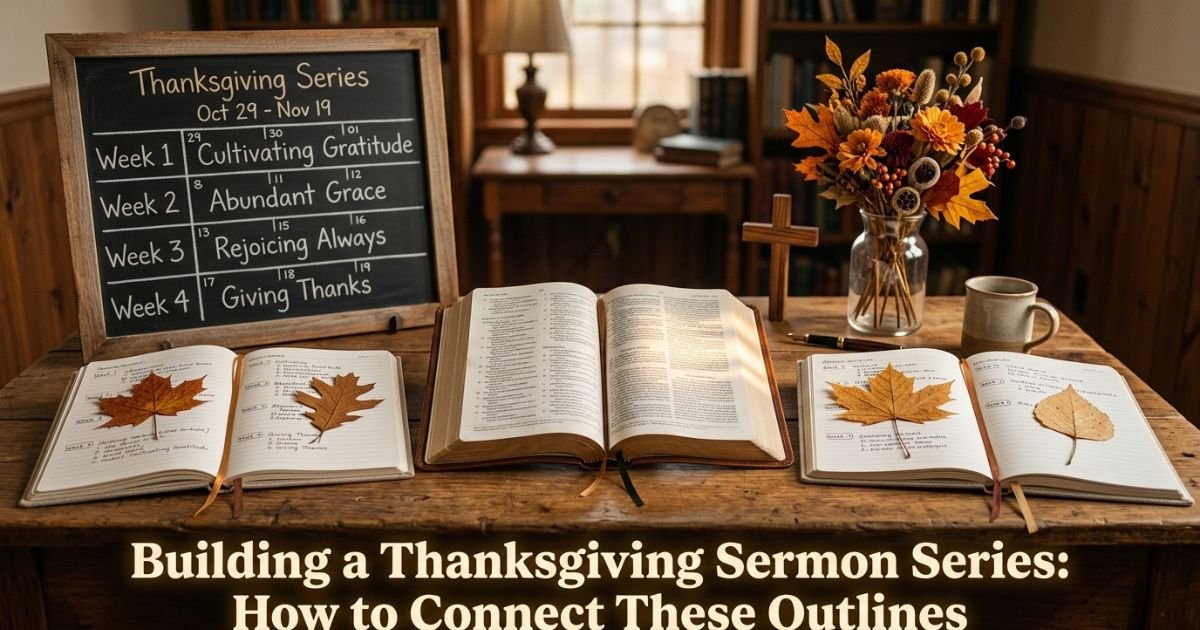
If you’re planning a multi-week series in November, here are a few natural groupings from the outlines above.
For a four-week series, consider organizing around expanding circles. Week one might focus on personal and inward gratitude, covering salvation, second chances, and God’s character. Week two could move outward to relational gratitude, exploring community, honest friendships, and the body of Christ. Week three might address gratitude in difficulty, bringing in the grief, wilderness, and unanswered prayer outlines. Week four could close with a call to a lifetime of grateful living, drawing from the daily practice and legacy outlines.
For a single Thanksgiving Sunday message with depth, outline 25 serves as an ideal standalone sermon that captures the spirit of the whole collection, while outline 5 (gratitude in the wilderness) works powerfully for a congregation carrying significant collective grief or hardship.
Practical Tips for Delivering Thanksgiving Sermons That Land Deeply
The best sermon outline in the world can fall flat if the delivery doesn’t connect with where your people actually are. Here are a few things worth considering as you prepare.
Start with honesty, not performance. Your congregation can tell the difference between a pastor who is genuinely moved by what they’re saying and one who is saying what they think they’re supposed to say. If you’re preaching on gratitude, let them hear where you’ve personally struggled with it. Vulnerability from the pulpit creates space for vulnerability in the pew.
Name the hard cases directly. There are almost certainly people in your service who are grieving, who are financially stressed, or who are carrying things that make thanksgiving feel impossible this year. Acknowledge them early. Let them know that this message is for them, not in spite of where they are, but precisely because of it.
Give them something to do before they leave. Every great sermon creates a moment of genuine heart-response. But it also gives people a specific, concrete next step. Whether it’s a journaling prompt, a name to reach out to, or a simple daily practice to begin, give your congregation something to carry out with them.
Tell real stories. The sample sermons in these outlines are structured around specific stories and observations. When you prepare your own version, replace or supplement them with stories from your own experience, your congregation’s life, or people you have walked with. Real stories, even brief ones, create the kind of emotional connection that makes sermons memorable.
Leave room for silence. In a world of constant noise, the most powerful moment in a Thanksgiving service is often a pause. A moment when you give your congregation thirty seconds to be still and actually say thank you, quietly, personally, to God. Don’t rush past that.
A Note for Pastors About Thanksgiving Preaching and Your Own Heart
This is perhaps the most important section in this entire resource, and it’s the one most sermon outline collections skip entirely.
You cannot lead your congregation somewhere you haven’t personally traveled. If you’re preaching about gratitude but you’re carrying resentment, exhaustion, or discouragement in your own heart, the words will be technically correct and emotionally hollow. Your congregation will hear the gap.
So before you use any of these outlines, use them on yourself. Take one of them and sit with it, not as a message to prepare but as a word for your own soul. Ask yourself honestly where your gratitude is genuine and where it’s performed. Ask where your thankfulness is deep and where it’s shallow. Ask what God might be pointing to in your own life before He asks you to point to it in anyone else’s.
The pastors and preachers who move congregations most deeply are the ones who arrive at the podium already moved. Who has been in the text themselves, not just above it. Who are sharing something they are living, not just preparing.
That authenticity is what your congregation most needs from you this Thanksgiving. Not a polished performance of gratitude, but a genuine one.
Frequently Asked Questions
What is the best Scripture for a Thanksgiving sermon?
Psalm 107:1 is a powerful choice: “Give thanks to the Lord, for he is good; his love endures forever.” It speaks to God’s constant goodness regardless of circumstances.
How do I preach Thanksgiving to a grieving congregation?
Acknowledge their pain openly and show that grief and gratitude can coexist. God comforts us inside our struggles, not just after them.
How long should a Thanksgiving sermon be?
Most effective Thanksgiving sermons run 25 to 35 minutes. Long enough to go deep, short enough to keep emotional engagement strong throughout.
Can I use these sermon outlines for a Thanksgiving series?
Absolutely. Group them by theme across four Sundays: personal gratitude, relational gratitude, gratitude in hardship, and lifelong thankfulness.
How do I make a Thanksgiving sermon feel emotionally real?
Share a personal story of struggle and gratitude honestly. Congregations connect deeply when their pastor speaks from lived experience, not just theology.
Conclusion
Thanksgiving is not a holiday that happens once a year. It’s a way of inhabiting your life. It’s the practice of seeing clearly, of recognizing the hand of God in ordinary and extraordinary things alike, of choosing faith over fear, praise over complaint, trust over anxiety.
The sermon outlines in this collection are meant to help you lead your congregation toward that kind of thanksgiving. Not the kind that lasts for one meal on one Thursday in November. The kind that holds in February, when the year is long, and the cold has settled in. The kind that holds in the hard diagnosis and the empty chair and the unanswered prayer. The kind that becomes, over years of faithful practice, the very posture of the soul.
Preach that kind of Thanksgiving. Your congregation needs it more than they need another pleasant seasonal message. And God, who is good all year long, deserves the praise that goes with it.