
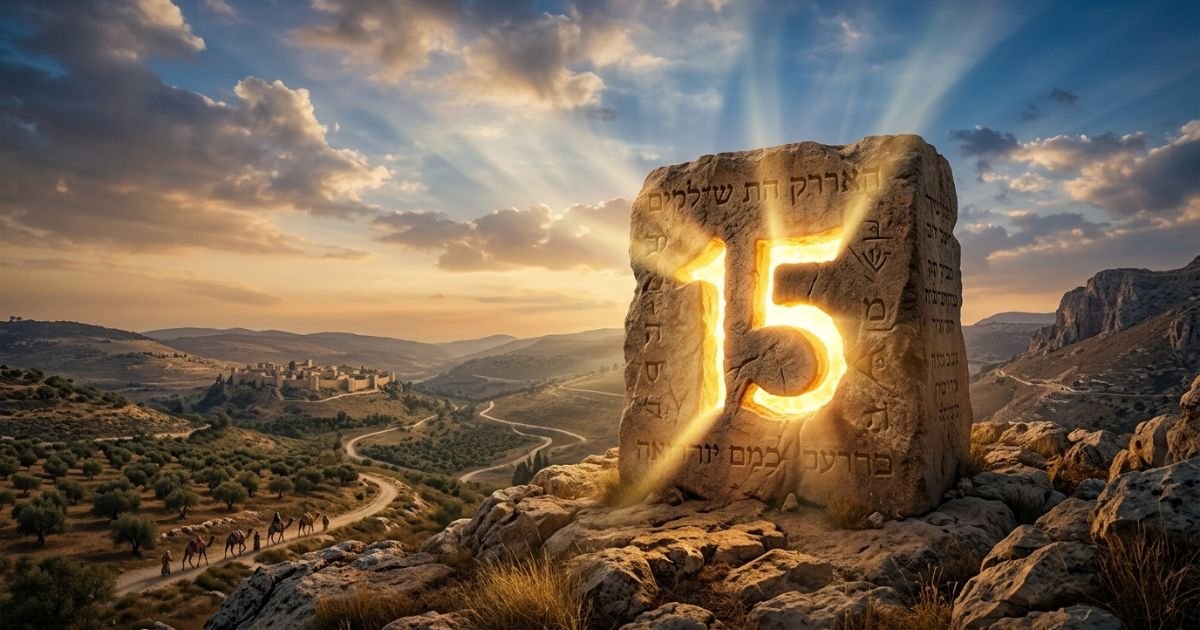

Have you ever noticed a number appearing again and again in Scripture and wondered if God was trying to tell you something? The number 15 in the Bible is one of those quietly powerful numbers that most people walk right past. But once you start looking closely, it shows up in places that will take your breath away – from the height of floodwaters to a king’s answered prayer to the very calendar of heaven’s feasts. This article walks through 50 hidden spiritual meanings of this remarkable number, and by the end, you may never read your Bible the same way again.
What Does the Number 15 Mean in the Bible? A Quick Overview

Before diving into the individual meanings, it helps to understand the foundational theme. In biblical numerology, the number 15 is most deeply connected to rest after deliverance. The number 14 often represents salvation or release, and 15 naturally follows as the breath you take after you’ve been set free. Think of it this way: after the storm comes the calm. After the crossing comes the promised rest. That pattern plays out over and over in Scripture, and it’s one of the first things that tells you this number carries real weight.
The number 15 is also the sum of the Hebrew letters yod (10) and heh (5), which together spell one of the sacred names of God. That alone should give you a moment’s pause. When a number literally spells the name of God in the original language, something deeper is going on beneath the surface.
Also READ: The Remarkable Meaning of Number 4 in the Bible Revealed
50 Hidden Spiritual Meanings of the Number 15 in the Bible
1. Rest Follows Deliverance
The most foundational meaning of the number 15 in the Bible is the arrival of rest after God rescues His people. The 15th of Nisan marked the first night of freedom for Israel as they walked out of Egypt. God didn’t just save them from slavery – He gave them a night ‘to be much observed’ (Exodus 12:42). That night of rest and wonder is the template for how God works: He rescues, and then He breathes peace into the rescued.
2. God’s Perfect Timing in the Exodus
Exodus 12:40–42 tells us that the children of Israel began their journey out of Egypt exactly 430 years after entering. They left on the 15th of Nisan. God’s precision here is staggering. Not a day early, not a day late. The spiritual meaning is clear: God is never rushing, and He is never behind. He works on a calendar that was set before the world began.
3. The Feast of Unleavened Bread Begins on the 15th
Leviticus 23:6 establishes that the Feast of Unleavened Bread begins on the 15th day of the first month, the day after Passover. The seven-day feast represented the complete removal of sin from the home and the heart. It was not just a ritual – it was a declaration that freedom from Egypt was also freedom from the corruption that Egypt represented. For believers today, this feast still whispers: you have been set free from sin, now live like it.
4. A Holy Convocation – No Ordinary Work
On the 15th of Nisan, God commanded complete rest. No laboring. No ordinary work. Just holiness (Leviticus 23:7). In a world that never stops demanding productivity, that command feels radical. The spiritual meaning here is that some moments are so sacred that the right response is simply to stop and receive. You don’t earn rest after deliverance – God gives it as a gift.
5. The Floodwaters Rose 15 Cubits
Genesis 7:20 records that the floodwaters rose 15 cubits above the highest mountains. That number meant total coverage. Nothing was exempt. Nothing was left unchanged. The spiritual significance is sobering: God’s judgment is thorough. But so is His salvation. The same God who covered every mountain also carried eight souls safely through the storm on the ark He designed.
6. God Speaks on the 15th in Genesis 15
Genesis 15 records one of the most important nights in biblical history. God appeared to Abraham after sunset and cut a covenant with him, promising that his descendants would inherit the land. Many scholars believe this vision occurred on the 15th of Nisan, the same night Israel would later walk out of Egypt. God was showing Abraham what He would do long before anyone else could see it.
7. The Covenant of Deep Sleep and Darkness
During that covenant ceremony in Genesis 15, a deep sleep fell over Abraham, and a thick, dreadful darkness surrounded him (Genesis 15:12). God then passed through the pieces of the sacrificed animals alone, signifying that He alone would uphold the covenant. The spiritual meaning is breathtaking: God made a promise He would keep by Himself, not because Abraham was perfect, but because God is faithful.
8. God’s Prophecy Fulfilled on the Same Date Centuries Later
God told Abraham in Genesis 15 vision that his descendants would be strangers in a foreign land for 400 years, but then would come out with great possessions (Genesis 15:13–14). That prophecy was literally fulfilled on the 15th of Nisan when Israel left Egypt. Same number. Same night. Same faithful God. The spiritual meaning is this: God keeps His word, and He keeps it on time.
9. The Feast of Tabernacles Begins on the 15th
Leviticus 23:34 commands that the Feast of Tabernacles (Sukkot) begins on the 15th day of the seventh month. This was the most joyful feast of all, a week-long celebration after the final harvest. God’s people built temporary shelters and lived in them, remembering the wilderness years. The spiritual message is layered: gratitude for where you are, remembrance of where God brought you from, and hope for the permanent dwelling still to come.
10. Joy Was Commanded, Not Optional
During the Feast of Tabernacles, God literally commanded His people to rejoice (Deuteronomy 16:14–15). He listed who should be included in that joy: sons, daughters, servants, strangers, orphans, and widows. Nobody was left out. The number 15 carries the spiritual DNA of inclusive joy – not the kind that comes when everything goes right, but the kind that flows from knowing you belong to a God who doesn’t forget anyone.
11. The Tabernacle Courtyard Measured 15 Cubits on Each Side of the Gate
Exodus 27:14–15 describes the hangings on either side of the Tabernacle’s entrance, each 15 cubits long. The entrance was the only way in. And the approach to God’s presence was framed by a 15-cubit boundary on each side. There’s something beautiful in that detail: God’s presence isn’t formless or random. It is structured, intentional, and beautifully designed for His people to approach Him.
12. Symmetry in the Sacred Space
Both sides of the Tabernacle gate were equal – 15 cubits each (Exodus 38:14–15). God is a God of order. The spiritual meaning here is that access to His presence is balanced and fair. There’s no side door for the privileged and a back entrance for everyone else. The same distance, the same path, the same God on the other side.
13. Hezekiah’s 15 Extra Years
This is one of the most moving stories in all of Scripture. King Hezekiah was told he was going to die. He turned his face to the wall and wept before God, reminding Him of his faithfulness. And God changed the message. He added 15 years to the king’s life (2 Kings 20:6). The spiritual meaning is both personal and powerful: prayer moves the heart of God. Your tears are not wasted. Your cries in the night are heard.
14. A Sign That Defied Natural Law
To confirm the promise of 15 more years, God caused the shadow on the sundial to move backward ten degrees (Isaiah 38:8). Think about that. God reversed a shadow to prove He had reversed a death sentence. The spiritual meaning is this: the God who controls time can certainly rewrite the timeline of your life. Nothing He has decided for you is beyond His power to adjust when you cry out to Him in faith.
15. The Psalm of Hezekiah
After his healing, Hezekiah wrote a psalm of thanksgiving recorded in Isaiah 38:10–20. It is raw and honest and beautiful. He describes feeling like someone in the prime of life who suddenly saw death coming. Then he describes the joy of returning to the land of the living. The number 15 in this story carries the spiritual meaning of testimony: when God gives you more time, use it to praise Him.
16. Hezekiah’s 29-Year Reign
Hezekiah reigned for 29 total years (2 Chronicles 29:1). The final 15 of those years were a gift – an extension of grace poured into a man who had nearly run out of time. That means almost half of his entire reign happened because he prayed. The spiritual meaning for anyone reading this is unmistakable: don’t underestimate the power of earnest prayer when you’re up against something that feels final.
17. Hosea Paid 15 Shekels to Redeem Gomer
Hosea 3:2 records one of the most emotionally striking moments in the Old Testament. Gomer, Hosea’s unfaithful wife, had sold herself into degradation. And God told Hosea to go get her back. He paid 15 shekels of silver plus some barley – a humble, imperfect price for a humbled, broken woman. The spiritual meaning is overwhelming: God does not wait for you to clean up before He comes to find you. He pays the price while you’re still in your mess.
18. Redemptive Love That Mirrors God’s Heart
The 15 shekels Hosea paid for Gomer were half the standard price of a slave (Exodus 21:32). Gomer had been devalued by sin. But Hosea redeemed her anyway. The spiritual meaning of the number 15 here is this: God’s love is not based on our market value. He redeems what the world has discarded. He pays for what no one else wanted. He calls it beloved.
19. John the Baptist’s Ministry Began in the 15th Year of Tiberius
Luke 3:1 places the beginning of John the Baptist’s ministry precisely in the 15th year of Tiberius Caesar’s reign. Luke’s careful historical precision is telling us something important: this was not mythology. This was history. The ministry that would prepare the way for Jesus Christ broke into the world on a specific, dateable day. The spiritual meaning is that God enters human history in real time, with real names, in real places.
20. The Voice Crying in the Wilderness
John’s ministry launched in the wilderness, and it shook the religious establishment of an entire nation. This came in the 15th year. The spiritual meaning here ties back to the broader theme of the number: a new season of deliverance was beginning. The rest that 15 represents was coming – not the rest of inactivity, but the deep soul-rest that only Jesus can give.
21. Bethany Was About 15 Stadia from Jerusalem
John 11:18 notes that Bethany was about 15 stadia (roughly two miles) from Jerusalem. This small detail is the backdrop for the most dramatic miracle in the Gospels – the raising of Lazarus. Jesus walked that road knowing exactly what He was going to do. The spiritual meaning is that Jesus does not avoid the places of death and grief. He walks toward them, not away from them.
22. The Place of Resurrection Was Just 15 Stadia Away
Because Bethany was so close to Jerusalem, the news of Lazarus’s resurrection spread rapidly into the city. It changed the trajectory of Holy Week. The spiritual meaning is quietly powerful: sometimes the miracle that changes everything is closer than you think. It’s just 15 stadia away. God’s answer is not always far off.
23. Jesus Took His Last Steps Toward Bethany
Luke 24:50 records that the last place Jesus walked to before His ascension was the vicinity of Bethany. He lifted His hands and blessed His disciples, and then He was taken up into heaven. The spiritual meaning is that Jesus’ final earthly gesture was one of blessing – not judgment, not instruction, just blessing. And it happened near Bethany, that village 15 stadia away.
24. The Ship Found Water at 15 Fathoms
Acts 27:28 describes the terrifying storm at sea during Paul’s voyage to Rome. The sailors took soundings and found the water was 20 fathoms deep, then shortly after 15 fathoms, which told them land was dangerously near. They dropped anchors and prayed for dawn. The spiritual meaning here is that even the scariest moments can be navigated when God is in the vessel with you. Paul had already told everyone no lives would be lost (Acts 27:22), and none were.
25. Anchors Dropped While Praying for Dawn
When the depth reached 15 fathoms, the sailors dropped four anchors and prayed for daylight. The number 15 in this story carries the spiritual meaning of holding steady when the storm rages. The anchor holds while you wait for morning. That picture in Acts 27 is exactly what Hebrews 6:19 was talking about when it described hope as an anchor for the soul.
26. Numbers Chapter 15 and the Law of Offerings
Numbers 15 lays out specific laws for offerings that Israel would make once they entered the Promised Land. God gave these instructions while the people were still in the wilderness, still wandering. The spiritual meaning is that God was already preparing them for the blessing before they arrived. He was setting up the framework of worship for a place they hadn’t yet seen.
27. One Law for All – Native and Stranger Alike
Numbers 15:15 explicitly states that the law applies equally to native Israelites and to foreigners living among them. God is no respecter of persons. The spiritual meaning of the number 15 in this passage is unity under grace. The same God. The same rules. The same access. That principle doesn’t belong only to the Old Testament – it runs through the entire Bible like a golden thread.
28. The Man Who Gathered Sticks on the Sabbath
Numbers 15:32–36 records the sobering account of a man found gathering wood on the Sabbath. God declared he must die. This is hard for modern readers, but the spiritual meaning is that God takes the covenant seriously. The Sabbath was a sign of the covenant. To break it openly was to publicly reject the relationship. The number 15 chapter teaches that belonging to God means living as it matters.
29. Tassels on the Garments – A Constant Reminder
Numbers 15:38–40 closes the chapter with God commanding tassels on the corners of garments, with a blue cord in each. Every time an Israelite looked down, they saw the reminder: you belong to Me, obey My commands, don’t follow your own wandering heart. The spiritual meaning is that God understands our tendency to forget. He built reminders into the fabric of daily life.
30. Blue Like Heaven
The blue cord in the tassels of Numbers 15 was not just decorative. Blue was the color of the sky, of heaven, of God’s throne room. The spiritual meaning is that Israel’s calling was heavenly in origin. They weren’t just following a human set of rules – they were living as citizens of heaven on earth. That identity-in-fabric foreshadowed what Paul would later write in Philippians 3:20 about our citizenship being in heaven.
31. Purim Celebrated on the 15th of Adar
Esther 9:18–19 records that the Jews of Susa celebrated their deliverance from Haman’s murderous plot on the 15th day of Adar. The rest of the Jewish world celebrated on the 14th, but those in the walled city of Susa got one more day of battle, and so their celebration came one day later. The spiritual meaning is that deliverance looks different for different people. Your version of the 15th might not look like someone else’s. But it still counts.
32. God’s Hidden Hand in Esther
The book of Esther never mentions God by name. Not once. Yet the story is one of the most dramatic displays of divine providence in all of Scripture. The 15th of Adar became a feast day precisely because God was working invisibly behind every royal decree, every sleepless night, every brave act. The spiritual meaning is that even when God seems silent, He is not absent.
33. Sending Gifts and Giving to the Poor on the 15th
Esther 9:22 describes Purim as a time of sending food portions to one another and gifts to the poor. The celebration of deliverance was inseparable from generosity. The spiritual meaning is that when God rescues you, the natural overflow is a desire to bless others. True gratitude cannot be contained. It spills outward.
34. The 15th Psalm – A Portrait of the Person Who Walks with God
Psalm 15 opens with a direct question: ‘Lord, who may dwell in your sacred tent? Who may live on your holy mountain?’ Then it lists the characteristics of such a person – someone who walks blamelessly, speaks truth, keeps promises even when it hurts. The spiritual meaning of the number 15 in this psalm is that closeness to God is connected to the integrity of life. It’s not about perfection – it’s about direction.
35. Blameless Walking
Psalm 15:2 begins the portrait with ‘the one who walks blamelessly and does what is right.’ The spiritual meaning is that the life of faith is described as walking, not running, not performing, just walking. Consistently. One step at a time. The number 15 here carries the invitation to a steady, honest life in the presence of God.
36. The Person Who Honors Those Who Fear God
Psalm 15:4 describes someone who honors those who fear the Lord while despising what is vile. The spiritual meaning is that your relationships reveal your values. Who you celebrate says something about who you are. The 15th Psalm is a full picture of a person shaped by the presence of God.
37. The 15 Steps of the Temple
In Jewish tradition, there were 15 steps leading up to the inner court of the Temple in Jerusalem. The Levitical choir would sing the 15 Songs of Ascent (Psalms 120–134) on those steps during the Feast of Tabernacles – one psalm per step. The spiritual meaning is that worship is a journey. It takes you somewhere. Each step closer to the presence of God is its own song.
38. The 15 Songs of Ascent
Psalms 120 through 134 are called the Songs of Ascent – 15 psalms that pilgrims sang as they climbed toward Jerusalem and toward the Temple. These are songs of longing, trust, community, and hope. They cover homesickness, marital blessing, trust in God’s protection, and the joy of arriving at God’s house. The number 15 in this collection carries one of the richest spiritual meanings in all of Scripture: the journey toward God is itself a form of worship.
39. Psalm 121 – Help Comes from the Lord
Among the 15 Songs of Ascent, Psalm 121 stands out for its sheer comfort: ‘I lift my eyes to the mountains – where does my help come from? My help comes from the Lord, the Maker of heaven and earth.’ For pilgrims trudging upward on dusty roads, those words were survival. The spiritual meaning is that the 15-step climb toward God is never something you do alone.
40. Psalm 133 – How Good It Is When Brothers Dwell Together
Psalm 133, the 14th of the 15 Songs of Ascent, celebrates unity among brothers. ‘How good and pleasant it is when God’s people live together in unity.’ The spiritual meaning is that community is not optional to faith – it’s one of the songs on the way to God’s presence. The number 15 frames this psalm as part of a larger journey toward wholeness.
41. Paul Visited Peter for 15 Days
Galatians 1:18 records that after his conversion, Paul went to Jerusalem and stayed with Peter for 15 days. This was not a casual visit. Paul was learning from the man who had walked with Jesus, eaten with Him, watched Him die, and seen Him risen. The spiritual meaning of this 15-day stay is that transformation takes time and relationship. Even the great apostle sat at someone’s table and listened.
42. The Foundation of the Gospel in 15 Days
During those 15 days with Peter, Paul was building something that would eventually support his entire apostolic mission. The spiritual meaning is that personal discipleship matters. You can’t shortcut the time spent with people who know God deeply. Whatever Paul became, those 15 days were part of the formation.
43. 1 Corinthians 15 – The Resurrection Chapter
1 Corinthians 15 is arguably the most theologically important chapter in the New Testament. It contains Paul’s fullest explanation of the resurrection: why it happened, what it means, and why it changes everything. The number 15 in the Bible’s most comprehensive resurrection passage is not an accident – it speaks to the core theme of the number. Death is not the end. Rest follows deliverance. New life comes after the grave.
44. Christ Appeared to More Than 500 at Once
In 1 Corinthians 15:6, Paul mentions that Jesus appeared to more than 500 people simultaneously after His resurrection. Paul adds that most of them were still alive when he wrote the letter – meaning they could be questioned. The spiritual meaning is that the resurrection is not a fairy tale. It is historical. Verifiable. Real. And 1 Corinthians 15 is the chapter that says so plainly.
45. The Last Enemy Destroyed Is Death
1 Corinthians 15:26 declares: ‘The last enemy to be destroyed is death.’ The spiritual meaning of this verse in the 15th chapter carries the full weight of the number’s biblical theme – deliverance ultimately ends with the complete, final abolition of what has always tried to stop us. Death itself will die. Rest will be complete and permanent.
46. The Seed That Dies and Rises
1 Corinthians 15:36–38 uses the image of a seed planted in the ground to explain the resurrection. The seed doesn’t become a plant without dying first. The spiritual meaning is that transformation always involves a death of some kind. But what comes up from the ground is more glorious than what went in. The number 15 frames this as a comfort: something better is coming.
47. The Feast of Tabernacles and the Millennial Reign
Zechariah 14:16–19 prophecies that during Christ’s future reign on earth, all nations will come to Jerusalem every year to celebrate the Feast of Tabernacles, which begins on the 15th of the seventh month. The nations that refuse will receive no rain. The spiritual meaning of 15 here is eschatological: the number associated with rest and divine dwelling isn’t finished with history. It’s pointing toward the ultimate rest, the Millennium, when God Himself dwells with His people permanently.
48. The Name Zaphnathpaaneah Has 15 Letters
Pharaoh renamed Joseph ‘Zaphnathpaaneah’ in Genesis 41:45. That name contains 15 letters. It’s a small detail that most people skip right over. But Joseph himself was a picture of salvation – rejected by his brothers, sold into slavery, falsely imprisoned, and then raised to the highest position in the land to save the very people who had rejected him. The number 15 hovering over his Egyptian name quietly underscores his role as a type of Christ.
49. 15 Promises for Christians in the Book of Matthew
A careful study of the Gospel of Matthew reveals at least 15 specific promises made to those who follow Christ. They range from the Kingdom of Heaven (Matthew 5:3) to ‘I am with you always’ (Matthew 28:20). The number 15 in Scripture often marks moments of divine promise – and Matthew’s collection of 15 such promises is one of the richest treasuries in the New Testament for the believer’s heart.
50. God’s Name Encoded in the Number Itself
This final meaning may be the most profound of all. In ancient Hebrew, the number 15 is represented by the letters yod (10) and heh (5). Together, these two letters form ‘Yah’ – one of the sacred names of God Himself. It appears in words like ‘hallelujah,’ which literally means ‘praise Yah.’ Every time the number 15 appears in Scripture, it carries a whisper of the divine name. The number itself is a fingerprint of God.
Why Does the Number 15 Keep Appearing in Scripture?

If you’ve read this far, you’ve probably noticed the pattern. The number 15 in the Bible is not random. It clusters around the same themes: divine rescue, holy rest, feasts of joy, answered prayer, and the presence of God among His people. These aren’t coincidences – they’re what you’d expect from a God who designed both language and mathematics and wove His fingerprints into both.
Biblical numerology is not about finding hidden codes or predicting the future. It’s about seeing more of who God is in the details He chose to preserve in Scripture. When you notice that the 15th of Nisan was the night of freedom, the night Abraham received the covenant vision, and the night Jesus lay in the tomb after the cross, you’re not seeing a coincidence. You’re seeing a God who thinks in patterns and keeps His promises across centuries.
Also READ: 75 Bible Verses About the Consequences of Disobedience
What the Number 15 Means for Your Life Today
Here’s the thing. These 50 spiritual meanings aren’t just interesting Bible trivia. They carry something for your actual life right now.
If you’re in a season that feels like the 14th day – like the struggle isn’t over yet, like the hardest moment is still at hand – then the number 15 is a promise. Rest is coming. Deliverance is real. God has a 15th day in your story.
If you’re waiting for an answered prayer like Hezekiah waited, turning your face to the wall in desperation, let his story remind you that God hears tears. He’s not unmoved by yours.
If you feel like Gomer, broken and far from home, and worth less than you used to be, the number 15 says God pays the price for people the world has written off. He paid it at the cross, and He’s not taking it back.
The number 15 in the Bible is ultimately a number about God’s faithfulness across time. It says: He was there at the beginning, He is here in the middle, and He will be there at the end. And the end – for those who belong to Him – is not death. It’s rest.
Frequently Asked Questions About the Number 15 in the Bible
What is the biblical meaning of the number 15?
The number 15 in the Bible primarily represents rest following deliverance. It appears on key dates in Israel’s sacred calendar, in moments of miraculous healing and rescue, and in prophetic passages pointing toward the ultimate rest of God’s coming kingdom. It also numerically encodes one of God’s sacred names in Hebrew.
What does 15 mean spiritually?
Spiritually, 15 carries the meaning of divine completeness in the area of rescue and peace. It signals that God’s work of deliverance has moved into its next phase – not just freedom from bondage, but the peaceful rest that comes on the other side of it.
Why is the Feast of Unleavened Bread on the 15th?
The Feast of Unleavened Bread begins on the 15th of Nisan immediately after Passover, which falls on the 14th. The 14th represented salvation through the blood of the Passover lamb. The 15th marked the beginning of the journey out of Egypt – freedom in motion, rest in progress.
Is 15 a significant number in both testaments?
Yes. The number 15 carries significance throughout the entire Bible. In the Old Testament, it marks sacred feast days, divine covenants, answered prayers, and acts of redemption. In the New Testament, it frames the beginning of John the Baptist’s ministry, key moments in Paul’s apostolic journey, the location of Lazarus’s resurrection, and the great resurrection chapter of 1 Corinthians 15.
What are the 15 Songs of Ascent?
The 15 Songs of Ascent are Psalms 120–134. They were sung by pilgrims as they journeyed to Jerusalem for the three annual feasts, climbing the 15 steps into the Temple courts. Each psalm is a song of trust, longing, community, and praise.
Conclusion
The number 15 in the Bible carries 50 layers of meaning, and we’ve only just walked through them together. But if you set all 50 aside and keep just one thing, let it be this: God is a God who delivers and then gives rest. He doesn’t just rescue you from one thing – He rescues you into something better. Into peace. Into His presence. Into feasts of joy and seasons of singing.
Every time that number appears in Scripture – on a sacred calendar, in the height of floodwaters, in the depth of a sailor’s soundings, in the shekels a prophet paid for his wandering wife – it’s saying the same thing. God has not forgotten. God is on time. God is faithful to the people who bear His name.
You are one of those people. And there is a 15th day in your future.

Welcome to Blessing Bloom. I’m Ahsan Ali, founder of BlessingBloom.com a faith-based website dedicated to sharing prayers, blessings, and heartfelt wishes. Based in Islamabad, Pakistan, I created Blessing Bloom to help people find the right words during life’s most meaningful moments. With a background in Information Technology, I combine a passion for digital content with a genuine love for faith-inspired writing.