

Finding the right motivation synonym can change how you write, speak, and even think about success. Whether you’re a student, a professional, or someone trying to push through a rough season of life, understanding the words behind motivation helps you connect with your own drive more deeply. This guide breaks down every major synonym, meaning, type, and real-life example in a way that’s simple, honest, and genuinely useful for you.
What Does “Motivation” Mean?
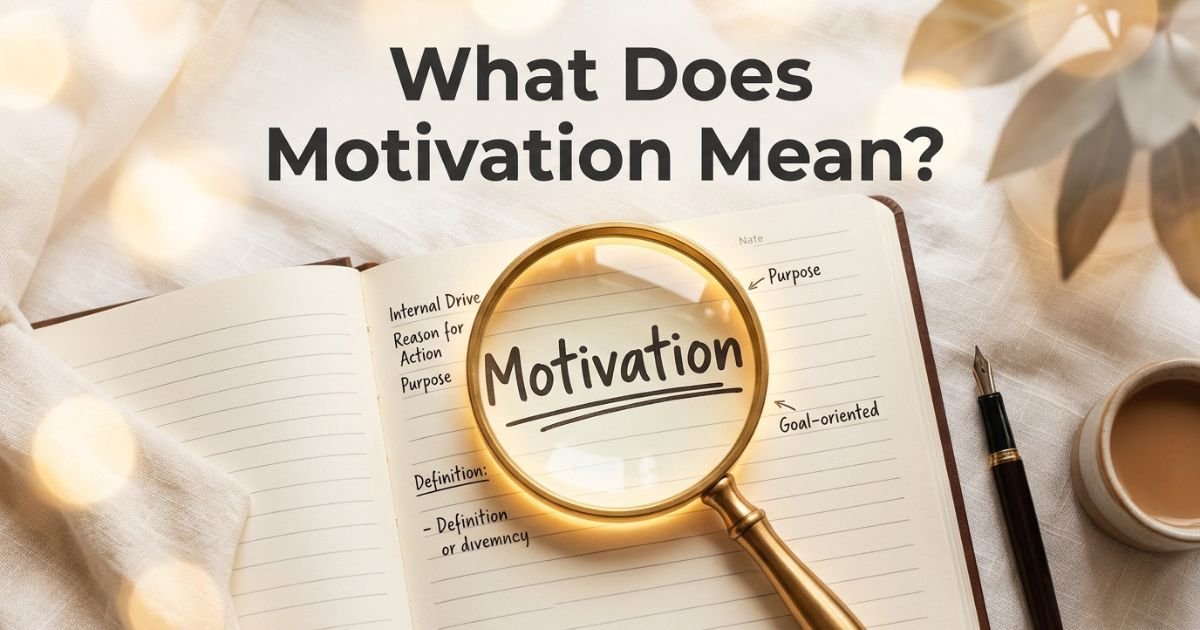
The word “motivation” gets used everywhere, but its actual meaning runs deeper than most people realize.
At its core, motivation is the internal or external force that starts, guides, and sustains your behavior toward a goal. It’s not just a feeling of excitement. It’s the psychological engine behind every decision you make, every habit you build, and every obstacle you push through.
Here’s what makes the definition worth understanding:
- It’s both a feeling and a force. Motivation isn’t just about feeling pumped up. It includes the quiet, steady determination that keeps you going even when nothing feels exciting. That persistence is motivation working at its most honest level.
- It has direction and intensity. According to basic motivation psychology, two things define how motivated someone is: where they’re aiming (direction) and how hard they’re pushing (intensity). You can be highly motivated in the wrong direction or weakly motivated in the right one. Both matter.
- It’s rooted in need and desire. Motivation always begins somewhere. Hunger, ambition, fear, curiosity, love, these are all needs or desires that activate motivational energy. When a need exists, motivation rises to meet it.
- It can be conscious or unconscious. Sometimes you know exactly why you’re working hard. Other times, deeper emotional or psychological forces are driving your behavior without you fully realizing it. That’s why motivation psychology is such a rich and important field of study.
Understanding motivation meaning at this level helps you use the right words, apply the right strategies, and recognize what’s actually fueling your actions.
Best Synonyms for Motivation
Not every word for motivation carries the same weight or meaning. Some are stronger, some more poetic, and some more precise, depending on what you’re trying to express.
Here are the best and most widely used motivation synonyms, with a clear breakdown of what each one really means:
- Drive: This is the closest synonym to motivation in everyday use. Drive refers to a strong internal push toward achievement. It suggests raw energy and persistence. When someone says “she has incredible drive,” they mean she keeps going no matter what.
- Ambition: Ambition adds a layer of aspiration and long-term vision. It’s not just about doing something now. It’s about wanting to become something. Ambition’s meaning includes a forward-reaching hunger for achievement, status, or improvement.
- Determination: This word focuses on resolve. Determination synonym territory covers words like resolve, grit, and tenacity. It’s what keeps you going when motivation as a feeling has faded.
- Zeal: Zeal is motivation with fire. It carries a sense of passionate devotion or enthusiastic energy. Zeal definition often includes religious or moral fervor, but it applies equally to any pursuit you care deeply about.
- Inspiration: Inspiration is the spark that lights motivation. While motivation sustains, inspiration ignites. The two work together, but inspiration is often the emotional trigger that gets things started.
- Incentive: An incentive is an external reason to act. It could be a reward, a bonus, or any outcome that makes the effort worthwhile. Incentive motivation is common in workplaces and educational settings.
- Impetus: Impetus is a slightly more formal word meaning the force or energy behind a movement or action. It’s often used in professional writing to describe what triggered a decision or change.
- Purpose: Purpose is motivation with meaning attached. When someone has purpose, they aren’t just moving toward a goal. They believe the goal matters. Purpose-driven motivation tends to be the most durable of all.
- Desire: Desire is an emotionally charged motivation. It’s rooted in wanting something deeply, whether that’s success, connection, freedom, or growth.
- Stimulus: A stimulus is something that provokes a reaction or triggers action. It comes from behavioral psychology and refers to any external cue that activates motivated behavior.
- Encouragement: Encouragement is motivation offered by others. When someone believes in you out loud, that’s encouragement. It fuels your own internal drive by reflecting belief back at you.
- Enthusiasm: Enthusiasm is motivation expressed with energy. It’s visible, contagious, and powerful. Enthusiasm’s meaning includes keen interest and energetic engagement with what you’re doing.
- Passion: Passion is a deep, emotionally resonant motivation. It’s what makes work feel less like work. Passion tends to be intrinsic and long-lasting when it’s genuine.
- Willpower: Willpower is motivation applied against resistance. It’s the deliberate decision to keep going when your feelings say stop. Willpower explanation often overlaps with self-discipline and self-regulation.
- Enterprise: Enterprise, as a motivation synonym, refers to initiative and readiness to take on challenges. It’s commonly used in professional or leadership contexts.
- Urge: An urge is a short-term, often intense impulse toward action. Unlike purpose, it may not be deeply thought out. But urges can be early signals of deeper motivational needs.
- Instinct: Instinct-driven behavior is motivation that bypasses conscious thought. It’s primal and immediate, rooted in survival or deeply ingrained patterns.
- Perseverance: While not always listed as a direct synonym, perseverance is the sustained form of motivation. It’s the ability to stay in motion even without immediate reward or visible progress.
Motivation Synonyms by Context
The right motivation synonym depends on where and how you’re using it. Context shapes meaning, and choosing the wrong word can weaken your message.
Here’s how different synonyms work best in specific settings:
- In Academic or Essay Writing: Words like “impetus,” “incentive,” and “determination” carry more intellectual weight. They signal precision and awareness of motivational psychology. Avoid casual words like “push” or “spark” in formal writing.
- In Personal Development Content: “Drive,” “ambition,” “purpose,” and “passion” resonate most in self-improvement and growth contexts. These words feel personal and aspirational. They connect with readers who are actively working on themselves.
- In Professional or Business Writing: “Incentive,” “enterprise,” “goal-oriented behavior,” and “performance motivation” are the right tools here. These terms align with workplace motivation strategies and organizational psychology.
- In Emotional or Mental Health Contexts: “Encouragement,” “desire,” “willpower,” and “emotional drive” fit best. These words acknowledge the real human experience behind motivation, including when it’s hard to find or maintain.
- In Creative or Spiritual Writing: “Zeal,” “inspiration,” “passion,” and “calling” carry deeper resonance. They connect motivation to something beyond the practical, touching the emotional and even spiritual dimensions of human drive.
- In Psychology or Scientific Writing: Use technically grounded terms like “stimulus,” “arousal,” “behavioral motivation theory,” or “cognitive drive theory.” These signals credibility and match the expectations of informed readers.
- For SEO and Content Writing: “Motivation synonym,” “drive synonym,” and “ambition synonym” are all strong short-tail variants. Mixing these naturally with LSI keywords improves both readability and search performance without forced repetition.
Words That Mean “Encouragement” or “Drive”
Sometimes, the best motivation synonym isn’t about personal power. It’s about the fuel others give you.
Words related to encouragement and drive capture the relational side of motivation, the part that comes from outside yourself. These are important both in writing and in life.
- Encouragement: This is perhaps the most emotionally warm word in the motivation vocabulary list. Encouragement meaning covers support, belief, and verbal reinforcement. It tells someone, “You can do this.” Research consistently shows that encouragement from others plays a powerful role in sustaining intrinsic motivation over time. Think about how a father’s belief in his child shapes that child’s confidence for life. That kind of love and family drive is one of the earliest and most lasting forms of encouragement any person can receive.
- Inspiration: Inspiration and motivation are siblings, not twins. Inspiration is a moment of awakening. It’s what happens when you hear a story, see an example, or read a quote that makes something click inside you. It activates your drive.
- Support: Support as a motivational word, emphasizes relationship. When people feel supported, they’re more willing to take risks and persist through difficulty. Emotional support is one of the strongest extrinsic motivators known to psychology.
- Affirmation: Affirmations are statements of belief in someone’s worth or ability. They work internally (self-affirmation) and externally (affirmation from others). Both have measurable effects on motivation and confidence-building.
- Reinforcement: In behavioral psychology motivation, reinforcement is any response to a behavior that increases the likelihood of that behavior happening again. Positive reinforcement is especially powerful in habit formation and goal-setting.
- Stimulation: When your environment, relationships, or experiences excite your curiosity and energy, that’s stimulation. It can reignite motivation that has gone quiet, especially in creative or professional settings.
- Empowerment: Empowerment is encouragement elevated. It doesn’t just tell you that you can do something. It gives you the tools, belief, and permission to act. Empowered people tend to show stronger intrinsic motivation and better long-term results.
- Provocation: This word carries a slightly edgier energy. In a healthy context, provocation can be the challenge or spark that pushes you out of comfort and into action. Some people are motivated most powerfully when they’re told something is too hard for them.
Intrinsic vs Extrinsic Motivation
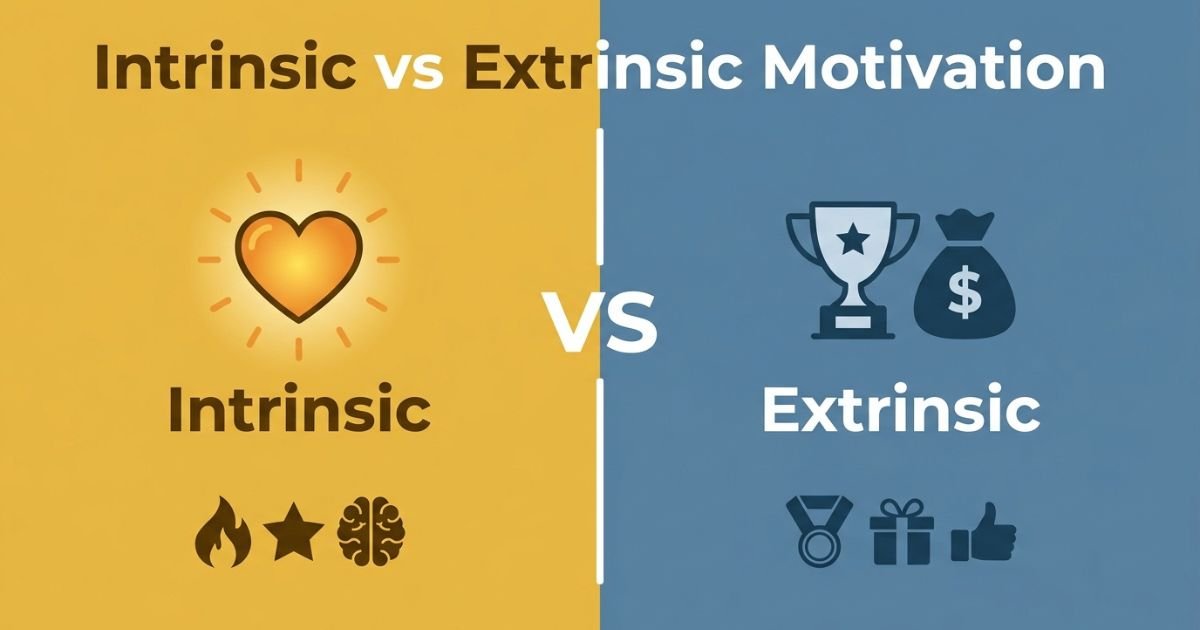
Understanding the difference between intrinsic and extrinsic motivation isn’t just academic. It’s one of the most practical insights you can use to improve how you work, learn, and grow.
- Intrinsic motivation comes from within. It’s driven by personal interest, genuine curiosity, or the natural satisfaction of doing something well. Intrinsic motivation examples include studying a subject because you love it, exercising because it makes you feel strong, or creating art because self-expression matters to you. This type of motivation tends to produce deeper engagement, higher creativity, and more lasting commitment.
- Extrinsic motivation comes from outside yourself. It’s driven by rewards, recognition, pressure, or consequences. Extrinsic motivation’s meaning includes working for a salary, studying to pass an exam, or exercising to meet a social expectation. While extrinsic motivation can be very effective in the short term, it often fades when the external reward disappears.
- The key tension: Many psychologists note that over-relying on external rewards can actually reduce intrinsic motivation. This is called the “overjustification effect.” When you start getting paid for something you used to love, the love can quietly disappear.
- They work best together: In real life, most motivated behavior involves a mix of both. You might pursue a career because it pays well (extrinsic) and because you genuinely enjoy the work (intrinsic). Recognizing which force is dominant helps you understand your behavior and make smarter choices.
- For sustainable motivation: Research in motivation psychology consistently shows that building intrinsic motivation is the more durable strategy. Finding personal meaning, autonomy, and satisfaction in what you do creates a self-reinforcing cycle that external pressure simply cannot replicate over the long term.
- A practical test: Ask yourself why you’re doing something. If the honest answer is “because I want to” or “because it matters to me,” that’s intrinsic. If the honest answer is “because I have to” or “because I’ll get something,” that’s extrinsic. Neither is inherently wrong, but knowing the difference helps you manage your energy wisely.
The 4 Main Types of Motivation
Motivation isn’t one-size-fits-all. Psychologists have identified several distinct types, each operating through different mechanisms and serving different needs.
- Intrinsic Motivation This is motivation that lives inside you. It’s the drive that doesn’t need a reward because the activity itself is the reward. Intrinsic motivation is associated with flow states, deep learning, and genuine passion. Students who are intrinsically motivated tend to learn more thoroughly. Athletes who are intrinsically motivated tend to train harder and bounce back faster from setbacks. It’s the gold standard of motivational drive, difficult to manufacture but deeply powerful when it’s real.
- Extrinsic Motivation Extrinsic motivation operates through external outcomes. Salaries, grades, praise, trophies, and social approval are all extrinsic motivators. This type is useful, especially for starting new behaviors or maintaining short-term performance. But it requires ongoing maintenance. Remove the reward, and the behavior often follows. The most effective use of extrinsic motivation is as a bridge, something that gets you moving until intrinsic motivation has time to develop.
- Identified motivation. Identified motivation is a bridge between extrinsic and intrinsic. It happens when you don’t personally love an activity, but you genuinely value the outcome. A student who dislikes studying but deeply values becoming a doctor is experiencing identified motivation. The behavior is externally framed but internally endorsed. This type of motivation is much more sustainable than pure extrinsic motivation because the “why” feels personally meaningful.
- Introjected Motivation Introjected motivation is driven by internal pressure rather than genuine personal value. It’s the kind of motivation that comes from guilt, shame, ego protection, or fear of embarrassment. You exercise not because you love it or even because you value health, but because you’d feel bad about yourself if you didn’t. Introjected motivation can produce results, but it tends to be emotionally costly and fragile over time. Building healthier motivational patterns often means slowly shifting from introjected to identified or intrinsic motivation.
Motivation Theory Explained
Motivational psychology has produced some genuinely useful frameworks for understanding why people act and what drives behavior change.
Here are the most important theories explained simply:
- Maslow’s Hierarchy of Needs: Abraham Maslow proposed that human motivation operates in a hierarchy. Basic survival needs come first (food, safety), followed by social needs (belonging, love), and finally higher needs (esteem, self-actualization). You can’t reliably pursue ambition and personal growth if you’re still fighting for basic safety or connection. This theory is foundational to understanding why motivation looks so different from person to person based on their life circumstances.
- Expectancy Theory: This theory, developed by Victor Vroom, says motivation is shaped by three beliefs: Do I expect my effort to lead to a result? Do I expect that result to lead to a reward? Do I actually value the reward? If any of these three links is weak, motivation drops. This explains why telling someone to “just try harder” rarely works when they don’t believe trying harder will change anything.
- Goal Setting Theory: Edwin Locke and Gary Latham found that specific, challenging goals produce higher performance than vague or easy ones. “Do your best” is actually one of the weakest motivational instructions you can give. Clear, measurable goals with real difficulty create the best conditions for sustained drive and action.
- Self-Determination Theory (SDT): Developed by Deci and Ryan, SDT argues that humans have three core psychological needs: autonomy (feeling in control), competence (feeling capable), and relatedness (feeling connected to others). When these needs are met, intrinsic motivation flourishes. When they’re blocked, motivation weakens, and psychological well-being suffers.
- Cognitive Drive Theory: This framework emphasizes curiosity and the desire to understand as primary motivators. People are motivated by intellectual gaps, problems to solve, and new information that challenges their existing beliefs. In educational and creative contexts, this theory explains why interesting challenges are more motivating than easy ones.
- Behavioral Motivation Theory: Rooted in behaviorism, this approach focuses on stimulus and response. Behavior is shaped by its consequences. Reward a behavior, and it increases. Punish it, and it decreases. While this theory has been criticized for being overly simplistic, it remains highly practical for habit formation and behavior change programs.
Examples of Motivation in Real Life
Motivation doesn’t live in textbooks. It shows up in everyday moments, quiet decisions, and the long stretches between inspiration and achievement.
Here are real-life examples that illustrate how motivation actually operates:
- The early morning workout: A person sets their alarm for 5 AM even though they’re tired, cold, and could easily stay in bed. That’s intrinsic motivation in action, driven by how exercise makes them feel, not by anyone watching or rewarding them. Over time, this behavior becomes habitual, but the early catalyst was a genuine internal desire.
- The student studying without being told: A high school student spends weekend hours reading beyond the required curriculum because they’re fascinated by the subject. No exam is pushing them. No parent is watching. This is identified motivation blending into intrinsic, and it’s the kind that produces true mastery.
- The employee going above expectations: Someone at work consistently delivers more than their job description requires, not because of a bonus but because they take pride in quality. That’s achievement motivation at work, the deep satisfaction of doing something well.
- The person starting therapy: Deciding to see a counselor or pursue behavioral therapy for motivation issues requires courage and self-awareness. The desire to improve, even when it’s uncomfortable, is a powerful form of goal-oriented behavior driven by personal values.
- The parent learning a new skill for their child: A parent who has never had an interest in technology decides to learn coding or music because their child loves it. Relational motivation is real and strong. Love creates drive in ways that career goals often can’t. Whether it shows up in parenting, friendship, or love and relationship motivation shared between two people building a life together, connection is one of the most powerful fuels for sustained action.
- The entrepreneur rebuilding after failure: Someone who loses a business and starts again has to dig deep past fear, shame, and exhaustion to find renewed purpose. That second-wind drive is some of the most powerful motivations that exists, forged by loss and fueled by meaning.
- The recovering person maintaining a healthy habit: Someone overcoming addiction, depression, or burnout who shows up for their routine day after day, even when it doesn’t feel good, is demonstrating willpower and introjected-to-identified motivation in real time.
- The writer finishing the draft: Any creative person who pushes through the “ugly middle” of a project to completion knows exactly what motivation feels like when the excitement is gone, and only discipline remains. That’s motivation at its most honest and most necessary.
How to Find Motivation and Stay Consistent
Finding motivation is one thing. Staying consistent is another challenge entirely, and it’s where most people struggle.
Here’s what actually works, based on psychology and honest experience:
- Start with your “why.” Before building any habit or chasing any goal, get clear on the real reason behind it. A surface-level why (I want to lose weight) is easy to abandon. A deep why (I want to be healthy enough to be present for my children’s lives) has staying power. Many people also find that spiritual strength and purpose through prayer and faith gives their goals a meaning that no career target ever could. Purpose-driven motivation is the most durable kind.
- Lower the entry barrier. One of the biggest motivation killers is making starting feel too hard. If you want to exercise daily, don’t begin with a 90-minute workout. Begin with 10 minutes. Consistency builds momentum, and momentum rebuilds motivation. Start small enough that there’s no excuse not to begin.
- Design your environment. Motivation is easier when your environment supports the behavior you want. Leave your gym bag by the door. Keep healthy food visible. Remove friction. Behavioral psychology motivation research consistently shows that the environment shapes behavior as much as willpower does.
- Track progress visibly. When you can see how far you’ve come, it reinforces effort and activates achievement motivation. A simple journal, habit tracker, or checklist creates a visual record of consistency that the brain finds genuinely rewarding.
- Use implementation intentions. Research shows that saying “I will do X at Y time in Z place” dramatically increases follow-through compared to vague intentions. “I’ll go to the gym on Monday mornings at 7 AM before work” is five times more likely to happen than “I’ll try to work out more.”
- Connect with accountable people. Social reinforcement is a powerful motivator. Finding a workout partner, study group, or professional community creates an external structure that supports your internal drive during the days when it’s running low.
- Manage your energy, not just your time. Motivation fluctuates with sleep, nutrition, stress, and emotional load. Protecting your physical health isn’t just about wellness. It’s a direct investment in your motivational capacity. Tired, depleted people consistently struggle to find and sustain drive.
- Allow imperfect days. Perfectionism quietly kills consistency. If you miss a day and then decide the streak is broken, so nothing matters anymore, that’s an all-or-nothing thinking pattern, not a motivation problem. Give yourself permission to be inconsistent occasionally without treating it as failure.
- Reconnect with past wins. When motivation is low, reviewing evidence of your past successes rebuilds confidence and reignites drive. A record of what you’ve already achieved is a powerful antidote to the feeling that you’ll never get there.
- Rotate your sources of inspiration. Relying on the same podcast, quote, or routine for motivation eventually leads to diminishing returns. Expose yourself to new stories, new people, new challenges. Fresh inspiration refreshes the drive.
- Accept that motivation follows action, not the other way around. Waiting until you feel motivated to start is one of the most common procrastination traps. Often, the feeling of motivation comes after you begin, not before. Act first. The feeling follows.
- Build identity around your goals. The shift from “I’m trying to run” to “I’m a runner” is a powerful psychological tool. Identity-based motivation is incredibly durable because behavior aligned with your self-concept doesn’t feel like discipline. It feels like being yourself.
Common Reasons People Lose Motivation
Loss of motivation is more common than anyone admits, and it almost always has a real cause.
Understanding why your drive disappears is the first step toward getting it back.
- Unclear or unconnected goals. When goals don’t feel personally meaningful or are set by someone else’s expectations, motivation drains fast. If you don’t genuinely care about the destination, the journey feels pointless.
- Fear of failure. One of the most invisible motivation killers, fear of failing, keeps people stuck in planning mode or avoidance mode. The drive exists, but it is paralyzed by anxiety about what happens if things go wrong. Sometimes that fear is made worse by overcoming discouragement and deception from people around you whose words quietly convinced you that you were not capable enough to succeed.
- Burnout and exhaustion. Chronic overwork depletes the psychological and physical reserves needed to sustain motivation. When your system is running on empty, even things you love feel like burdens. Stress and burnout recovery requires rest, not more effort.
- Lack of visible progress. Humans are wired to need feedback. When effort doesn’t produce noticeable results, motivation fades. This is especially common in the early stages of big goals, where real change takes months before it becomes visible.
- Depression and anxiety. These are medical realities, not character flaws. Depression and motivation loss are deeply connected. Anxiety creates avoidance patterns that drain drive. If your lack of motivation feels persistent, heavy, or disconnected from any obvious external cause, talking to a professional is a real and important step.
- Environment and social pressure. When your environment constantly drains you, or the people around you undermine your goals, staying motivated requires fighting upstream every single day. Changing your environment or community often matters more than any personal development technique.
- Reward misalignment. If the rewards you’re working toward don’t genuinely matter to you, motivation will always feel thin. This happens when people chase goals set by culture, comparison, or obligation rather than genuine personal desire.
- All-or-nothing thinking. When people demand perfection from themselves, any slip becomes a complete collapse. This pattern is one of the most reliably damaging thought patterns for sustained motivation and consistent goal achievement.
- Information overload and decision fatigue. Modern life creates an overwhelming number of choices and inputs daily. Constant overstimulation can numb the decision-making circuitry, making it harder to choose, commit, and sustain any single direction.
Antonyms of Motivation
Just as useful as knowing synonyms for motivation is knowing its opposites. Understanding what motivation is not helps you recognize when and where you’ve lost it.
- Apathy: The absence of feeling or concern. Apathy is the emotional flatness that makes nothing feel worth pursuing. It’s often associated with burnout, depression, or prolonged periods of unmet needs.
- Discouragement: This is motivation actively deflated. When effort consistently fails to produce results, or when criticism comes without support, discouragement sets in. It’s one of the most common antonyms of motivation in real life.
- Indifference: Similar to apathy but more passive. Indifference doesn’t necessarily involve pain. It’s the quiet absence of caring, the shrug where passion used to live.
- Reluctance: Reluctance is hesitation and unwillingness. It’s the friction between knowing you should do something and being unable to push yourself to begin.
- Inertia: Inertia is the state of staying still. It’s not laziness exactly. It’s the tendency of a body at rest to remain at rest. Overcoming motivational inertia often just requires a small initial push.
- Lethargy: Physical and mental sluggishness that makes even simple actions feel heavy. Lethargy can be a symptom of many things, from poor sleep to depression to nutritional deficiency.
- Procrastination: While not purely an antonym of motivation, procrastination is what motivation’s absence produces in practice. It’s the behavior pattern of delay, avoidance, and last-minute scrambling that results from insufficient drive or excessive fear.
Motivation Quotes to Inspire Action
Sometimes a single well-chosen sentence can reignite a fire that seemed completely out.
Here are quotes worth sitting with:
- “You don’t have to feel motivated to move. Movement creates motivation.” This quiet truth inverts the common assumption and gives permission to begin without waiting for feelings to catch up.
- “Discipline is choosing between what you want now and what you want most.” The tension in this quote is its power. It names the daily battle honestly.
- “A river cuts through rock not because of its power, but because of its persistence.” Consistent effort over time is a force that raw intensity can’t match.
- “The secret of getting ahead is getting started.” Simple. Honest. Still one of the most actionable things anyone has ever said about motivation.
- “What you do every day matters more than what you do once in a while.” Consistency beats occasional brilliance in every area of meaningful growth.
- “Hardship often prepares an ordinary person for an extraordinary destiny.” This speaks to something deeper than productivity. It touches the soul of why hard seasons matter.
- “You are never too old to set another goal or to dream a new dream.” Because purpose doesn’t expire, and ambition has no age limit.
- “Success is not final, failure is not fatal: it is the courage to continue that counts.” One of the most honest things ever said about the long arc of motivation and achievement.
- “Don’t watch the clock. Do what it does. Keep going.” Steady forward movement, regardless of how slow, is still movement.
- “The only way out is through.” Short and unflinching. When motivation feels impossible, sometimes the only option is continuing anyway.
- “Your future self is watching you right now through your memories.” This reframe makes today’s effort feel connected to a larger story, which is exactly how purpose-driven motivation works.
- “Believe you can, and you’re halfway there.” Confidence is a prerequisite for sustained drive, and this quote names that truth simply and memorably.
Modern Motivation Challenges in 2026
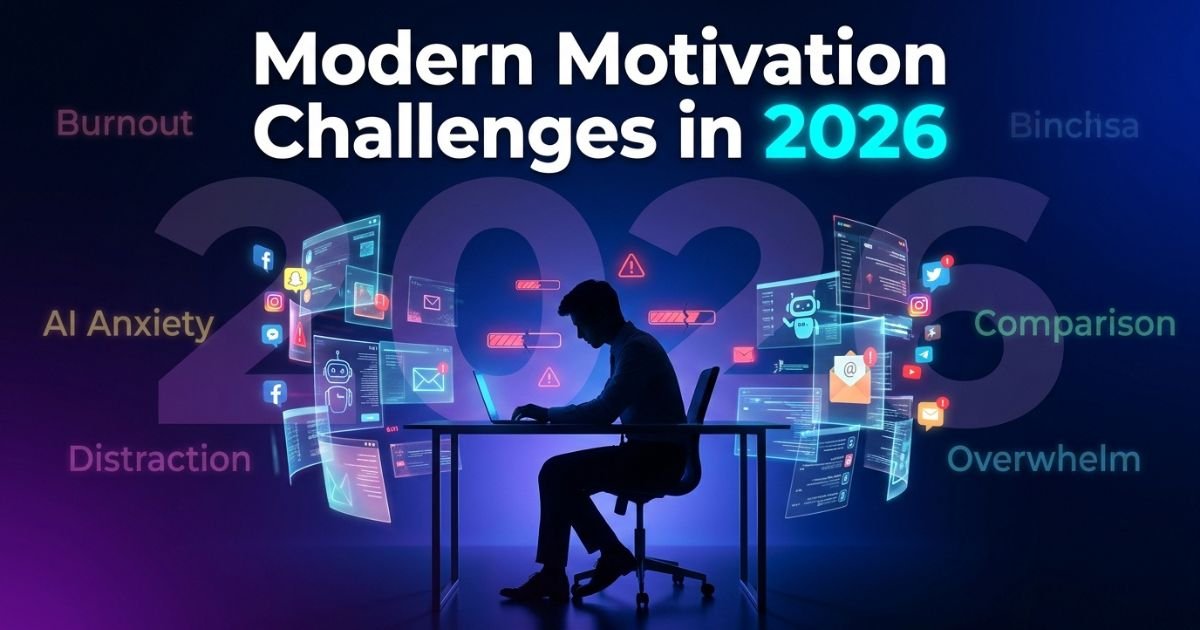
The landscape of motivation has shifted. The challenges people face today are distinctly different from even a decade ago, and understanding them matters.
- Attention fragmentation. Smartphones, social media, and constant notifications have made sustained focus increasingly rare. Motivation requires the ability to stay directed toward a single goal long enough to make progress. In a world designed to scatter attention, protecting that focus has become a daily act of will. Procrastination solutions today must account for digital distraction in ways older models never had to.
- Comparison culture. Social media creates a constant stream of curated success that can make your own progress feel invisible and insufficient. Comparison kills motivation quietly, replacing genuine ambition with anxiety about how you measure up. In 2026, managing your media environment is a serious self-improvement strategy, not a luxury.
- Meaning deficit. Post-pandemic life shifted many people’s relationship with work, routine, and purpose. A significant number of people report feeling directionless or uncertain about what they’re actually working toward. Without a clear meaning, motivation has nowhere to attach. The modern motivation crisis is often a meaning crisis in disguise.
- Decision fatigue and overwhelm. The volume of choices, information, and demands available in modern life is historically unprecedented. When your mental bandwidth is constantly depleted, the cognitive and emotional resources needed to sustain motivated behavior simply aren’t there. Simplicity and structure have become underrated motivational tools.
- AI and automation anxiety. In 2026, concerns about job displacement, relevance, and the changing value of human effort are real psychological factors affecting motivation in professional contexts. When people are uncertain whether their work matters or will exist in five years, sustained drive toward career goals becomes genuinely harder to maintain.
- Mental health visibility. Greater awareness of depression, anxiety, ADHD, and burnout as real medical conditions has helped people understand that low motivation isn’t always a character problem. But it’s also created new complexity around what requires therapeutic support versus what requires habit change. This distinction is important and sometimes difficult to navigate without professional guidance.
- Recovery from hustle culture. A significant cultural backlash against the “grind at all costs” mentality has emerged. Many people are renegotiating their relationship with ambition and productivity, which is healthy but can also create uncertainty about what healthy motivation actually looks like. The goal in 2026 isn’t to grind harder. It’s to find a sustainable, meaningful drive.
How to Build a Motivated Mindset
Motivation isn’t something that happens to you. At its deepest level, it’s something you cultivate through the way you think, structure your time, and relate to yourself.
Here’s how to build a mindset that naturally generates and sustains drive:
- Define what success means to you, not to anyone else. A motivated mindset starts with personal clarity. If your goals are borrowed from someone else’s expectations, your motivation will always feel borrowed, too. Do the uncomfortable work of identifying what you actually want, separate from what you think you should want.
- Adopt a growth orientation. People with fixed mindsets believe ability is static and protect their ego by avoiding challenge. People with growth mindsets see effort as the path to competence. Building a growth orientation transforms failure from a threat into information, which makes sustained motivation dramatically more sustainable.
- Build identity around your values and behaviors. Who you believe you are drives what you do. Shifting from “I’m trying to be more disciplined” to “I’m someone who shows up every day” is more than a linguistic trick. It’s an identity reframe that makes motivated behavior feel like self-expression rather than self-discipline.
- Practice daily reflection. A consistent habit of reviewing your progress, adjusting your approach, and reconnecting with your purpose keeps motivation from becoming automatic and unconscious. Even five minutes of intentional reflection each day maintains the connection between action and meaning.
- Cultivate emotional regulation. Motivation lives and dies in the emotional landscape. People who can manage frustration, bounce back from discouragement, and process setbacks without collapsing have a structural advantage in sustaining drive over time. Emotional control isn’t about suppressing feelings. It’s about processing them without being derailed by them.
- Reduce the size of your commitments when energy is low. A motivated mindset doesn’t demand the same output every day. It recognizes that energy is cyclical and adjusts accordingly. Keeping a smaller version of every important habit alive during low-energy periods protects long-term consistency without burning out.
- Surround yourself with motivated people. Motivational energy is genuinely contagious. The people around you set an implicit standard for effort, ambition, and resilience. Choose your close community with some intentionality, not exclusively based on shared motivation, but with awareness of how different environments affect your own drive.
- Celebrate process wins, not just outcome wins. If you only reward yourself when you reach a destination, motivation starves during the long middle stretches. Recognizing the discipline of showing up, the courage of starting over, and the integrity of keeping promises to yourself builds the self-esteem that makes future motivation easier to access.
- Return to your why regularly. The deepest source of a motivated mindset is a connection to purpose. Life gets busy, routines become mechanical, and meaning fades if you don’t actively tend to it. Build a habit of returning to your fundamental reasons, the things that make your goals worth fighting for, especially when things get hard.
- Accept that mindset is built, not found. There’s no switch to flip, no single insight that permanently fixes your relationship with motivation. Building a motivated mindset is a daily practice, exactly like physical training. Some days it’s hard and nothing feels right. Other days, everything flows. Both are part of the same ongoing development.
Conclusion
Motivation is one of the most powerful forces in human life, and understanding it more deeply, whether through finding the right motivation synonym, learning about intrinsic vs extrinsic types, or applying real psychological theories, genuinely changes how you pursue your goals. The word you choose to describe your drive matters. The type of motivation you cultivate matters even more. Whether you’re writing, growing, leading, or simply trying to get through a hard season, the insights here are designed to give you more clarity, more vocabulary, and more practical tools. The journey toward a consistently motivated life isn’t always dramatic. It’s built on small, honest, daily choices. Start where you are. Use what you have. Keep going.
Frequently Asked Questions (FAQs)
What is another word for motivation?
The best synonyms for motivation include drive, ambition, determination, zeal, inspiration, and purpose. Each word carries a slightly different meaning depending on the context you are using it in.
What can I say instead of motivation?
Instead of motivation you can use words like drive, incentive, desire, willpower, enthusiasm, or passion depending on whether you mean an internal feeling or an external push toward action.
What is a synonym for motivating and encouraging?
Strong synonyms for motivating and encouraging include inspiring, empowering, uplifting, stimulating, energizing, and reinforcing. These words are commonly used in personal development, leadership, and coaching contexts.
What are the three types of motivation?
While many psychologists recognize three core types including intrinsic motivation, extrinsic motivation, and identified motivation, this article covers four main types for a more complete and practical understanding.
What are the 4 R’s of motivation?
The 4 R’s of motivation typically refer to Relevance, Respect, Reward, and Relationships as key drivers of sustained drive and engagement. This framework is commonly used in educational and workplace motivation settings.

Welcome to Blessing Bloom. I’m Ahsan Ali, founder of BlessingBloom.com a faith-based website dedicated to sharing prayers, blessings, and heartfelt wishes. Based in Islamabad, Pakistan, I created Blessing Bloom to help people find the right words during life’s most meaningful moments. With a background in Information Technology, I combine a passion for digital content with a genuine love for faith-inspired writing.