


Standing at a pulpit during a funeral is one of the most sacred and tender moments a pastor or speaker will ever face. The room is full of broken hearts. People are desperate for something real, something that meets them right where they are. That is exactly what these funeral sermon topics with samples are designed to do. Each one is rooted in Scripture, shaped by compassion, and written to bring genuine comfort to grieving families. Whether you are a pastor preparing for Sunday, a friend asked to speak at a memorial, or someone simply searching for words that honor a life well lived, you will find something here that speaks directly to the moment.
What Makes a Funeral Sermon Truly Meaningful?

Before we dive into the topics themselves, it helps to understand what separates a forgettable funeral message from one that people carry home in their hearts.
A meaningful funeral sermon does three things well. First, it acknowledges the pain without minimizing it. Grief deserves to be named, not rushed past. Second, it points toward hope without sounding hollow. There is a difference between a true promise and a platitude, and grieving people can feel that difference instantly. Third, it honors the person who has passed in a way that feels personal and real.
The best Christian funeral sermons weave together Scripture, human emotion, and eternal truth. They do not pretend everything is fine. They sit in the hard place alongside the family, and then gently lift their eyes toward something greater.
The funeral sermon topics below are built with all of that in mind. Each one includes a theme, a key Bible verse, a message overview, and a full sample sermon you can adapt, personalize, and deliver with confidence.
20 Heartfelt Funeral Sermon Topics with Samples
1. The Promise That Never Fades: God’s Gift of Eternal Life
Theme: Even in the deepest loss, the hope of eternal life gives us something solid to stand on. This sermon anchors grieving hearts in the most foundational promise of the Christian faith.
Key Verse: John 14:2-3 – “My Father’s house has many rooms; if that were not so, would I have told you that I am going there to prepare a place for you? And if I go and prepare a place for you, I will come back and take you to be with me that you also may be where I am.”
Message Overview: Jesus did not speak vaguely about eternity. He spoke with the quiet confidence of someone who had already made the arrangements. For grieving families, this is not just theology. It is a hand reaching through the darkness. The promise of heaven is not wishful thinking. It is the bedrock beneath our feet when everything else feels like it is shifting.
Sample Sermon:
Dear friends,
There are moments in life when words feel small. This is one of them. We have gathered here because someone we love is gone, and no amount of good theology makes that easy. But I want to share something with you today that has carried God’s people through loss for thousands of years, and it still holds.
Jesus, on the night before His own death, sat with His closest friends and said something remarkable. He told them He was leaving. He told them they would not fully understand why. And then He said this: “I am going to prepare a place for you.” He was not speaking in poetry. He was speaking the way a man speaks when he has made real plans for people he loves.
That is the promise we stand on today.
[Name] is not wandering. They are not lost. If they placed their faith in Jesus Christ, then they are in the place He spent His entire ministry pointing toward. A place with no more pain. No more medication, no more hard diagnoses, no more long nights. Just the full, complete presence of God.
I know that does not stop the ache in your chest right now. And it is not supposed to. Grief is real. Missing someone is real. But the promise of reunion is also real. Jesus said, “I will come back and take you to be with me.” That word “will” carries the weight of certainty.
So grieve today. Cry. Let the loss be what it is. But underneath all of it, let this truth be the floor beneath your feet. This is not a final goodbye. It is a temporary one. And the One who made the promise has never broken it.
Amen.
Also READ: Blessed Upgrade Scroll Guide: Maximize Every Upgrade Chance
2. Walking Through the Valley: God’s Presence in the Darkest Moments
Theme: Grief can feel like walking through a tunnel with no light at the end. This sermon reminds mourners that they are never walking alone.
Key Verse: Psalm 23:4 – “Even though I walk through the darkest valley, I will fear no evil, for you are with me; your rod and your staff, they comfort me.”
Message Overview: The psalmist does not say we should skip the valley. He says we walk through it. That is an important distinction. God is not promising us an easy path around grief. He is promising to be with us every step of the way through it. For families sitting in the front row of a funeral service, this is exactly the message their hearts need.
Sample Sermon:
Dear friends,
The valley is real. I am not going to stand here and pretend today does not hurt. Losing [Name] hurts. The empty chair at the table hurts. The quiet in rooms that used to be full of their voice hurts. And if you are honest with yourself, you might be wondering whether God even notices.
He does. And He is here.
Psalm 23 was written by a man who knew real fear. David wrote about walking through the darkest valley, and he did not write about it from a distance. He wrote about it from inside the valley. But here is what he discovered there: he was not alone. God’s rod and staff were right there with him. Those were not decorative tools. They were working tools. The rod to protect. The staff to guide.
God is not watching your grief from a comfortable distance. He is walking beside you in it. In the quiet moments tonight, when the house feels impossibly still, He will be there. In the mornings when the reality of the loss hits you all over again, He will be there. In the months ahead, when grief catches you off guard, He will be there.
You do not have to be strong today. You do not have to have it together. You just have to keep walking. And as you walk, know that the Shepherd who loves you is walking too, right beside you, through every step of this valley and all the way to the other side.
Amen.
3. More Than a Goodbye: Honoring the Body While Celebrating the Soul
Theme: Standing before a loved one’s body at a funeral service is a profound and sacred moment. This sermon helps mourners understand what they are seeing and what they are not seeing.
Key Verse: 2 Corinthians 5:1 – “For we know that if the earthly tent we live in is destroyed, we have a building from God, an eternal house in heaven, not built by human hands.”
Message Overview: Paul’s image of the body as an earthly tent is one of the most comforting pictures in all of Scripture. The tent is not the person. The person has moved on. This sermon helps families grieve the physical loss while holding onto the spiritual truth.
Sample Sermon:
Dear friends,
I want to help you understand what you are looking at today, because I think it matters.
What lies here is the earthly tent that [Name] lived in. This body served them faithfully. It carried them through decades of life. It held their laugh and their warmth and their very particular way of moving through the world. We loved this body because it was the vessel through which we experienced [Name]. And it is right and good to grieve its stillness.
But [Name] is not here anymore. Not in the way that matters most. What made them who they were, their spirit, their soul, the part that loved God and loved you, that has already moved on. Paul tells us that we do not lose what we truly are when the tent comes down. We gain a building from God. An eternal house. Something permanent and glorious that we cannot even fully imagine from here.
So today, honor this body as the gift it was. Let yourself grieve. But also let yourself trust. The person you love is not trapped here. They have stepped out of the temporary and into the permanent. They are more alive now than they have ever been.
That is not a comforting story we tell ourselves. That is the promise of God.
Amen.
4. When Faith Feels Fragile: Doubts Are Welcome at the Foot of the Cross
Theme: Grief often shakes our faith. This sermon gives people permission to bring their doubts, anger, and confusion to God without fear of rejection.
Key Verse: Mark 9:24 – “Immediately the boy’s father exclaimed, ‘I do believe; help me overcome my unbelief!'”
Message Overview: One of the most honest prayers in the Bible comes from a father in crisis. He believed and doubted at the same time. That tension is the lived experience of so many grieving people, and this sermon meets them right there with grace.
Sample Sermon:
Dear friends,
I want to say something that might surprise you coming from a pulpit.
It is okay if you are angry at God right now.
It is okay if your faith feels shattered. It is okay if you have been asking hard questions and getting silence in return. It is okay if a part of you is not sure what you believe today. None of that disqualifies you from God’s love. None of that pushes you out of His reach.
There is a moment in the Gospel of Mark where a desperate father brings his sick son to Jesus. When Jesus asks if he believes, the father gives the most human answer in Scripture. He says, “I do believe; help me overcome my unbelief.” And Jesus does not send him away. Jesus does not lecture him about the quality of his faith. Jesus heals his son.
That father’s prayer is available to every single person in this room today. You do not have to have pristine faith to come to God right now. You just have to come. Bring the anger. Bring the confusion. Bring the questions that have no good answers. God is not afraid of any of it. He can hold every hard thing you are carrying today.
[Name]’s passing has left a wound that will not close quickly. That is real. But the God who meets us in our weakness has not moved. He is still here. Still listening. Still holding you, even when you cannot feel His hands.
Amen.
5. The Gift That Grief Gives: Finding New Purpose After Loss
Theme: Grief, while devastating, has a way of opening our eyes to what truly matters. This sermon explores how loss can become a doorway into deeper purpose and compassion.
Key Verse: 2 Corinthians 1:3-4 – “Praise be to the God and Father of our Lord Jesus Christ, the Father of compassion and the God of all comfort, who comforts us in all our troubles, so that we can comfort those in any trouble with the comfort we ourselves receive from God.”
Message Overview: God does not waste pain. He redeems it. This sermon helps families see that their grief, as terrible as it is, has the potential to make them more compassionate, more loving, and more intentional about the life they still have.
Sample Sermon:
Dear friends,
The loss of [Name] will change you. I say that not as a warning but as a quiet truth I think you already know. When someone you love deeply is taken from you, you cannot go back to the person you were before. The world looks different now. The things that seemed urgent two weeks ago suddenly feel small. The people you love feel more precious than they did.
Paul writes about something beautiful in his second letter to the Corinthians. He says God comforts us so that we can comfort others. In other words, the very experience you are living through right now is being transformed into something that will one day be a gift to someone else. Your grief is becoming wisdom. Your pain is becoming empathy. The depth of what you are feeling right now will one day give you the capacity to sit with someone else in their worst moment and genuinely understand.
That is not a small thing. That is how love multiplies.
[Name]’s legacy does not end today. It continues in the way you love people going forward. Every time you sit with a friend who is hurting, every time you choose presence over comfort, every time you reach out because you remember what it felt like to need someone, that is [Name]’s life still working in the world through you.
Your grief has a future. And it is more beautiful than you can imagine from where you are standing today.
Amen.
6. The Silence They Left Behind: Meeting God in the Empty Spaces
Theme: One of the most painful parts of grief is the silence. The quiet that fills the space where a person used to be. This sermon invites mourners to sit in that silence rather than flee from it, and to discover God waiting there.
Key Verse: Psalm 46:10 – “Be still, and know that I am God.”
Message Overview: We live in a culture addicted to noise. When grief hits, our first instinct is to fill the silence with activity, distraction, anything to avoid facing the emptiness. But God often speaks in the quiet. This sermon gently invites mourners to stop running and let the stillness teach them something.
Sample Sermon:
Dear friends,
There is a particular kind of silence that only loss can create. You know the one I mean. It is the silence when you walk into the house, and they are not there. The silence at the table. The silence where their voice used to be. It is a heavy, shaped silence, and it is almost unbearable.
Most of us, when we encounter that silence, do everything we can to fill it. We turn on the television. We call friends. We stay busy from the moment we wake up until we are too exhausted to think. And that is not wrong. Distraction has its place in grief.
But I want to invite you, somewhere in the days ahead, to try something different. To sit in the silence for a few minutes. Not to punish yourself. Not to force a feeling. Just to be still.
God says in Psalm 46, “Be still, and know that I am God.” There is something about stillness that makes us more aware of His presence. It strips away the noise we use to keep ourselves from facing what is real. And in that stillness, in the very silence that feels so unbearable, God often shows up in the most tender and unexpected ways.
[Name]’s absence is real. The quiet they left behind is real. But that quiet is also full of something. It is full of God. And if you sit in it long enough, you may find that it does not feel quite so empty anymore.
Amen.
7. The Power of Memory: Keeping Them Alive in the Ways That Matter
Theme: Memory is one of the greatest gifts we carry after loss. This sermon celebrates the act of remembering and encourages families to hold their memories close rather than push them away.
Key Verse: Deuteronomy 8:2 – “Remember how the Lord your God led you all the way in the wilderness these forty years.”
Message Overview: Memory is not a prison. It is a bridge. It connects us to the people we love even after they are gone. This sermon encourages families to embrace their memories as sacred, to tell the stories, to keep the legacy alive.
Sample Sermon:
Dear friends,
I want to talk with you today about something you already own, something nobody can take from you. Your memories of [Name].
Right now, some of those memories might feel painful to touch. You might be tempted to push them away because looking at them hurts too much. But I want to encourage you to do the opposite. Hold onto them. Treasure them. Take them out and turn them over in your hands like something precious, because that is exactly what they are.
The way [Name] laughed at their own jokes. The particular phrase they used all the time. The way they looked when they were proud of you. The meals they made, the songs they sang, the stories they told for the hundredth time that you could recite right along with them. These are not just memories. They are proof that a real, irreplaceable person lived and loved and left a permanent mark on this world.
Throughout Scripture, God calls His people to remember. Remember what He did in the wilderness. Remember the faithfulness of those who came before. Memory is a spiritual practice. It is a way of saying, “You mattered. You still matter. I refuse to let you fade.”
Tell the stories about [Name]. Tell the funny ones. Tell the embarrassing ones. Tell the ones that will make everyone at the table laugh and cry at the same time. Because as long as you are telling those stories, [Name] is still shaping this world. Still making people laugh. Still teaching the people who loved them how to live.
Memory is not grief’s enemy. It is one of its greatest healers.
Amen.
8. God’s Timing: Trusting What We Cannot Understand
Theme: One of the hardest questions in grief is “Why now?” This sermon does not offer false answers. Instead, it invites mourners into the deeper peace of trusting a God whose wisdom exceeds our understanding.
Key Verse: Isaiah 55:8-9 – “For my thoughts are not your thoughts, neither are your ways my ways, declares the Lord. As the heavens are higher than the earth, so are my ways higher than your ways and my thoughts than your thoughts.”
Message Overview: We are finite creatures trying to understand an infinite God. This sermon helps families release the need for explanations and find peace in trust instead.
Sample Sermon:
Dear friends,
I am going to be honest with you today, because you deserve honesty more than you deserve comfortable answers.
I do not know why [Name] died when they did. I cannot tell you the divine reason, the cosmic purpose, the specific plan that required this particular loss at this particular time. If someone has told you they know, they were offering comfort they were not qualified to give. The truth is, we do not always get to understand God’s timing.
And that is one of the hardest things about faith.
Isaiah tells us plainly that God’s ways are not our ways. His thoughts are not our thoughts. The distance between His understanding and ours is not a small gap. It is as vast as the space between heaven and earth. We are not going to think our way into comprehending why this happened.
But here is what we can do. We can trust the character of the One whose ways we cannot fully see.
We know God is good. We know He loves [Name] with a love that makes our own love feel like a candle next to the sun. We know He is not careless or cruel. And we know that He sees the end of the story from the beginning in ways we cannot.
Faith is not understanding. Faith is choosing to trust when understanding runs out. And today, I am asking you to choose that. Not because it makes the pain go away. But it gives you a place to stand when the ground feels like it is shaking beneath your feet.
Amen.
9. Love That Cannot Die: The Bond That Outlasts Everything
Theme: Death ends a life, but it cannot end love. This sermon helps grieving families understand that the bond they shared with their loved one is real and enduring.
Key Verse: Romans 8:38-39 – “For I am convinced that neither death nor life, neither angels nor demons, neither the present nor the future, nor any powers, neither height nor depth, nor anything else in all creation, will be able to separate us from the love of God that is in Christ Jesus our Lord.”
Message Overview: If nothing can separate us from God’s love, then love itself is the most powerful force in the universe. The love between [Name] and the people who are grieving them today did not end when [Name]’s heart stopped. It continues, transformed but real.
Sample Sermon:
Dear friends,
There is a lie that grief tells us in those first raw days after a loss. The lie sounds like this: it is over. What you had is gone. The relationship is finished.
I need you to hear me when I say: that is not true.
Paul writes that nothing in all of creation can separate us from the love of God. And love, real love, does not originate in us. It comes from God. It flows through us. It connects us to one another in ways that do not simply stop because time does.
The love [Name] had for you is not deleted. The love you had for them is not wasted. Love like that does not expire. It transforms. It lives in the choices you make because of what they taught you. It lives in the values you carry forward that they modeled for you. It lives in the moments when you catch yourself doing something exactly the way they would have done it.
The relationship is not over. It has changed. You cannot call them on the phone anymore. You cannot make new memories in the old ways. But you can still carry them. You can still honor them. You can still let the love you shared be a guiding force in the life you are still living.
Death is powerful. But love is more powerful. And love, rooted in the God who is love, never truly ends.
Amen.
10. The Waves Will Come: Understanding the Rhythm of Grief
Theme: Grief does not follow a schedule or a set of stages. It comes in waves. This sermon prepares families for the unpredictable nature of loss and helps them extend grace to themselves through the process.
Key Verse: Lamentations 3:31-33 – “For no one is cast off by the Lord forever. Though he brings grief, he will show compassion, so great is his unfailing love. For he does not willingly bring affliction or grief to anyone.”
Message Overview: Many grieving people are caught off guard by how grief actually works. They expect a linear process, and instead, they experience something far more unpredictable. This sermon normalizes the wave pattern of grief and assures families that God is present in every wave.
Sample Sermon:
Dear friends,
I want to prepare you for something, because I think it will help.
In the days and weeks ahead, you are going to have moments that feel almost okay. You will go a few hours without the weight of this loss pressing down on you. And then something completely ordinary will happen. A song will come on the radio that [Name] loved. You will reach for your phone to text them something funny. You will smell something that brings them instantly to mind. And the grief will come crashing back, harder than ever, and you will wonder if you are going backward.
You are not going backward.
Grief does not move in a straight line. It moves in waves. Some waves are small. Some are enormous. Some come when you expect them, around birthdays and anniversaries, and holidays. And some ambush you on a perfectly average Tuesday in the grocery store.
Lamentations tells us that God does not cast us off in our suffering. His compassion is great. His love is unfailing. And those words are not just for the first week of grief. They are for the second month. The first anniversary. The moment two years from now, when a wave comes out of nowhere.
Be patient with yourself through this. There is no timeline for healing. There is no schedule you are supposed to be keeping. Give yourself permission to grieve in waves, to have good days and devastatingly hard days, and to know that both are part of the journey.
God is in every wave. And none of them will swallow you entirely.
Amen.
11. Living Out Their Legacy: How to Keep Someone’s Life Going
Theme: The best memorial to someone’s life is the way the people who loved them choose to live going forward. This sermon challenges and inspires families to carry forward the best of who their loved one was.
Key Verse: Hebrews 12:1 – “Therefore, since we are surrounded by a great cloud of witnesses, let us throw off everything that hinders and the sin that so easily entangles. And let us run with perseverance the race marked out for us.”
Message Overview: [Name] lived a particular life. They had values, habits, and ways of showing up for people. This sermon invites the gathered community to take those qualities seriously and carry them forward as a living tribute.
Sample Sermon:
Dear friends,
People worry about being forgotten. I think most of us, if we are honest, carry that fear quietly. We wonder whether our lives will matter once we are gone. Whether the things we cared about will outlast us.
Today, I want to tell you: [Name]’s life will not be forgotten. Not if the people in this room decide it will not be.
Hebrews tells us we are surrounded by a great cloud of witnesses. I believe [Name] is part of that cloud now. And I believe they are watching the way we choose to live after them. Not with judgment. With love and with hope.
Think about what [Name] was known for. Was it generosity? The way they always showed up for people who were struggling? The quiet consistency of their faith? The way they made everyone around them feel like they mattered? Whatever it was, that is the inheritance they left behind. Not just in memories, but in invitation.
Every time you choose to be as generous as [Name] was generous, they live on. Every time you show up for someone the way [Name] used to show up for you, their legacy continues. Every time you extend grace in a moment when you could have withheld it, because you remember how they extended it to you, their name is spoken in the language of love.
That is how a life outlasts a body. That is how someone you love continues to change the world after they are gone.
Amen.
12. All Your Emotions Are Holy: Permission to Feel Everything
Theme: Grief is not just sadness. It is anger, guilt, relief, confusion, and even unexpected laughter. This sermon validates the full emotional experience of grief and assures mourners that no feeling disqualifies them from God’s love.
Key Verse: Ecclesiastes 3:4 – “A time to weep and a time to laugh, a time to mourn and a time to dance.”
Message Overview: People in grief often feel guilty for feeling the “wrong” things. Angry at God. Relieved that suffering is over. Confused about why they can still laugh. This sermon frees them from the need to manage their emotions and gives them permission to feel whatever is true.
Sample Sermon:
Dear friends,
I want to give you something today that you might not expect to receive at a funeral.
Permission.
Permission to feel exactly what you are feeling, whatever that is, without judgment or apology.
Some of you are devastated. Some of you are numb. Some of you are furious at God, at the illness, at the unfairness of all of it. Some of you are quietly relieved that [Name] is no longer suffering, and then immediately feel terrible for feeling relieved. Some of you might even find yourself laughing at a memory this week, and then wonder what is wrong with you.
Nothing is wrong with you. Ecclesiastes tells us there is a time for everything. A time to weep and a time to laugh. A time to mourn and a time to dance. All of it belongs to the human experience. All of it belongs to love.
Grief is not one emotion. It is a whole landscape of them, shifting constantly, sometimes contradicting each other in the same hour. You can love God deeply and be furious at Him right now. You can miss [Name] terribly and feel a complicated kind of relief at the same time. Both things can be true.
Do not try to perform the right kind of grief for the people around you. Do not shut down what is real in order to make others more comfortable. God can handle every honest thing you bring to Him. He is not fragile. He is not easily offended. He is a Father who welcomes His children just as they are.
So feel what you feel. All of it. And know that in every single emotion, God is right there with you.
Amen.
13. You Were Not Meant to Grieve Alone: The Gift of Community in Loss
Theme: Grief is one of the loneliest experiences in human life, yet we were designed to carry it together. This sermon calls the community to show up for one another and challenges the grieving family to let themselves be held.
Key Verse: Romans 12:15 – “Rejoice with those who rejoice; mourn with those who mourn.”
Message Overview: People in grief often isolate themselves. They do not want to be a burden. They put on a brave face. This sermon gently dismantles that instinct and replaces it with an invitation to let the body of Christ do what it was designed to do.
Sample Sermon:
Dear friends,
I know that some of you, in the days ahead, are going to want to pull away. You are going to cancel the visits. You are going to say you are fine when you are not. You are going to feel like your grief is too heavy a thing to ask other people to carry alongside you.
I want to ask you gently, do not do that.
Paul says we are called to mourn with those who mourn. That is not a suggestion. That is a description of what the body of Christ is supposed to look like. When you are hurting, we are supposed to be there. Not with all the right answers. Not with explanations or silver linings. Just there. Present. Willing to sit in the hard place with you.
And on your end, letting people in is not a weakness. It is not being a burden. It is giving the people who love you the gift of being able to love you well.
Some of the most healing moments in grief do not come from sermons or scriptures, as important as those are. They come from someone who shows up at your door with food and does not expect you to talk. They come from a friend who sits with you in silence because words are not enough. They come from the person who calls two months later, when everyone else has moved on, just to check in.
Let those people in. The body of Christ is not supposed to be a group of individuals struggling privately. It is supposed to be a community where the strongest carry the weakest, and everyone gets a turn being carried.
You do not have to walk through this alone. And you should not.
Amen.
Also READ: 190+Inspirational Graduation Messages for Myself with Bible Verses & Quotes
14. The Road Ahead: Rebuilding Life After Loss Without Betraying Love
Theme: At some point, grief gives way to the slow work of rebuilding. Many people feel guilty about this. This sermon gives them permission to move forward while honoring everything that came before.
Key Verse: Isaiah 43:19 – “See, I am doing a new thing! Now it springs up; do you not perceive it? I am making a way in the wilderness and streams in the wasteland.”
Message Overview: Moving forward after loss is not a betrayal. It is an act of courage. This sermon helps families understand that rebuilding their lives is not moving away from their loved one. It is carrying them forward into a new season.
Sample Sermon:
Dear friends,
At some point in the weeks or months ahead, something will shift. You will have a day when you feel almost like yourself again. You will make a plan for the future and feel something that resembles excitement. You will laugh at something and mean it.
And then you might feel terrible about it.
You might think, “How can I be making plans? How can I be okay when [Name] is gone?” I have seen this happen over and over again in grieving families, and I want to speak to it directly today.
Moving forward is not forgetting. Moving forward is not betraying [Name]. It is not minimizing the love you had or the loss you feel. It is simply the act of continuing to be alive, which is a deeply brave thing to do after you have lost someone.
Isaiah writes about God doing something new, making a way in the wilderness, streams in the wasteland. That imagery matters. The wilderness does not disappear when the stream appears. But life comes into it anyway. New growth. New possibility. Right there in the hard place.
God is not asking you to pretend the wilderness is not real. He is inviting you to receive the streams He is bringing into it.
You can honor [Name] fully and still choose to live fully. In fact, choosing to live well, to love people generously, to pursue what matters, that is one of the most powerful ways to keep their legacy alive. [Name] would not want you to stop living. They would want you to live in a way that reflects everything they poured into you.
The new season ahead is not the absence of them. It is the continuation of their influence.
Amen.
15. The Mystery of Suffering: Peace Without All the Answers
Theme: Sometimes loss does not come with explanations. This sermon helps mourners find peace not through understanding, but through trust.
Key Verse: Job 38:4 – “Where were you when I laid the earth’s foundation? Tell me, if you understand.”
Message Overview: Job demanded answers from God and received something better: a deeper knowledge of God Himself. This sermon invites grieving families into that same encounter, where mystery and trust coexist.
Sample Sermon:
Dear friends,
I am not going to pretend today that I have answers that explain why [Name] died. And I am going to ask you to be suspicious of anyone who tells you they do.
Some losses come without explanations that satisfy. Some prayers seem to go unanswered. Some timing feels simply wrong, and no amount of theological reasoning makes it feel right. And if that is where you are today, I want you to know: you are in good company. Job sat in that exact place.
Job lost everything. And he demanded that God explain Himself. He was bold enough, honest enough, desperate enough to stand before the Almighty and say, “I need answers.” And God responded. Not with the answers Job expected, but with something far more powerful. God showed Job the vastness of creation, the depth of His knowledge, the breadth of His wisdom, all the things Job had never seen and could not understand. And in that encounter, Job found something better than answers. He found God.
He found that the One holding the universe together was not absent or careless or random. He found that the depth of God’s understanding made his own questions feel like the questions of a child who cannot yet grasp what their parents can see.
Today, I am not offering you explanations. I am offering you something better. I am inviting you to encounter the God who holds what we cannot hold, who sees what we cannot see, who knows what we cannot know. And I am asking you to trust Him with this loss, even without understanding why.
That is the deepest kind of faith. And it is available to all of you today.
Amen.
16. Grief Is Not Linear: Grace for the Long Road Ahead
Theme: The journey of grief is longer and more complicated than our culture prepares us for. This sermon offers patience, grace, and God’s sustaining power for the road ahead.
Key Verse: 2 Corinthians 12:9 – “My grace is sufficient for you, for my power is made perfect in weakness.”
Message Overview: People expect to be “over it” on a certain timeline. This sermon gently corrects that expectation and replaces it with the truth of God’s grace that is new every morning, sufficient for every day of the long journey ahead.
Sample Sermon:
Dear friends,
I want to be honest with you about what the next year looks like.
Some of you are in the first wave of shock right now, and everything feels surreal. Some of you have been in this grief longer than today, and you know exactly how hard it gets. And I want to speak to both of you.
The road ahead is not short. Grief over a person you truly loved does not wrap up neatly in a few months. It changes shape. It gets quieter in some seasons. It comes back louder than ever in others. You will have days that feel like genuine progress, and then days when it feels like you are right back at the beginning.
That is not failure. That is grief.
Paul learned something in his own suffering that he shared with the church in Corinth. He said God told him, “My grace is sufficient for you, for my power is made perfect in weakness.” Not in strength. In weakness. God shows up most powerfully in the moments when we have nothing left to offer. When we cannot hold it together. When we cannot manufacture faith or courage or hope.
Those moments are coming for you. And in every single one of them, God’s grace will be there. Not just enough to barely survive, but truly sufficient. Sufficient for the first week. Sufficient for the sixth month. Sufficient for the moment, two years from now, when the grief catches you completely off guard.
Be patient with yourself. Be gentle with yourself. You are not on anyone else’s schedule. And the grace you need for today will be there today. And the grace you need for tomorrow will be there tomorrow.
Amen.
17. When People Say the Wrong Thing: Giving Grace in Hard Conversations
Theme: In grief, well-meaning people often say things that hurt. This sermon helps mourners navigate those moments with grace and helps those who support the grieving to show up well.
Key Verse: Colossians 4:6 – “Let your conversation be always full of grace, seasoned with salt, so that you may know how to answer each person.”
Message Overview: Almost everyone who has grieved has experienced the painful awkwardness of people saying exactly the wrong thing. This sermon helps both sides of that conversation, normalizing the experience and offering a grace-centered path forward.
Sample Sermon:
Dear friends,
Something is probably going to happen to you in the coming weeks, if it has not already. Someone who loves you, someone who means well, is going to say something that hurts.
They are going to tell you that everything happens for a reason. They are going to say that God needed another angel. They are going to compare their loss to yours in a way that feels dismissive. They are going to say they know exactly how you feel. And in that moment, you are going to have to decide what to do with the hurt they just handed you.
Colossians tells us to let our conversations be full of grace. That is a tall order when you are already running on empty from grief. But I think it is possible, and here is why: most people who say the wrong thing are doing their best with very limited tools. They have never been taught how to sit with someone in grief. They are terrified of saying the wrong thing, which ironically leads them straight to the wrong thing. They want to help. They just do not know how.
So when it happens, try, just try, to see the care beneath the clumsy words. You do not have to pretend it did not sting. You do not have to absorb everything without protecting yourself. But you can let grace be your default.
And for those of you here today who are supporting a grieving family: you do not need the right words. You really do not. Just show up. Say, “I do not know what to say, but I am here.” Sit with them in the silence. Let your presence be the message. That is almost always enough.
Amen.
18. Sacred Rituals: Practical Ways to Honor and Remember
Theme: Grief needs containers. Rituals give us a structured, meaningful way to honor our loved ones and process our loss on the hard days that follow.
Key Verse: Ecclesiastes 4:9-10 – “Two are better than one, because they have a good return for their labor: If either of them falls down, one can help the other up.”
Message Overview: Creating rituals around grief is not morbid. It is an act of love. This sermon encourages families to build meaningful practices that keep their loved one’s memory alive and give structure to the grief that might otherwise feel formless.
Sample Sermon:
Dear friends,
The days after a funeral have a particular kind of difficulty. The meals stop arriving. The visitors go home. The text slows down. And you are left with the ordinary rhythm of life, which feels anything but ordinary now.
One of the things that can help in those days is ritual. I do not mean anything complicated. I mean small, intentional acts of remembrance that give your grief a place to go.
Maybe on [Name]’s birthday each year, your family gathers and tells the stories you love best about them. Maybe you cook their favorite meal on the anniversary of their passing. Maybe you plant something in your yard that blooms in their favorite color. Maybe you set aside five minutes on Sunday mornings to sit quietly and pray, thanking God for the years you had with them.
These rituals do something important. They say, out loud and on purpose: “You mattered. You still matter. You have not been forgotten.” They create protected space in the calendar for grief to be honored rather than suppressed. And they give families, especially children, a consistent way to stay connected to someone they love.
Over time, these rituals can become some of the most treasured moments in a family’s year. What starts as a response to loss can become a celebration of life, a tradition that gets passed down, a story that stays alive.
[Name] is worth remembering intentionally. Do not leave that to chance. Build the rituals. Keep the memory alive. That is one of the most loving things you can do in the days ahead.
Amen.
19. The Seasons Will Change: Nature’s Promise of Renewal After Loss
Theme: The changing seasons offer a gentle, continuous reminder that darkness does not last forever. This sermon uses the cycle of nature to bring hope to those in the winter of their grief.
Key Verse: Ecclesiastes 3:11 – “He has made everything beautiful in its time. He has also set eternity in the human heart; yet no one can fathom what God has done from beginning to end.”
Message Overview: The seasons change without asking our permission. They move on their own timetable. Grief is similar. This sermon helps families trust that, just as spring follows winter, renewal will come even after the deepest loss.
Sample Sermon:
Dear friends,
Pay attention to the world around you in the coming weeks and months.
If this loss is happening in winter, notice the bare trees. Notice the cold. Notice how everything looks like it has stopped. And then watch what happens in March and April. The trees will bud. The ground will soften. Things that looked dead will turn out to be simply dormant, waiting for the right conditions.
That is a picture of where you are right now.
You are in winter. Everything inside you feels cold and still and bare. The future looks bleak in a way you cannot quite describe. You cannot imagine the kind of person who can walk through this and come out the other side.
But you will. Not because grief is easy, or because time magically fixes things, but because God has built renewal into the fabric of creation. He has made everything beautiful in its time, Ecclesiastes tells us. Even this. Even the hardest season of your life is not exempt from God’s redemptive timing.
The seasons do not change quickly. They change in their own time, on their own terms, and you cannot rush them. Grief is the same. Your healing will not follow your preferred schedule. But it will come. Slowly, quietly, in ways you might not even notice at first. A morning where you wake up and the weight is slightly lighter. A moment where you laugh and it feels real. A day when you think of [Name] and smile before you cry.
The seasons will change. They always do. And so will you.
Amen.
20. Until We Meet Again: The Eternal Promise of Reunion
Theme: This final sermon brings the whole arc of grief to a point of hope. Death is not the last word. For those who are in Christ, it is a temporary separation. And the reunion is coming.
Key Verse: 1 Thessalonians 4:16-17 – “For the Lord himself will come down from heaven, with a loud command, with the voice of the archangel and with the trumpet call of God, and the dead in Christ will rise first. After that, we who are still alive and are left will be caught up together with them in the clouds to meet the Lord in the air. And so we will be with the Lord forever.”
Message Overview: Every great story has a reunion scene. This is the Christian’s reunion scene. The separation is real and it is painful, but it is not permanent. This sermon closes with the most powerful, hope-filled truth in all of Scripture: we will see them again.
Sample Sermon:
Dear friends,
I want to close with the most important thing I know.
This is not the end.
I am not saying that to rush past the grief. I am not saying it to minimize how much today hurts or how long the road ahead is going to be. I am saying it because it is the truest thing I can offer you, and it is the one truth that changes everything.
Paul writes to the church in Thessalonica about what is coming. He describes the day when the Lord will come down from heaven, and the dead in Christ will rise, and those of us still living will be caught up together with them. Together with them. Not just together with the Lord, though that would be enough. Together with the people we love. Together with [Name].
That reunion is not a fairy tale. It is not religious comfort food. It is the promise of the risen Jesus, who Himself came back from death to prove that death is not the final chapter.
Right now, the separation is real. The ache of missing [Name] is real. The silence where their voice should be is real. But it is temporary. We are saying “goodbye for now.” We are saying “until we meet again.” And for those who are in Christ, that reunion is as certain as the resurrection itself.
So carry this with you as you walk out of this place today. Carry the grief, because it is real. But carry the hope too, because it is even more real. You will see [Name] again. You will embrace them again. You will spend eternity together in the presence of the God who made you both and loved you both, and refused to let death have the final word.
Until that day, hold on. God is holding you.
Amen.
Also READ: 170+ Bible Verses for Celebrating Christmas (Joy, Peace & Christ’s Birth)
Practical Tips for Pastors Delivering a Funeral Sermon
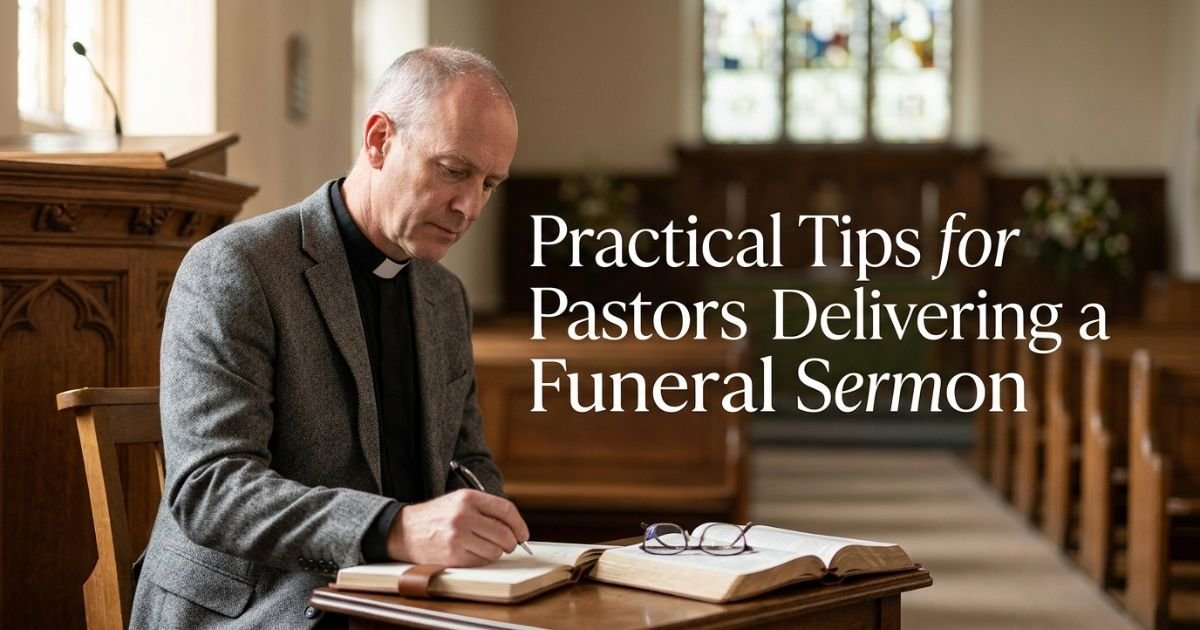
Understanding how to write and deliver a funeral sermon is just as important as knowing what to say. Here are a few practical things worth remembering before you take the pulpit.
Know the family before you speak. If at all possible, spend time with the family before the service. Ask them about [Name]. Ask for the stories, the quirks, the things that made that person uniquely themselves. The more specific and personal your message, the more deeply it will land.
Keep it focused. A funeral sermon is not the place for a ten-point theological lecture. Choose one strong theme, anchor it in one key verse, and develop it with warmth and clarity. Fifteen to twenty focused minutes is usually ideal.
Name the grief directly. Do not begin by rushing people toward hope. Acknowledge the loss first. Say it plainly. “Today is hard. Losing [Name] is hard.” When people feel genuinely seen, they become far more open to the hope you are about to offer them.
Personalize the Scripture. Do not just read the verse. Show how it connects to this specific family, this specific loss, this specific day. The sermon topics in this guide are written with that kind of personalization built in, using the placeholder [Name] throughout.
End with hope, not obligation. The conclusion of a funeral sermon should leave people with something to hold onto, not a list of things they should do differently. Send them out with the warmth of a promise, not the weight of a challenge.
How to Choose the Right Funeral Sermon Topic
With twenty options to choose from, it helps to have a framework for selecting the right one for a specific service.
For a young person who died suddenly, topics that address “why” questions, like “God’s Timing” or “The Mystery of Suffering,” tend to resonate most. Families in these situations are grappling with shock and a desperate search for meaning.
For an elderly person who lived a long, faithful life, topics like “A Life of Legacy” or “Until We Meet Again” tend to fit best. There is more celebration woven into the grief.
For someone who suffered through a long illness, “The Body at Rest” and “The Promise of Eternal Life” are especially comforting. Families who watched someone they love struggle often find deep peace in the image of a person finally free.
For a service with many non-believers present, choose a sermon that leads with human emotion before it leads with Scripture. Topics like “All Your Emotions Are Holy” or “You Were Not Meant to Grieve Alone” are accessible to everyone regardless of faith background.
Bible Verses That Work Well in Any Funeral Sermon
Beyond the specific verses attached to each topic above, the following passages are widely used in Christian funeral sermons and can be woven into almost any message.
Psalm 34:18 – “The Lord is close to the brokenhearted and saves those who are crushed in spirit.”
Revelation 21:4 – “He will wipe every tear from their eyes. There will be no more death or mourning or crying or pain, for the old order of things has passed away.”
Philippians 4:7 – “And the peace of God, which transcends all understanding, will guard your hearts and your minds in Christ Jesus.”
Romans 8:28 – “And we know that in all things God works for the good of those who love him, who have been called according to his purpose.”
John 11:25-26 – “Jesus said to her, ‘I am the resurrection and the life. The one who believes in me will live, even though they die; and whoever lives by believing in me will never die.'”
Psalm 116:15 – “Precious in the sight of the Lord is the death of his faithful servants.”
A Word for Those Who Are Grieving
If you found this page not because you are preparing to preach, but because you are the one who is grieving, these words are for you too.
You do not have to be okay right now. You do not have to have strong faith. You do not have to know what you believe about heaven or eternity or God’s plan. You can bring all of the broken pieces, exactly as they are, to a God who is not afraid of any of it.
Grief is one of the most human experiences there is. It is proof that love was real. And on the other side of this hardest season, you will find that you are still standing, a little wiser, a little more tender, and held by hands that never once let go.
Conclusion
The twenty funeral sermon topics with samples in this guide are built to do one thing above everything else: help people feel less alone in their grief. Whether you are a pastor preparing a message for Sunday, a family member asked to say a few words, or someone quietly searching the internet for comfort in the middle of the night, the hope woven through every sermon above is the same.
Death is not the end. Love does not disappear. God is closer than our grief makes Him seem. And the separation, as painful and real as it is, is temporary. These are not beautiful ideas designed to help us cope. These are the anchoring truths of the Christian faith, promised by Jesus Himself and sealed by His resurrection.
May every family walking through loss find someone who speaks these words over them with the warmth and sincerity they deserve. And may every grieving heart find the peace that surpasses understanding, the kind that holds even when everything else feels like it is falling apart.

Welcome to Blessing Bloom. I’m Ahsan Ali, founder of BlessingBloom.com a faith-based website dedicated to sharing prayers, blessings, and heartfelt wishes. Based in Islamabad, Pakistan, I created Blessing Bloom to help people find the right words during life’s most meaningful moments. With a background in Information Technology, I combine a passion for digital content with a genuine love for faith-inspired writing.