


There is something quietly powerful about the Serenity Prayer. Most people have heard the opening lines. Maybe you have whispered them during a hard morning, or seen them on a wall somewhere. But the full Serenity Prayer goes much deeper than those familiar words. It speaks to the heart of what it means to be human, to struggle, to hope, and to trust in something greater than yourself. Whether you are walking through grief, navigating recovery, or simply searching for peace in an overwhelming world, the complete text of this prayer has something real and lasting to offer you.
What Is the Full Serenity Prayer?

You may know the short version by heart. Many people do. But the full Serenity Prayer is something more. It is a complete spiritual reflection, written to carry a person through not just the surface-level moments of frustration, but through the deep ache of life when things feel truly out of hand.
The prayer was written by Reinhold Niebuhr, a Christian theologian and one of the most influential religious thinkers of the 20th century. He used various versions of it in sermons as early as 1934. It spread quickly through church communities, military chaplaincies, and by the 1940s had been adopted by Alcoholics Anonymous, where it became a cornerstone of recovery culture worldwide.
What makes the full version different is its scope. It does not stop at asking for serenity, courage, and wisdom. It continues into a meditation on surrender, trust, daily living, and the hope of something beyond this life. It is, at its heart, a prayer about how to live well when so much feels uncertain.
The full Serenity Prayer is relevant far beyond recovery settings. It speaks to anyone facing anxiety, loss, chronic stress, difficult relationships, or simply the ordinary weight of being human. That is why it has endured.
Also Read: 20 Powerful Unity Prayer Examples to Bring People Together
The Full Serenity Prayer: Complete Text
Read this slowly. Each line carries its own weight. There is no need to rush through it.
God, grant me the serenity
to accept the things I cannot change,
courage to change the things I can,
and wisdom to know the difference.
Living one day at a time,
enjoying one moment at a time,
accepting hardship as the pathway to peace,
taking, as He did, this sinful world
as it is, not as I would have it,
trusting that He will make all things right
if I surrender to His Will;
so that I may be reasonably happy in this life
and supremely happy with Him
forever in the next.
Amen.
This is the version most widely recognized as the complete Serenity Prayer, consistent with the text attributed to Reinhold Niebuhr and later adopted by Alcoholics Anonymous and other twelve-step programs. Some variations exist in punctuation and minor wording, but the meaning remains consistent across all of them.
The Short Version vs. the Full Version: What Is the Difference?
Most people first encounter the abbreviated form of the prayer. That short version consists of just the opening four lines: the ask for serenity, courage, and wisdom. It is powerful on its own, and it travels easily. You can hold it in your mind during a stressful moment at work, a difficult conversation, or a sleepless night.
But the full version adds an entire second layer of meaning. It moves from asking for qualities to describing how to actually live. It introduces concepts like taking the world as it is rather than as we wish it were, surrendering to a higher will, and holding onto the hope of peace not just in this life but beyond it.
Think of the short version as a compass and the full version as the map. The compass points you in a direction. The map shows you the terrain.
For people in recovery communities, the full version is especially meaningful because it addresses some of the deepest emotional struggles in the process: the temptation to control outcomes, the difficulty of accepting things you cannot change, and the challenge of trusting that goodness is still possible even after real harm has been done.
The Meaning of the Full Serenity Prayer, Line by Line
To truly understand this prayer, it helps to slow down and sit with each piece. The meaning is not always obvious at first glance. Some of the most powerful lines are also the most quietly worded.
“God, grant me the serenity…”
The prayer begins with a request, not a statement. That is worth noticing. It does not say, “I will be serene.” It says, “Grant me serenity.” There is humility in that opening word, an acknowledgment that serenity is not something we manufacture on our own. It is something we receive.
Serenity, in the context of this prayer, is not the absence of difficulty. It is a kind of inner calm that holds steady even when everything around you is turbulent. It is the peace that, as the Bible describes in Philippians 4:7, surpasses human understanding.
“To accept the things I cannot change…”
Acceptance is one of the most misunderstood words in spiritual and therapeutic language. A lot of people hear it and think it means giving up, or deciding that something wrong is actually okay. That is not what it means here.
Acceptance means acknowledging reality as it is. It means releasing the exhausting internal fight against facts that cannot be altered. You cannot change what happened yesterday. You cannot control another person’s choices. You cannot undo certain losses. Acceptance is the moment you stop pouring energy into resisting those truths and begin working with what is actually in front of you.
That shift is often where real healing begins.
“Courage to change the things I can…”
After acceptance comes action. This is where the prayer turns from reflection to responsibility. Courage, in this context, is not about grand gestures or dramatic moments. It is the quiet decision to do the right thing, even when it is hard.
Courage might look like making an appointment you have been avoiding. It might be having an honest conversation. It might mean changing a habit, setting a boundary, or simply choosing to get out of bed and try again. The prayer does not ask for fearlessness. It asks for the ability to move forward despite fear.
“And wisdom to know the difference…”
This is the line that holds the other two together. Without wisdom, acceptance can become passivity, and courage can become recklessness. Wisdom is what helps you discern which is which.
Wisdom does not arrive all at once. It develops slowly through experience, reflection, and honest self-examination. Over time, it becomes easier to recognize the difference between what is yours to carry and what is not. Between what you can genuinely influence and what is simply outside your reach.
“Living one day at a time…”
This line is one of the most practical in the entire prayer. When life feels overwhelming, the future can seem enormous and impossible. The full weight of what might happen, what could go wrong, what still needs to be fixed, piles on until it is hard to breathe.
One day at a time is not a way of ignoring tomorrow. It is a way of staying grounded in what is actually manageable right now. Today is all you are asked to handle. Tomorrow will come, and you will handle that when it arrives.
“Enjoying one moment at a time…”
This line is an invitation to presence. So much of modern life pulls attention away from the current moment. We rehearse the future or replay the past, and in doing so we miss the texture of what is actually happening around us.
Enjoying one moment at a time is a spiritual practice. It means letting yourself notice the small things. The warmth of a cup of coffee. A brief conversation that made you smile. The way light comes through a window in the afternoon. These things are real, and they are available, but only if you slow down enough to notice them.
“Accepting hardship as the pathway to peace…”
This is one of the most counterintuitive lines in the prayer, and possibly one of the most truthful. The instinct is to believe that peace comes from avoiding difficulty. But the prayer suggests the opposite. Hardship, when approached with the right posture, can actually lead somewhere meaningful.
That does not mean hardship is good in itself or that suffering should be minimized or romanticized. It means that within difficulty, there is often something being forged. Strength you did not know you had. Compassion that could not have grown any other way. Faith that only deepens when it is tested.
“Taking, as He did, this sinful world as it is, not as I would have it…”
This line connects the prayer to the example of Christ, who entered into a broken world and worked within it rather than waiting for it to become perfect first. It is an acknowledgment that the world is imperfect, that people are imperfect, and that fighting against that reality on every front is exhausting and fruitless.
It is an invitation to radical acceptance, not of wrongdoing, but of the limitations of human experience. You cannot remake the world according to your preferences. But you can choose how you live within it.
“Trusting that He will make all things right if I surrender to His Will…”
Surrender is a word that makes many people uncomfortable. It sounds like defeat. But in the context of this prayer, surrender is one of the most courageous acts there is. It means releasing your grip on outcomes. It means trusting that something larger than your own understanding is at work.
For those who hold a Christian faith, this is trust in God’s sovereignty. For others, it may be a more general trust in the arc of life, in goodness, in the idea that things can still be made right even after they go terribly wrong.
This kind of trust does not require certainty. It requires willingness. Just the willingness to let go, even for a moment.
“So that I may be reasonably happy in this life…”
Notice the word reasonably. Not perfectly happy. Not constantly happy. Reasonably happy. That is an honest and deeply human expectation. It does not demand that life be pain-free or that every situation resolve the way you hoped. It simply asks for enough peace and joy to make life feel worth living.
For anyone who has lived through addiction, depression, grief, or prolonged hardship, reasonable happiness is not a small thing. It can feel like everything.
“And supremely happy with Him forever in the next…”
The prayer ends with hope. It reaches beyond the limits of this life and points toward something more. Whether you interpret this theologically as heaven or as a more general sense of eternal peace, the line offers comfort. This is not all there is. There is more to come. And it will be better.
That kind of hope is not escapism. It is fuel. It gives people the strength to keep going when the present moment feels like too much.
Who Wrote the Serenity Prayer and How Did It Spread?
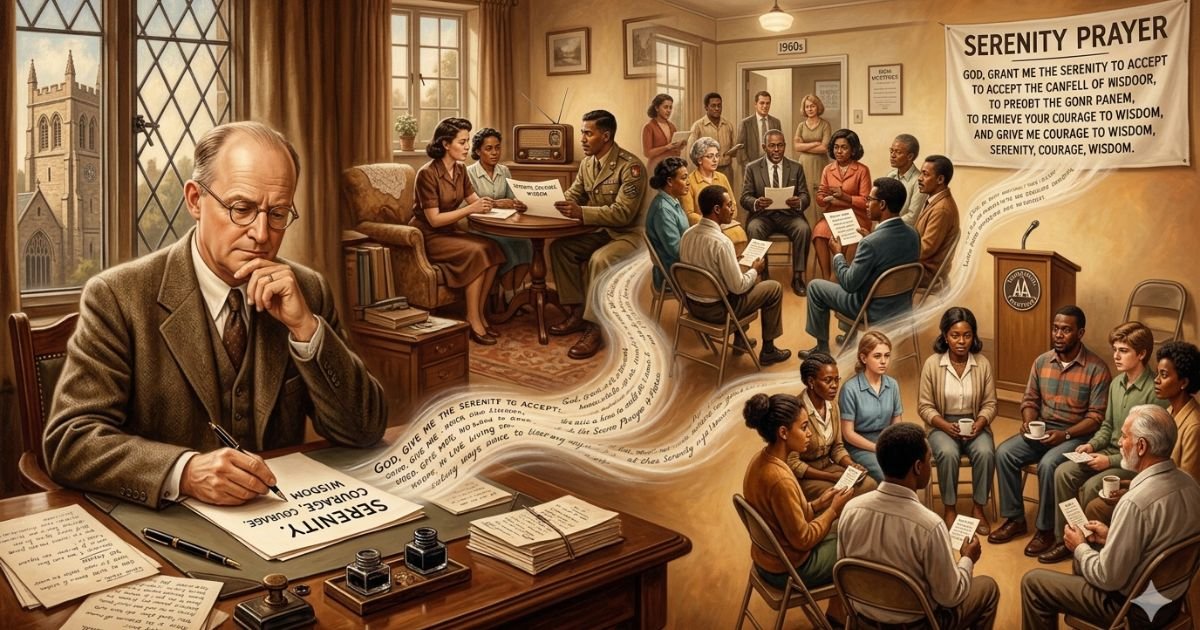
The Serenity Prayer is most commonly attributed to Reinhold Niebuhr, an American theologian born in 1892 who became one of the most respected Christian thinkers of the 20th century. He used various forms of the prayer in his sermons beginning around 1934.
The prayer spread largely without his name attached to it. In the early 1940s, it was distributed through the United Service Organizations to American military chaplains. It appeared in a 1944 collection of prayers and services for the armed forces, reaching soldiers and their families across the country during World War II.
Around the same time, Alcoholics Anonymous adopted the prayer. Bill Wilson, one of the co-founders of AA, recognized in its words something essential to the recovery process. The balance between acceptance and action, the call for wisdom, the grounding in something larger than oneself. These aligned directly with the spiritual principles of the twelve steps.
From there, the prayer spread rapidly through AA and other twelve-step communities, and eventually into broader American culture. It has appeared in courtrooms and church bulletins, on refrigerator magnets and framed prints, in therapy offices and hospital waiting rooms. Niebuhr himself published the prayer in a magazine column in 1951, finally establishing an official written record.
Today, the Serenity Prayer is recognized across faith traditions and even in secular contexts. Its reach extends far beyond Christianity into any space where people are seeking peace in difficult circumstances.
Also Read: 20 Powerful Prayer for Fasting and Prayer to Strengthen Your Faith
The Full Serenity Prayer in Recovery: Why It Matters So Much
For people in recovery from addiction, the Serenity Prayer is not just a poem. It is a daily practice. It shows up at the beginning of AA meetings and countless other twelve-step gatherings because its message speaks directly to the experience of addiction and the process of healing.
Addiction often involves a desperate attempt to control: to control pain, to control feelings, to control outcomes. The Serenity Prayer gently but consistently redirects that energy. It asks the person in recovery to release what cannot be controlled and to focus only on what can be. That shift in orientation is not just spiritually meaningful. Research in addiction treatment consistently shows that acceptance-based approaches lead to better outcomes.
The three core requests of the prayer align naturally with key aspects of recovery:
- Serenity supports emotional regulation and reduces the reactivity that can trigger relapse.
- Courage supports the willingness to do the hard work of recovery, making amends, changing relationships, facing buried feelings.
- Wisdom helps people recognize their own patterns, triggers, and limitations, which is essential for long-term sobriety.
The extended portion of the prayer adds even more. The call to live one day at a time is foundational in recovery culture. The acceptance of hardship as meaningful rather than meaningless helps reframe the pain of the journey. And the trust in something greater than oneself mirrors the higher-power framework that undergirds twelve-step programs.
Many people in recovery describe the Serenity Prayer as the thing they reach for when nothing else is working. It is brief enough to hold in the mind during a craving, deep enough to return to in quiet moments of reflection.
The Serenity Prayer and Mental Health: A Therapeutic Perspective
Beyond recovery, the Serenity Prayer has found a meaningful home in mental health contexts. Therapists, counselors, and psychiatrists have long recognized the psychological wisdom embedded in its framework, even when their clients are not approaching it from a faith perspective.
The core structure of the prayer mirrors several evidence-based therapeutic approaches. Acceptance and Commitment Therapy, or ACT, centers on the idea that psychological suffering is often caused not by difficult experiences themselves but by the way we fight against them. The more we resist what we cannot change, the more power it holds over us. ACT teaches clients to accept their inner experience and commit to action aligned with their values. This is, in essence, what the Serenity Prayer has been teaching for nearly a century.
Similarly, Cognitive Behavioral Therapy emphasizes the importance of distinguishing between what is in your control and what is not. Learning to redirect mental energy toward actionable steps rather than fixating on unchangeable circumstances is a core skill in CBT. The prayer models exactly this distinction.
Mindfulness practices, which have become central to modern mental health treatment, echo the prayer’s invitation to live one moment at a time. Staying present, noticing without judgment, and releasing the urge to control, these are themes that connect deeply to both the mindfulness tradition and the full Serenity Prayer.
Even from a purely secular standpoint, the prayer offers a psychologically sound framework for coping with uncertainty, loss, anxiety, and change. It does not promise that things will always work out. It offers something more honest: a way of moving through life with less resistance and more clarity.
How to Pray the Full Serenity Prayer in Daily Life
Knowing the words is only the beginning. The real power of the Serenity Prayer comes through consistent, intentional practice. It is not a magic formula. It is a daily orientation, a way of returning to the center when life pulls you off course.
Here are some practical ways to make it part of your daily rhythm:
Start Your Morning With It
Reading the full Serenity Prayer before your day begins sets a tone. It reminds you of what you can and cannot control before you encounter the inevitable friction of the day. Even reading it silently takes less than a minute, but the effect can carry through hours.
Use It During Stressful Moments
When something catches you off guard and your body tightens with anxiety or frustration, returning to the opening lines can interrupt that spiral. Taking a breath and quietly repeating the first four lines is a simple but effective way to create space between what happened and how you respond.
Journal Around Its Themes
Choose one line from the prayer and spend five minutes writing about it. What is one thing in your life right now that you cannot change? What is one thing you can? Where do you feel the tension between them? Writing creates clarity that reading alone does not always produce.
Pray It With Intention
If you come from a faith background, pray the full version slowly and with genuine openness. Let each line become an actual request rather than a recitation. Notice what comes up as you sit with the harder lines, the ones about surrender, or about taking the world as it is.
Return to It in the Evening
Ending the day with the Serenity Prayer can help process whatever happened. It is a way of releasing the day, naming what you tried to control and what you need to let go, and resting in the hope the prayer holds for what comes next.
Common Misunderstandings About the Serenity Prayer
Because the Serenity Prayer is so widely known, it is also widely misread. A few misconceptions come up again and again, and they can actually limit the prayer’s effectiveness if left uncorrected.
Acceptance Does Not Mean Approval
This is probably the most common misunderstanding. When people hear “accept the things I cannot change,” they sometimes think it means deciding that bad things are acceptable or that injustice should go unchallenged. That is not what it means.
Acceptance, in this context, is about acknowledging reality clearly, not endorsing it. You can accept that someone hurt you and still believe what they did was wrong. You can accept a diagnosis and still grieve it. Acceptance is the first step toward an honest response, not a declaration that everything is fine.
The Prayer Is Not Only for People in Recovery
The Serenity Prayer is deeply associated with AA and twelve-step communities, and that connection is meaningful. But limiting it to those contexts misses something important. The prayer was written for a much broader human experience. Anyone navigating anxiety, grief, change, or uncertainty can find something genuine in its words.
Surrender Is Not Weakness
The language of surrender makes some people uncomfortable, especially in a culture that prizes control and self-sufficiency. But surrender in the spiritual sense is not defeat. It is the release of an illusion. The illusion that we can control everything if we just try hard enough. Letting go of that illusion is actually one of the most liberating things a person can do.
It Is Not a Passive Prayer
Some people read the Serenity Prayer as an invitation to stop trying. That misses the courage half entirely. The prayer is not asking you to be passive. It is asking you to direct your energy wisely: toward what you can actually change, and away from what you cannot. That requires discipline, not passivity.
Variations of the Serenity Prayer You May Encounter
Because the prayer spread so widely and so quickly in its early years, often without attribution, several variations developed over time. You may encounter slightly different versions in different contexts.
Some versions use “grant us” rather than “grant me,” reflecting a communal rather than individual prayer. Some include slightly different punctuation or line breaks. Occasionally, the word “hardships” appears in plural form rather than singular. Some AA groups use a slightly condensed version that omits a line or two from the extended portion.
None of these variations changes the core meaning of the prayer. The essential framework remains: ask for serenity, courage, and wisdom; live one day at a time; accept hardship as meaningful; trust in something greater; hold onto hope for what comes after.
If you have encountered a version that feels different from what you have read here, that is normal. What matters is not the precise wording but the posture of the heart that the prayer invites.
The Theological Depth of the Full Serenity Prayer

Reinhold Niebuhr was not writing a self-help slogan. He was a serious theologian, and the full Serenity Prayer reflects his theological convictions about human nature, grace, and hope.
The prayer is grounded in a realistic view of the world. It does not pretend that life is easy or that faith removes difficulty. It acknowledges that the world is broken (“this sinful world”) and that human beings are limited in what they can fix. This is a theologically honest starting point.
But the prayer does not stop at human limitation. It points toward grace. The things we cannot do on our own, accept with peace, act with courage, discern with wisdom, are given to us through prayer. This is a distinctly Christian theological move: the recognition that transformation comes not primarily through human effort but through divine gift.
The closing lines also reflect Niebuhr’s eschatological hope, his belief in something beyond this life. The prayer does not hold out for perfect happiness in the present. It holds out for something greater. “Supremely happy with Him forever in the next.” That is not a vague spiritual sentiment. For Niebuhr, it was a grounded theological conviction about the nature of Christian hope.
For readers who do not share that theological framework, the prayer can still be meaningful. But understanding its theological roots helps explain why it resonates so deeply. It was written not as a platitude but as a genuine spiritual statement by a person who had thought carefully about what it means to live faithfully in an imperfect world.
Also Read: 10 Powerful Prayers Before Confession for Spiritual Cleansing and Forgiveness
When Is the Best Time to Pray the Full Serenity Prayer?
There is no wrong time to pray the Serenity Prayer. But there are certain moments when it is particularly well-suited to where the heart is.
- When you are trying to control something you cannot actually control. This is the prayer’s most classic application. If you notice yourself obsessing over an outcome, a person’s choices, or a situation that is genuinely out of your hands, the prayer can help redirect that energy.
- When you are facing a decision and do not know which direction to go. The wisdom line is particularly useful in these moments. Sometimes just sitting quietly with that request can open up clarity that felt unavailable before.
- When grief or loss makes everything feel uncertain. The acceptance framework of the prayer can help create some emotional stability in the midst of deep pain.
- When you are in recovery and feeling the pull of old patterns. Having the prayer close in those moments gives you something concrete to return to.
- When anxiety about the future becomes overwhelming. The one-day-at-a-time framing can genuinely reduce that sense of being swamped by possibilities that have not happened yet.
- When you need a reminder that you are not carrying this alone. The prayer’s act of turning toward God is itself a reminder that help is available.
Frequently Asked Questions
What is the full version of the Serenity Prayer?
The full version includes asking for serenity, courage, and wisdom, followed by guidance on living one day at a time and accepting life as it is. It ends with trust in a higher will and hope for peace.
What is the full verse of the Serenity Prayer?
It is the same as the full Serenity Prayer text you provided. It includes both the short core lines and the extended reflection about acceptance, surrender, and daily living.
What was the original Serenity Prayer?
The original form is believed to be the short version: asking for serenity, courage, and wisdom. It was later expanded into the longer version used in recovery and spiritual contexts.
What is the old version of the Serenity Prayer?
The “old version” usually refers to the short 3–4 line prayer. It focuses only on serenity, courage, and wisdom without the extended explanation.
Is there an extended Serenity Prayer?
Yes, the extended version includes reflections on daily living, acceptance of hardship, surrender to God’s will, and hope for happiness in this life and beyond.
A Prayer Worth Returning To
The full Serenity Prayer has endured because it tells the truth. It does not promise that life will be easy or that faith will remove every difficulty. It offers something more honest and more useful: a framework for navigating difficulty with grace, clarity, and hope.
If you are in a season of struggle right now, this prayer was written for exactly where you are. Not for people who have it all figured out, but for people in the middle of something hard who are trying to hold on. The ask for serenity is real. The courage it calls for is the kind that most of us need every single day. And the wisdom it points toward comes slowly, through experience and humility and the willingness to keep trying.
Come back to this prayer when life feels unmanageable. Read the full version slowly. Let it settle. Not every line will hit you the same way each time you read it. Some seasons will make the acceptance lines feel most urgent. Others will call you toward the surrender in the later portion. That is how a truly good prayer works. It meets you where you are.
You do not have to carry this alone. That is what the prayer has always been trying to say.

Welcome to Blessing Bloom. I’m Ahsan Ali, founder of BlessingBloom.com a faith-based website dedicated to sharing prayers, blessings, and heartfelt wishes. Based in Islamabad, Pakistan, I created Blessing Bloom to help people find the right words during life’s most meaningful moments. With a background in Information Technology, I combine a passion for digital content with a genuine love for faith-inspired writing.