


There is something quietly sacred about the way a child reaches out to touch a sleeping dog, or the way a farmer pauses to check on a limping horse before heading inside for the night. These small moments of tenderness reveal something true about the human heart. They also point to something true about God. If you have ever felt a deep love for animals and wondered whether Scripture has anything to say about that love, you are in exactly the right place. These scriptures about loving animals will surprise you, move you, and draw you closer to the God who created every living thing with purpose and care.
Why Scriptures About Loving Animals Still Speak to Us Today
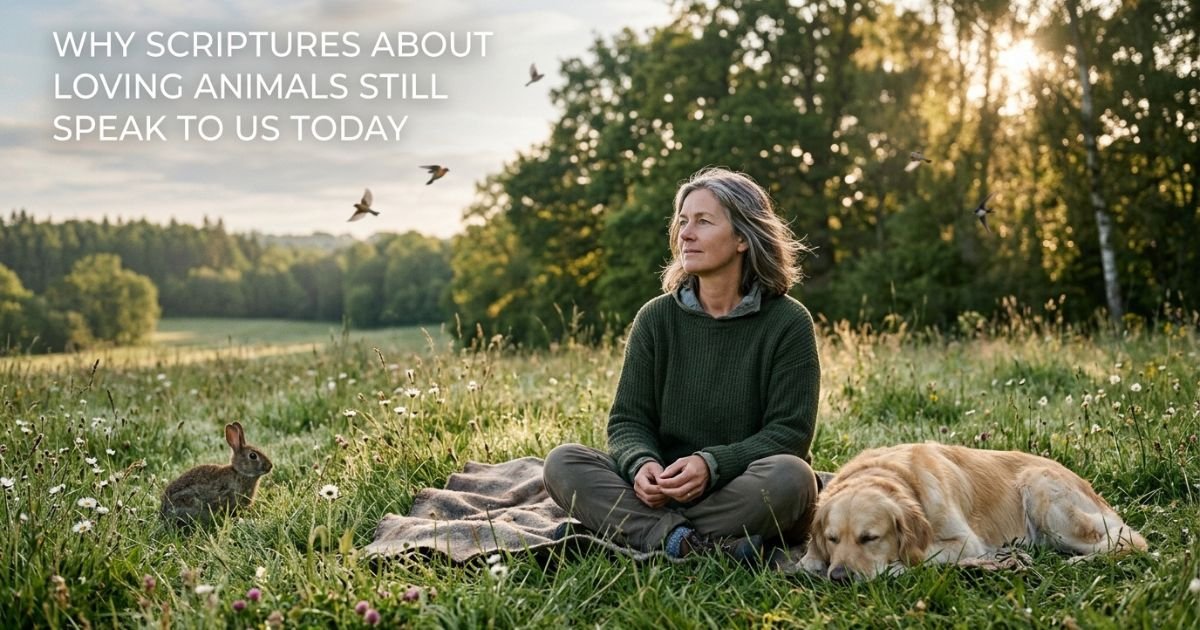
Most people do not think of the Bible as a book about animals. But once you start looking, the creatures are everywhere. Ravens and sparrows. Lions and lambs. Oxen and donkeys. Wild horses and mountain goats. God fills His Word with living creatures, and He does not treat them as unimportant background details.
The truth is, how we treat animals says something about who we are. Proverbs 12:10 makes this connection directly when it says that a righteous person cares about the needs of their animal. This is not a minor detail tucked into an obscure passage. It is a moral statement about character.
When you read these scriptures about loving animals, you are reading about the heart of God. He notices the creatures He made. He provides for them. He includes them in His covenants. And He calls us, His people, to reflect that same compassion in how we live.
Also Read: 65 Comforting Bible Verses for Heart Patients in Need of Hope
God Created Every Animal With Intention
Before we can understand why animals matter, we need to start at the beginning. Genesis is not just the story of human origins. It is the story of a God who spoke entire ecosystems into existence and called them good.
These verses show that every creature has a Maker who designed it, named it, and declared it worthy of existence.
- Genesis 1:20 “And God said, Let the waters bring forth abundantly the moving creature that hath life, and fowl that may fly above the earth in the open firmament of heaven.”
God did not accidentally fill the seas and skies. He commanded them to overflow with life. The abundance of animal life around us reflects the generosity of the Creator.
- Genesis 1:21 “And God created great whales, and every living creature that moveth, which the waters brought forth abundantly, after their kind, and every winged fowl after his kind: and God saw that it was good.”
God looked at the animals He made and called them good. That word good carries weight in Scripture. It means pleasing, complete, and worthy of existence.
- Genesis 1:24 “And God said, Let the earth bring forth the living creature after his kind, cattle, and creeping thing, and beast of the earth after his kind: and it was so.”
Every category of land animal came into being because God spoke. This was not random. It was intentional, ordered, and beautiful.
- Genesis 1:25 “And God made the beast of the earth after his kind, and cattle after their kind, and every thing that creepeth upon the earth after his kind: and God saw that it was good.”
Again, God looks at what He has made and declares it good. Animals were not an afterthought. They were part of a design that God evaluated and approved.
- Genesis 1:30 “And to every beast of the earth, and to every fowl of the air, and to every thing that creepeth upon the earth, wherein there is life, I have given every green herb for meat: and it was so.”
From the very beginning, God provided food for animals. He thought about their needs before they ever had a need. That is the kind of God we serve.
- Genesis 2:19 “And out of the ground the Lord God formed every beast of the field, and every fowl of the air; and brought them unto Adam to see what he would call them: and whatsoever Adam called every living creature, that was the name thereof.”
Adam named every animal. This naming was not merely a cataloging exercise. It was a relational act. It required Adam to look at each creature, observe it, and speak a name over it. That kind of attention is the beginning of care.
- Genesis 2:20 “And Adam gave names to all cattle, and to the fowl of the air, and to every beast of the field…”
Every creature received a name from the first human being. There is something tender about this. It suggests that the relationship between humans and animals goes back to the very first days of creation.
- Genesis 9:9-10 “And I, behold, I establish my covenant with you, and with your seed after you; And with every living creature that is with you, of the fowl, of the cattle, and of every beast of the earth with you…”
After the flood, God made a covenant with Noah and his family. But he did not stop there. He explicitly extended that covenant to every living creature. Animals were included in God’s promise of protection and preservation.
- Genesis 9:12 “And God said, This is the token of the covenant which I make between me and you and every living creature that is with you, for perpetual generations.”
The rainbow was a sign of a promise made not only to humanity but to all living creatures. Every time we see a rainbow, we are looking at a reminder that God keeps His word to every creature He has made.
God Provides for Every Creature He Made
One of the most comforting themes in the Bible is that God does not create something and then abandon it. He provides. He sustains. He feeds. These verses show that God’s care for animals is active, personal, and ongoing.
- Psalm 36:6 “Thy righteousness is like the great mountains; thy judgments are a great deep: O Lord, thou preservest man and beast.”
God preserves both people and animals. This verse puts humans and animals side by side under the umbrella of God’s care. His protection is wide enough to cover every living thing.
- Psalm 50:10 “For every beast of the forest is mine, and the cattle upon a thousand hills.”
Every animal belongs to God. This is a humbling reminder. When we own a pet or keep livestock, we are not the ultimate owners. We are stewards of what belongs to Him.
- Psalm 50:11 “I know all the fowls of the mountains: and the wild beasts of the field are mine.”
God knows every bird. Not just the songbirds in our backyards, but the birds on remote mountaintops that no human eye has ever seen. His knowledge of His creation is complete.
- Psalm 104:10-11 “He sendeth the springs into the valleys, which run among the hills. They give drink to every beast of the field: the wild asses quench their thirst.”
God engineers the water supply so that wild animals can drink. Even the wild donkeys in the desert are cared for by the God who made mountains and valleys and positioned springs to reach them.
- Psalm 104:14 “He causeth the grass to grow for the cattle, and herb for the service of man…”
God causes grass to grow specifically for cattle. He thinks about what animals need to eat and designs the earth to provide it. This is not passive. It is intentional provision.
- Psalm 104:17 “Where the birds make their nests: as for the stork, the fir trees are her house.”
God provides shelter for birds. The fir trees are not just scenery. They are homes designed by the Creator for the creatures He loves.
- Psalm 104:18 “The high hills are a refuge for the wild goats; and the rocks for the conies.”
Even the geography of the Earth serves animal life. Rocky terrain becomes shelter. High hills become a refuge. God has built the needs of His creatures into the very landscape of the world.
- Psalm 104:21 “The young lions roar after their prey, and seek their meat from God.”
Wild lions hunt, but Scripture says they seek their food from God. Even the predators of the wild are dependent on their Creator. No creature lives outside His awareness.
- Psalm 104:24-25 “O Lord, how manifold are thy works! In wisdom hast thou made them all: the earth is full of thy riches. So is this great and wide sea, wherein are things creeping innumerable, both small and great beasts.”
The diversity of animal life in the ocean alone is breathtaking. This verse calls diversity a sign of God’s wisdom. Every creature in every depth of the sea reflects the genius of its Maker.
- Psalm 104:27-28 “These wait all upon thee; that thou mayest give them their meat in due season. That thou givest them they gather: thou openest thine hand, and they are filled with good.”
Every creature is waiting on God. They gather what He provides. When He opens His hand, they are filled. This is one of the most beautiful pictures of divine generosity in all of Scripture.
- Psalm 145:15-16 “The eyes of all wait upon thee; and thou givest them their meat in due season. Thou openest thine hand, and satisfiest the desire of every living thing.”
Every living thing has desires, and God satisfies them. This is not just about physical hunger. The word desire here carries the sense of longing, want, and need. God meets the deep needs of every creature He made.
- Psalm 147:9 “He giveth to the beast his food, and to the young ravens which cry.”
Young ravens crying out in hunger are heard by God. He responds. This is one of the most intimate scriptures about loving animals in the entire Bible. No creature’s cry is too small for Him to notice.
- Job 38:41 “Who provideth for the raven his food? When his young ones cry unto God, they wander for lack of meat.”
God asks Job who provides for the raven. The implied answer is that He does. Even the raven’s young, wandering and hungry, are under the care of the Creator.
- Job 39:1-2 “Knowest thou the time when the wild goats of the rock bring forth? or canst thou mark when the hinds do calve? Canst thou number the months that they fulfil?”
God knows the exact timing of every wild animal’s birth. He tracks the pregnancies of mountain goats that no human shepherd tends. His knowledge of animal life is intimate and complete.
- Jonah 4:11 “And should not I spare Nineveh, that great city, wherein are more than sixscore thousand persons…and also much cattle?”
When God explains His mercy toward Nineveh, He mentions the cattle. He was not indifferent to the animals living in that city. They were part of His reason for showing compassion. This single phrase at the end of Jonah carries enormous weight.
Animals Teach Us About God’s Wisdom
The Bible uses animals to teach some of its most powerful lessons. From ants to eagles, from sparrows to lions, creatures become living illustrations of divine truth. These verses invite us to learn from the world God made.
- Job 12:7-10 “But ask now the beasts, and they shall teach thee; and the fowls of the air, and they shall tell thee: Or speak to the earth, and it shall teach thee: and the fishes of the sea shall declare unto thee. Who knoweth not in all these that the hand of the Lord hath wrought this? In whose hand is the soul of every living creature, and the breath of all mankind.”
Animals are teachers. Scripture says so directly. When we pay attention to the creatures around us, we learn something about God. Their instincts, their survival, their patterns, all of it points back to the hand of the Creator.
- Proverbs 6:6 “Go to the ant, thou sluggard; consider her ways, and be wise.”
A tiny insect becomes a moral instructor. The ant teaches diligence, preparation, and wisdom without a single word. If Scripture sends us to school with the ant, then no creature is too small to teach us something meaningful.
- Proverbs 30:24-25 “There be four things which are little upon the earth, but they are exceeding wise: The ants are a people not strong, yet they prepare their meat in the summer.”
Small animals are called exceedingly wise. Their wisdom is not human intelligence. It is a God-designed instinct that reflects divine order and purpose.
- Proverbs 30:26 “The conies are but a feeble folk, yet make they their houses in the rocks.”
The cony, a small rock-dwelling creature, finds its home in the cliffs. Its weakness does not disqualify it. It knows where to go for shelter. That is a lesson some of us are still learning.
- Proverbs 30:27 “The locusts have no king, yet go they forth all of them by bands.”
Locusts move in organized, disciplined swarms without a visible leader. Scripture notices this and draws a lesson. Order and unity can exist without one central authority when each part fulfills its role.
- Proverbs 30:28 “The spider taketh hold with her hands, and is in kings’ palaces.”
The spider builds her home through persistent effort and reaches places no one expects. Small, persistent creatures accomplish remarkable things. God designed that.
- Isaiah 1:3 “The ox knoweth his owner, and the ass his master’s crib: but Israel doth not know, my people doth not consider.”
God uses the ox and donkey as examples of loyalty. They know who feeds them and who cares for them. God says His own people have shown less awareness than farm animals. It is a sobering comparison.
- Matthew 6:26 “Behold the fowls of the air: for they sow not, neither do they reap, nor gather into barns; yet your heavenly Father feedeth them. Are ye not much better than they?”
Jesus tells His followers to watch the birds. Not just glance at them, but observe them. The birds do not plant or harvest, yet God feeds them. This is a living, daily demonstration of divine care that Jesus uses to build human faith.
- Luke 12:24 “Consider the ravens: for they neither sow nor reap; which neither have storehouse nor barn; and God feedeth them: how much more are ye better than the fowls?”
Ravens were not prestigious birds in the ancient world. They were considered unclean by Jewish law. Yet God feeds them. His care does not follow the hierarchy of human preference.
God Calls His People to Care for Animals
The Bible does not just describe God’s care for animals. It commands ours. These verses show that treating animals with compassion is not optional for people who follow God. It is part of what it means to live righteously.
- Proverbs 12:10 “A righteous man regardeth the life of his animal: but the tender mercies of the wicked are cruel.”
This verse is the cornerstone of biblical animal care. A righteous person pays attention to the life and well-being of their animal. The wicked person, even when trying to be kind, does it cruelly. Compassion is a character issue.
- Deuteronomy 25:4 “Thou shalt not muzzle the ox when he treadeth out the corn.”
Working animals were to be allowed to eat while they worked. This is a law about practical fairness. Animals that labor for human benefit should not be denied the basic provision of food.
- Exodus 23:5 “If thou see the ass of him that hateth thee lying under his burden, and wouldest forbear to help him, thou shalt surely help with him.”
This law is remarkable. Even if the animal belongs to your enemy, you are required to help it when it is suffering under a heavy load. The animal’s suffering takes priority over human grudges.
- Exodus 23:12 “Six days thou shalt do thy work, and on the seventh day thou shalt rest: that thine ox and thine ass may rest, and the son of thy handmaid, and the stranger, may be refreshed.”
The Sabbath rest was designed for animals, too. God specifically included oxen and donkeys in the weekly rest. Even animals deserve time to recover from labor.
- Deuteronomy 22:6-7 “If a bird’s nest chance to be before thee in the way in any tree, or on the ground, whether they be young ones, or eggs, and the dam sitting upon the young, or upon the eggs, thou shalt not take the dam with the young: But thou shalt in any wise let the dam go, and take the young to thee; that it may be well with thee, and that thou mayest prolong thy days.”
God’s law protected mother birds from being taken along with their young. This is a law about restraint and respect for the natural order. Humans are allowed to take from creation, but not without limit, and not without mercy.
- Deuteronomy 5:14 “But the seventh day is the sabbath of the Lord thy God: in it thou shalt not do any work, thou, nor thy son, nor thy daughter, nor thy manservant, nor thy maidservant, nor thine ox, nor thine ass, nor any of thy cattle…”
The Ten Commandments include animals in the Sabbath rest. If the Ten Commandments are serious enough to include cattle, then how we treat animals is a serious moral matter.
- Deuteronomy 22:10 “Thou shalt not plow with an ox and an ass together.”
This law protected animals from being forced to work at a pace or in a manner that caused unnecessary difficulty. The ox and the donkey move differently, and yoking them together would harm them both. God noticed even that.
- Deuteronomy 22:4 “Thou shalt not see thy brother’s ass or his ox fall down by the way, and hide thyself from them: thou shalt surely help him to lift them up again.”
When an animal is struggling, you are not allowed to look away and keep walking. God requires action. Compassion must be active, not passive.
- Numbers 22:28 “And the Lord opened the mouth of the ass, and she said unto Balaam, What have I done unto thee, that thou hast smitten me these three times?”
God used a donkey to speak truth and protect a man from his own blindness. The animal saw what the prophet could not see. God can use any creature He chooses to accomplish His purposes.
- Numbers 22:32-33 “And the angel of the Lord said unto him, Wherefore hast thou smitten thine ass these three times? behold, I went out to withstand thee, because thy way is perverse before me: And the ass saw me, and turned from me these three times: unless she had turned from me, surely now also I had killed thee, and saved her alive.”
The donkey saved Balaam’s life. God acknowledged the animal’s obedience and told Balaam that the donkey had been protecting him. This passage treats the donkey’s perception and behavior as meaningful and praiseworthy.
Also Read: 100 Bible Verses Proving God Will Restore 7 Times What the Enemy Has Stolen
Jesus and His Tender View of Animals
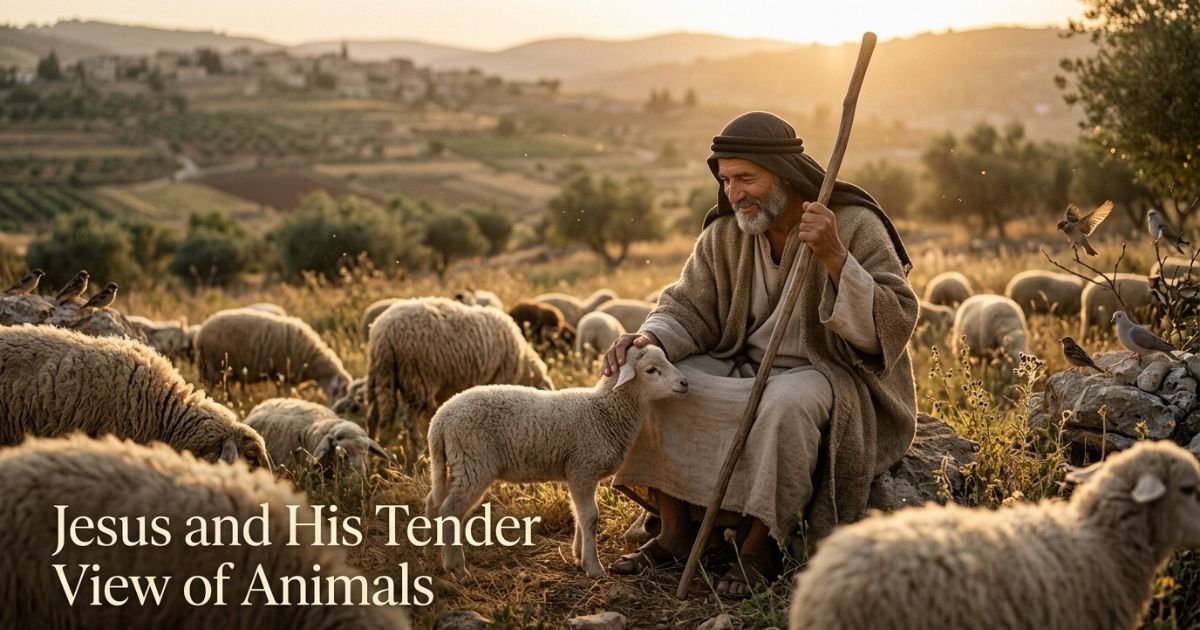
Jesus grew up in a world filled with animals. Sheep, goats, oxen, donkeys, sparrows, fish. He used them constantly in His teaching, not because they were convenient props but because He understood them and cared about them. These verses reveal the compassion of Jesus toward the creatures He created.
- Matthew 10:29 “Are not two sparrows sold for a farthing? and one of them shall not fall on the ground without your Father.”
Sparrows were the cheapest birds sold in the marketplace. Two of them could be bought for almost nothing. Yet Jesus says the Father notices when even one of them falls. No creature is too small or too common to escape God’s attention.
- Matthew 10:31 “Fear ye not therefore, ye are of more value than many sparrows.”
Jesus does not say sparrows have no value. He says humans have more. The comparison only works if sparrows already matter to God. Their value is the baseline from which human value is measured.
- Luke 12:6 “Are not five sparrows sold for two farthings, and not one of them is forgotten before God?”
Five sparrows for two pennies. The price drops when you buy more. Yet God forgets not one. His attention to the small and the cheap and the overlooked is without limit.
- Luke 13:15 “The Lord then answered him, and said, Thou hypocrite, doth not each one of you on the sabbath loose his ox or his ass from the stall, and lead him away to watering?”
Jesus used the ordinary care people showed for their animals as a moral argument. If you would relieve your thirsty ox on the Sabbath, surely healing a suffering person is more than acceptable. He assumed that basic animal care was already a given.
- Luke 14:5 “And answered them, saying, Which of you shall have an ass or an ox fallen into a pit, and will not straightway pull him out on the sabbath day?”
Jesus assumed everyone listening would immediately rescue an animal that had fallen into a pit, even on the Sabbath. He used this natural compassion as evidence that mercy always takes priority over religious rigidity.
- John 10:11 “I am the good shepherd: the good shepherd giveth his life for the sheep.”
Jesus did not choose this metaphor casually. A good shepherd was someone who knew each sheep, protected them from predators, led them to water and pasture, and placed their well-being above personal comfort. Jesus claimed that identity for Himself.
- John 10:14-15 “I am the good shepherd, and know my sheep, and am known of mine. As the Father knoweth me, even so know I the Father: and I lay down my life for the sheep.”
The shepherd knows his sheep. This is personal, intimate knowledge. The same word used for the Father knowing the Son is used for the shepherd knowing his flock. That tells us something about the depth of care Jesus describes.
- Matthew 12:11 “And he said unto them, What man shall there be among you, that shall have one sheep, and if it fall into a pit on the sabbath day, will he not lay hold on it, and lift it out?”
Again, Jesus points to the rescue of a fallen sheep as an obvious moral act. He did not have to argue for it. He simply assumed it. The love we feel for animals is not irrational. It is built into how God designed human hearts.
- Luke 15:4 “What man of you, having an hundred sheep, if he lose one of them, doth not leave the ninety and nine in the wilderness, and go after that which is lost, until he find it?”
A shepherd leaves ninety-nine sheep to search for one lost sheep. This parable is about human souls, but the picture works because a good shepherd actually does this. The care Jesus describes is real and costly.
All Creation Praises God
Animals are not just recipients of God’s care. According to Scripture, they participate in the worship of their Creator. These verses expand our understanding of what praise looks like in a world made by God.
- Psalm 148:7 “Praise the Lord from the earth, ye dragons, and all deeps.”
Sea creatures are called to praise the Lord. Their existence is a form of praise. Every creature in the deep ocean that no human eye has ever seen still glorifies its Creator simply by being what it was made to be.
- Psalm 148:10 “Beasts, and all cattle; creeping things, and flying fowl.”
Every category of animal is included in the psalmist’s call to worship. Beasts of the wild, cattle of the farm, insects on the ground, birds in the sky. All of them are woven into the chorus of creation’s praise.
- Isaiah 43:20 “The beast of the field shall honour me, the dragons and the owls: because I give waters in the wilderness, and rivers in the desert, to give drink to my people, my chosen.”
God says the beasts of the field will honor Him. Their response to His provision is a form of recognition. Even the wild creatures acknowledge what God does for them.
- Revelation 5:13 “And every creature which is in heaven, and on the earth, and under the earth, and such as are in the sea, and all that are in them, heard I saying, Blessing, and honour, and glory, and power, be unto him that sitteth upon the throne, and unto the Lamb for ever and ever.”
John’s vision includes every creature in heaven and earth joining in praise to God. The final vision of Scripture is one of universal worship, and animals are part of it. Their voices are in the choir.
God’s Peace Includes the Animal Kingdom
Some of the most beautiful passages in the prophets describe a restored creation where animals live without fear, where violence gives way to peace, and where the whole created world reflects God’s original intention. These verses give us hope that God has not forgotten what He made.
- Isaiah 11:6 “The wolf also shall dwell with the lamb, and the leopard shall lie down with the kid; and the calf and the young lion and the fatling together; and a little child shall lead them.”
This is one of the most beloved prophetic images in all of Scripture. Animals that are natural enemies rest together. The little child leads them. God’s peace reaches into the animal kingdom and transforms it.
- Isaiah 11:7 “And the cow and the bear shall feed; their young ones shall lie down together: and the lion shall eat straw like the ox.”
The bear and the cow eat side by side. The lion eats straw. God’s restored world does not just heal human relationships. It heals the relationship between predator and prey. Creation itself is made new.
- Isaiah 11:9 “They shall not hurt nor destroy in all my holy mountain: for the earth shall be full of the knowledge of the Lord, as the waters cover the sea.”
When the knowledge of God fills the earth, harm and destruction will end. This promise includes the animal world. The violence that marks creation now is not the end of the story.
- Isaiah 65:25 “The wolf and the lamb shall feed together, and the lion shall eat straw like the bullock: and dust shall be the serpent’s meat. They shall not hurt nor destroy in all my holy mountain, saith the Lord.”
Isaiah returns to this image of peace between animals. It is not accidental repetition. God wants us to understand that His redemptive plan is wide enough to include the entire created order.
- Hosea 2:18 “And in that day will I make a covenant for them with the beasts of the field, and with the fowls of heaven, and with the creeping things of the ground: and I will break the bow and the sword and the battle out of the earth, and will make them to lie down safely.”
God promises a future covenant that includes animals. When He brings peace to the earth, the beasts of the field, the birds of the air, and the creatures of the ground are all included in that covenant of safety.
- Romans 8:19-21 “For the earnest expectation of the creature waiteth for the manifestation of the sons of God. For the creature was made subject to vanity, not willingly, but by reason of him who hath subjected the same in hope, because the creature itself also shall be delivered from the bondage of corruption into the glorious liberty of the children of God.”
Paul writes that all creation is waiting for liberation. The created world, including animals, is longing for the day when corruption and death will end. They were subjected to the brokenness of this world against their will, and God has promised them freedom.
- Romans 8:22 “For we know that the whole creation groaneth and travaileth in pain together until now.”
All of creation is in pain. Animals suffer. The natural world bears the marks of a broken world. But Paul frames this groaning as the labor pains that precede new birth. Hope is part of the picture.
Two More Scriptures That Deepen Our Understanding
- Psalm 145:9 “The Lord is good to all: and his tender mercies are over all his works.”
All of God’s works. Not just human works. Not just human prayers. His tender mercies cover everything He has made. That includes every creature in every corner of creation.
- Job 39:26-27 “Doth the hawk fly by thy wisdom, and stretch her wings toward the south? Doth the eagle mount up at thy command, and make her nest on high?”
God reminds Job that the hawk and the eagle operate according to divine design, not human understanding. Their migration patterns, their hunting instincts, their nesting choices, all of it reflects God’s creative intelligence. We did not design them, and we do not control them. We can only stand in awe of the One who does.
What Righteousness Looks Like in How We Treat Animals
Proverbs 12:10 says it plainly. A righteous person cares about the life of their animal. This is not a personality type or a preference. It is a character trait that the Bible connects directly to moral integrity.
The word used in that verse for the righteous person is the same word used throughout the Old Testament to describe people who are just, fair, and in right standing with God. In other words, this is not a verse for a special group of animal lovers. It is a verse for every person who wants to walk rightly before God.
What does this look like practically? It looks like noticing when an animal is in pain. It looks like providing adequate food, water, shelter, and care for animals under your responsibility. It looks like refusing to participate in cruelty. It looks like teaching children to be gentle with living creatures. It looks like supporting practices that are humane and opposing ones that are not.
These are not complicated ideas. They are extensions of the same compassion God calls us to show in every area of life.
The Difference Between Stewardship and Dominion
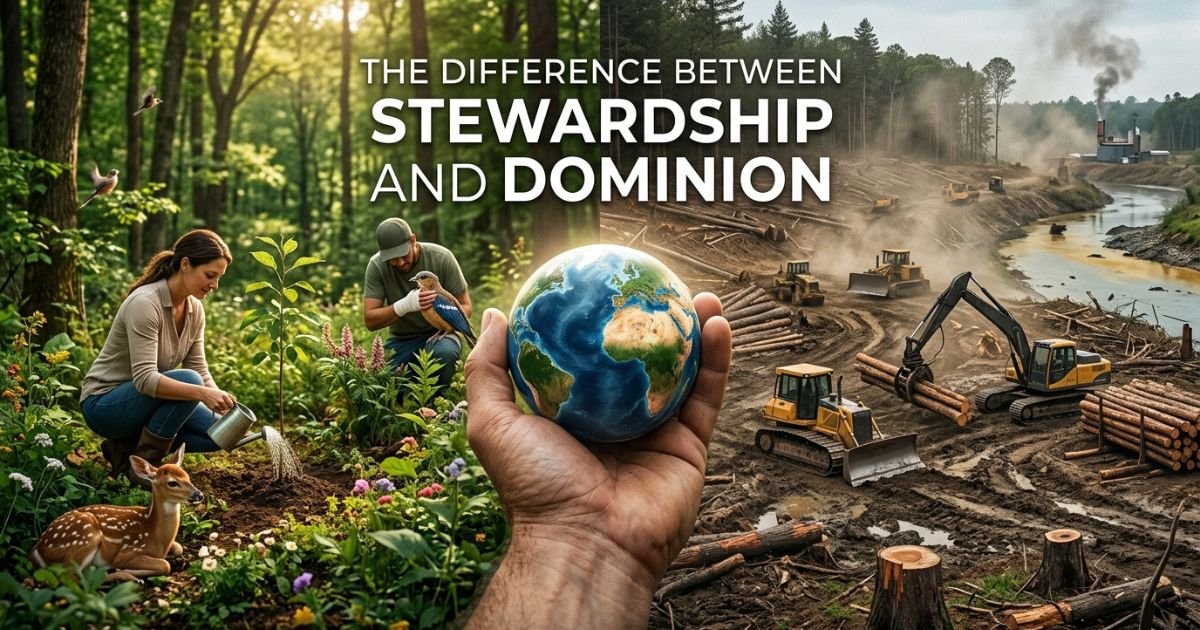
Genesis 1 gives humans dominion over animals, and that word has sometimes been misused to justify cruelty or careless exploitation. But biblical dominion was never designed to function that way.
Dominion in the biblical sense is stewardship. It means being entrusted with the care of something that belongs to God. Psalm 50:10 reminds us that every beast of the forest belongs to God. We are not the ultimate owners. We are managers of someone else’s property.
Good managers do not destroy what they have been given. They protect it, maintain it, and return it in better condition than they received it. That is the model God gives us for our relationship with the animal world.
The same God who gave us dominion also told us not to muzzle the working ox, not to take the mother bird with the young, to let our animals rest on the Sabbath, and to rescue a fallen animal even on a holy day. Dominion, properly understood, sounds a lot like tenderness.
When Animal Love Becomes an Act of Worship
There is a kind of care for animals that goes beyond mere sentiment. It becomes worship when it flows from an awareness of who created these creatures and why.
When you feed a stray dog on a cold morning because you know that God feeds ravens, that is worship. When you stop your car to move a turtle off a busy road because you believe God notices sparrows, that is worship. When you choose not to participate in systems that cause unnecessary animal suffering because you know that God’s tender mercies are over all His works, that is worship.
Worship is not limited to what happens in a church building on Sunday morning. It is any moment when human action aligns with divine character. God is compassionate toward every creature He made. When we are too, we are reflecting the image of the One in whose image we were made.
How to Use These Scriptures in Your Daily Life
These scriptures about loving animals are not just for reading. They are for living. Here are a few ways to let them shape your daily experience.
When you are with your pet, take a moment to remember that this creature was designed by God and entrusted to your care. That changes how you handle a difficult moment with a misbehaving dog or a scratch from a stressed cat.
When you feel moved to help an animal in distress, trust that impulse. It is consistent with the heart of God as revealed throughout Scripture. You are not being overly emotional. You are being righteous.
When you see animal suffering in the world and feel troubled by it, that is not weakness. It is a sign that your heart is aligned with God’s own concern for His creation. Channel it into prayer, into action, into advocacy.
When you are in nature, and you stop to watch a hawk circle overhead or notice the way a dog greets you at the door, let that moment connect you to the God who designed both the hawk and the dog and every creature in between. Let gratitude rise. Let wonder grow.
FAQs About Scriptures About Loving Animals
What does Proverbs 12:10 say about animals?
It says a righteous person cares for the needs of their animals, while the wicked are cruel even when trying to be kind.
It directly teaches that compassion toward animals is a sign of moral character.
What does Psalms 36:6 say about animals?
It says God preserves both humans and animals together under His righteousness.
This shows that God’s care and protection extend to all living creatures, not just people.
What did Jesus say about kindness to animals?
Jesus used animals like sparrows and sheep to show God’s care for all creation.
He taught that if God cares for animals, He surely values and provides for people even more.
Does God tell us to care for animals?
Yes, Scripture includes laws and teachings about treating animals with fairness and compassion.
Examples include resting for working animals, feeding them properly, and helping them in distress.
What does Ecclesiastes say about animals?
It teaches that humans and animals both share the same breath of life and return to dust.
This highlights the shared reality of all living beings under God’s creation.
What did Billy Graham say about pets going to heaven?
Billy Graham suggested that God may allow pets in heaven, but this is not a direct Bible teaching.
It is a personal theological opinion, not a confirmed Scripture-based doctrine.
Conclusion
What strikes me most about these scriptures about loving animals is how consistently God notices what human beings are tempted to overlook. The raven is crying. The sparrow falling. The ox is straining under its load. The cattle in a city that deserved judgment. God sees them all, and He cares.
That tells us something important. Compassion for animals is not a modern sentiment that Christians need to cautiously accept. It is woven into the character of God as revealed throughout the entire Bible, from the first chapter of Genesis to the final vision in Revelation.
You do not have to choose between loving God and loving the creatures He made. In fact, loving them well is one way of honoring Him. When you show tenderness to an animal, you are reflecting the heart of the One who made it, provides for it, and has not forgotten it.
Let these verses settle deep in you. Let them change the way you see the animals around you. And let them deepen your trust in a God whose tender mercies really do extend over all His works.

Welcome to Blessing Bloom. I’m Ahsan Ali, founder of BlessingBloom.com a faith-based website dedicated to sharing prayers, blessings, and heartfelt wishes. Based in Islamabad, Pakistan, I created Blessing Bloom to help people find the right words during life’s most meaningful moments. With a background in Information Technology, I combine a passion for digital content with a genuine love for faith-inspired writing.