


The ripple effect is one of the most quietly powerful forces in human life. It starts with something small. A word offered at the right moment. A hand extended without a second thought. A choice to stay and listen when everything inside you wants to go home. And then it moves. It travels through people and time in ways you will never fully track, and it changes things you will never even know needed changing.
Most of us underestimate what we carry. We move through our days believing that kindness is only meaningful when it is large, visible, and measurable. But that is simply not how kindness works. That is not how people work. And if you look closely at your own life, you will probably find that the moments someone changed you were not grand gestures at all. They were small ones, offered freely, from someone who may not have even realized what they were doing.
That is the ripple effect. That is what this is really about.
What Is the Ripple Effect, Really?
Before we go any further, it helps to understand what the ripple effect actually means, because the phrase gets used a lot, and sometimes it loses its weight in the repetition.
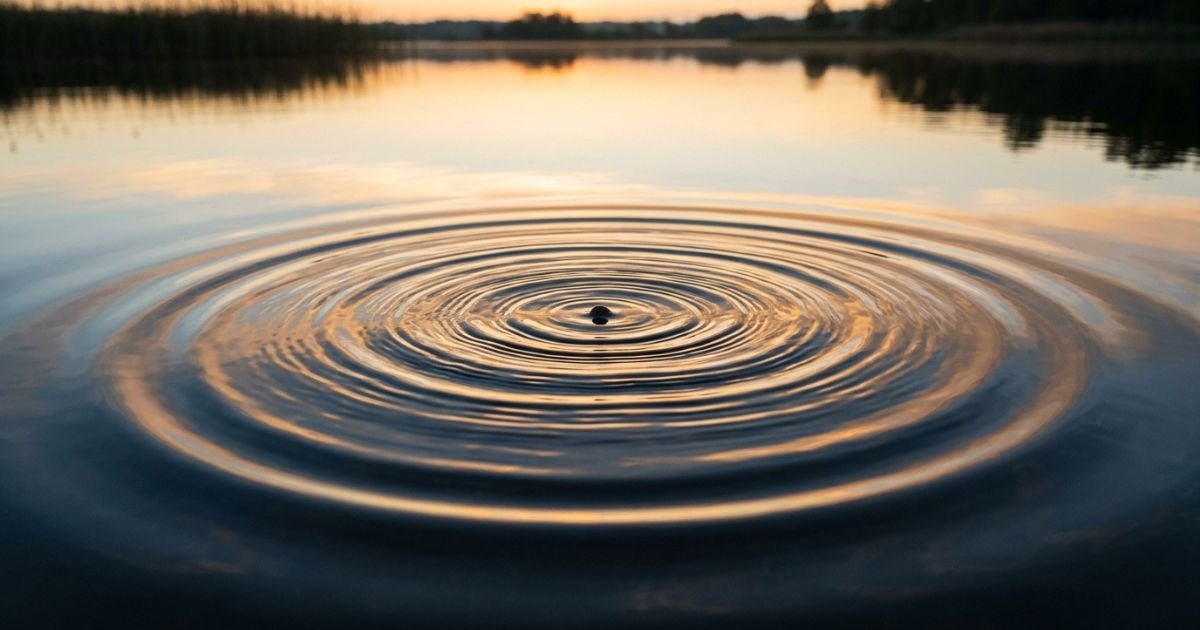
When you drop a single stone into still water, it does not create just one wave. It creates dozens, spreading outward in every direction, growing wider and quieter as they go, until they reach shorelines that the stone never aimed at. That image is the heart of the ripple effect.
Applied to human life, the ripple effect describes how one action, even a small one, sets off a chain of consequences that reaches far beyond the original moment. A word of encouragement given to a struggling coworker becomes the reason she finishes a project she almost abandoned. That project inspires a younger colleague who had been thinking about quitting. That younger colleague stays, grows, and years later mentors someone who needed exactly that kind of steadiness.
You said something kind on Tuesday afternoon. You will never know the rest of that story. But the story happened.
Also READ: The Beauty of Humility: A Lesson from the Clever Woodcutter
The Science That Confirms What Faith Already Knew
Research published in the Proceedings of the National Academy of Sciences found that acts of generosity are socially contagious. When one person behaves generously, others around them become more generous too. And that effect does not stop at one degree of separation. It spreads three connections outward. The person you helped helps someone they know. That person helps someone they know. And so on.
Scientists call this prosocial contagion. People of faith have simply called it love thy neighbor. The language is different. The truth underneath it is the same.
“Do not be weary in doing good, for in due season we will reap if we do not give up.” — Galatians 6:9
The Starfish and the Question That Changes Everything
There is an old story that has found its way into sermons, therapy offices, and quiet conversations between people trying to figure out how to keep going. You may have heard it before. It is worth sitting with again.
A man was walking along a beach at dawn when he noticed a young boy bending down, picking something up from the sand, and throwing it into the ocean. As he got closer, he saw that the beach was covered in starfish that had washed ashore overnight. The boy was throwing them back one by one.
The man stopped. He looked at the miles of beach. He looked at the thousands of starfish still lying on the sand. He said, kindly but honestly, that the boy could not possibly make a difference. There were too many. The task was too big.
The boy picked up another starfish and threw it into the waves. Then he looked at the man and said simply: it made a difference to that one.
Why the Old Man’s Logic Feels So Familiar
Here is the uncomfortable truth about the old man. He is not wrong about the math. He is wrong about the question.
When we look at the world and all of its broken, overwhelming places, the old man’s voice is the first one most of us hear. There is too much. I am too small. One person cannot fix this.
That voice is understandable. In many ways, it sounds like wisdom. But it is actually the voice of paralysis dressed up in reasonable clothing.
The boy shifts the question entirely. He is not asking, ” Can I fix everything? He is asking, ” Can I help this one? And the moment you shift from the scale of the problem to the scale of the person in front of you, the entire equation changes. You are no longer trying to rescue the ocean. You are trying to give one starfish a chance to live.
You are not responsible for solving all of it. You are responsible for what is in your hands right now.
The One in Front of You Is Never an Accident
There is a quiet but important spiritual truth woven into that story. The starfish that landed at the boy’s feet did not end up there randomly. The person who shows up in your path today, needing something you have, is rarely a coincidence. Faith asks us to take that seriously.
Treating each moment as an appointment rather than an interruption changes the way you move through the world. The neighbor who knocks on your door at an inconvenient time. The coworker who seems off today. The stranger in line who is clearly carrying something heavy. These are not obstacles. They are opportunities wearing ordinary disguises.
How the Ripple Effect Shows Up in Real Life
The ripple effect is not a metaphor that lives only in philosophy books and inspirational posters. It shows up in the actual texture of daily life, in workplaces, kitchens, parking lots, and hospital waiting rooms. Here is how it actually works.
In the People You Work With Every Day
Think about the best workplace environment you have ever been part of, or the best you have ever heard someone describe. Almost always, when you trace it back, there is a person at the center of it. Not necessarily a manager or a title. Just someone who decided to be kind consistently, without making it a performance.
Someone who remembered people’s names. Who said thank you and meant it. Who asked how you were doing and waited for the actual answer. Who made the culture feel human instead of transactional.
That kind of person does not transform a workplace through a single dramatic gesture. They transform it through accumulation. Through the slow, patient practice of treating people like they matter every single day. And eventually, almost without anyone noticing, other people start doing the same thing.
The ripple effect is not always loud. Sometimes it just looks like the office feels warmer than it used to.
In Your Family, Where Patterns Are Set
Families are, in many ways, the original ripple pools. The choices made inside a home travel for generations in ways that no one fully sees or tracks.
When a parent chooses patience over frustration with a child, that child is watching. Not consciously filing it away as a lesson, but absorbing it as a blueprint. How we handle anger. How do we talk about people who are different from us. Whether we help strangers or look away. These things are being recorded in the people around us, especially the young ones, and they will replay at moments we will never witness.
Your grandmother’s way of making people feel welcome. Your father’s habit of stopping to help someone whose car had broken down. Your aunt, who always had a kind word for the grocery store cashier. These things did not die with them. They are alive in the people who watched them, and in the people those people have touched.
This is one of the most hopeful things about the ripple effect: goodness outlives us. Every act of genuine love we put into the world keeps going after we are gone.
In Strangers, Who Remember More Than You Know
There is something about kindness extended to a stranger that seems to carry unusual weight. Perhaps because there is no social debt involved. No relationship to protect. No history. Just one person seeing another person and deciding to be good to them, simply because they can.
People carry those moments for years. A driver who let you in during a terrible commute when you were running late to something that mattered. A cashier who said something warm when you were clearly having a hard day. A person who sat next to you in a waiting room and offered a quiet, unhurried presence.
These things sound trivial when listed out. They are not trivial at all. They are, in many cases, the small handholds that people use to keep climbing when everything around them feels steep.
Why We Hold Back: The Honest Reasons We Don’t Always Start the Ripple
If kindness is this powerful, and its effects travel this far, why do we not do it more? That is a fair question, and it deserves an honest answer.
The Overwhelm of Scale
One of the biggest reasons people hold back is that they look at how much needs doing and feel completely undone by the gap between what they can offer and what the world seems to need.
Psychologists call this psychic numbing. The more enormous a problem becomes, the less emotionally able we are to respond to it. We feel more moved by one person’s specific story than by statistics about thousands. We are wired for the individual. And when the individual gets buried under the scale of everything, we shut down.
The boy on the beach has, without knowing any of this, solved the problem completely. He is not looking at thousands of starfish. He is looking at this one. And this one. And this one.
The antidote to overwhelm is not a bigger plan. It is a smaller focus.
The Fear That It Will Not Matter
Another very human reason for holding back is the quiet, unsettling fear that what we do simply will not make a difference. That the kindness we put out will dissolve into the noise. That no one will notice, or remember, or be changed.
This fear is understandable. It is also based on everything we know about how kindness actually travels, almost entirely wrong.
The research is detailed: we are terrible judges of our own impact. The things we consider too small to matter are often the things that matter most to the people who receive them. The offhand encouragement you gave someone in passing. The card you sent when someone was grieving. The time you showed up when it was inconvenient.
You may never know what those moments meant. That is not the same as them meaning nothing. The ripple goes where it goes, whether or not you watch it.
Waiting for the Perfect Moment That Never Comes
A third obstacle is the habit of waiting. Waiting until we have more to offer. More time, more resources, more confidence, more certainty that the help will land well. Meanwhile, the person in front of us waits too.
The perfect moment for kindness is almost always right now. Not because urgency demands it, though sometimes it does. But because the habit of waiting trains the heart to treat generosity as a special event rather than a daily way of living. And kindness that waits for the right occasion tends not to happen very much at all.
“And whatever you do, whether in word or deed, do it all in the name of the Lord Jesus, giving thanks to God the Father through him.” — Colossians 3:17
The Spiritual Dimension of the Ripple Effect

For people of faith, the ripple effect is not just an interesting psychological observation. It is a deeply theological reality. It is the way God tends to move in the world: not usually through the spectacular, but through the ordinary, the available, and the willing.
You Are Never Just One Person Acting Alone
There is a passage in 1 Corinthians 3 where Paul writes about planting and watering and growing, and how none of those roles is greater than the others, because God is the one who brings the increase. That framework changes how we think about the impact of our actions.
You do not have to be the whole harvest. You may simply be called to plant something small in one person’s life today. Someone else will water it. Someone else will tend it. And the fruit of that will belong to God, not to any one of the people along the chain.
This is enormously freeing. It releases you from the pressure of needing to see the full result of what you do. You are not the whole story. You are a chapter. And that chapter matters, whether or not you ever read the ending.
Faithfulness in Small Things as a Spiritual Practice
Jesus said that the person who is faithful in small things will be trusted with larger ones. That is not a productivity principle. It is a statement about character and formation.
Every small act of kindness is an act of spiritual practice. It shapes the person doing it just as much as it helps the person receiving it. Every time you choose patience over irritation, generosity over withholding, presence over distraction, you are becoming someone more capable of those things. You are building a self that leads with love. And that self reaches people in ways you cannot plan or predict.
The Widow’s Offering and the Logic of Enough
When Jesus watched the widow drop two small coins into the offering box, he did not say, that is not much. He said she had given more than anyone else, because she gave everything she had.
The ripple effect does not require abundance. It requires faithfulness. Whatever you have today, however small it feels, is enough to start a ripple. A prayer for someone who does not know you prayed it. A text that says, I was thinking about you. A meal was brought to the door. A seat given up on a bus. Two coins.
God has always preferred the loaves and fishes to the banquets. He tends to do more with what seems like not enough than we could ever do with what seems like plenty.
You do not need more to begin. You need to begin with what you already have.
What Happens to You When You Live This Way
It would be dishonest to talk about the ripple effect only in terms of what it does for other people. Because living with this kind of intention does something quietly profound to the person living it.
Kindness Is Not Just Good for Others
The neurological research here is striking. Acts of genuine generosity and kindness trigger the release of oxytocin, serotonin, and dopamine in the brain. These are the same chemicals associated with bonding, satisfaction, and well-being. People who regularly engage in acts of kindness tend to report higher levels of life satisfaction, stronger feelings of purpose, and lower rates of anxiety and depression.
There is even a term researchers use for it: the helper’s high. That warm, settled feeling you get after doing something genuinely good for someone else. It is real. It is measurable. And it is one of the reasons that people who make kindness a habit tend to seem more at peace than people who live primarily for themselves.
It Shifts How You See the World
Something else happens over time when you practice this. You start to see the world differently. Instead of moving through your day preoccupied with your own interior noise, you begin to notice people. You see the heaviness someone is carrying in the way they hold their shoulders. You notice when someone has gone quiet in a group. You pick up on things that you used to move past without registering.
That noticing is a gift. Not because you can fix everything you see, but because presence itself is a form of care. The people who feel most seen in this world are not always the ones who have been given the most. They are the ones who have been genuinely noticed by another person.
It Connects You to Something Larger Than Yourself
When you live with the ripple effect in mind, you stop feeling like an isolated individual trying to survive a complicated world. You begin to feel like a participant in something ongoing and larger than yourself. Like a thread in a fabric that stretches in every direction, woven together with people you have never met and never will.
That is not a small thing. In a culture that can feel deeply isolating, the sense that what you do matters, actually, that you are connected to others in ways that go beyond what you can see, is one of the most sustaining beliefs a person can carry.
“Let us not become weary in doing good, for at the proper time we will reap a harvest if we do not give up. Therefore, as we have opportunity, let us do good to all people.” — Galatians 6:9-10
How to Build a Life Around the Ripple Effect
This is not about transforming your entire life overnight or taking on a burden of heroic generosity that wears you down. It is about building small, sustainable habits of attention and care that become the ordinary texture of your days.
Start With What Is Already in Front of You
The ripple effect does not begin with a plan. It begins with a person. The one who is in front of you right now, today, in the ordinary circumstances of your ordinary Tuesday.
A text to someone you have been meaning to check in on. A genuine thank-you to someone who usually goes unacknowledged. A moment of real patience with someone who is testing yours. A compliment offered without any agenda. Choosing to listen fully instead of waiting for your turn to speak.
None of these requires money, special talent, or a cleared schedule. They require only attention. A willingness to notice who is in front of you and to respond to them with care.
Make Kindness a Habit, Not an Event
The most consistently kind people tend not to think of kindness as something they do on special occasions. They think of it as the default setting. The texture of ordinary life. They are not perfect and never claim to be. But they have built small rituals of care into their daily rhythms, and those rituals shape everything around them.
You do not have to be naturally inclined toward generosity to live this way. Habits are built, not inherited. The choice to lean toward care, made again and again in small moments, eventually becomes who you are. And who you are is the most powerful ripple you will ever send.
Let Go of Needing to See the Outcome
This is the hardest part for many people, and it is worth sitting with honestly.
The boy in the story does not stand on the beach cataloguing outcomes. He does not wait to learn whether each starfish survived. He does not need the old man’s approval. He throws the starfish back and moves on to the next one.
That detachment from outcome is not indifference. It is trust. Trust that the action itself has value, independent of whether you ever see its effects. Trust that what God does with what you offer is not your responsibility to manage.
Your job is the stone. The ripple belongs to God.
Also READ: 20 Sermons of Encouragement for Church Workers
When It Feels Pointless: What to Do With Discouragement

Not every act of kindness is received well. Some things you offer with a full heart will go unnoticed, or be misread, or simply land in silence. There will be days when the beach feels too long and the starfish too many, and you feel too tired to do any more throwing.
That discouragement is real, and it deserves honesty rather than a cheerful push through it.
Kindness Does Not Always Feel Like It Works
There is a man in the Gospels who was given one talent and buried it in the ground because he was afraid. He did not lose it. He simply never risked it. And when asked about it, he explained that he had been afraid of the outcome. He could not bear the uncertainty of not knowing how it would land.
The fear of futility is one of the oldest human fears. But the invitation of faith is to act anyway. Not because results are guaranteed, but because the act of faithfulness matters in itself. Because we are not the ones who measure the harvest.
The Ripple Has Already Started
Here is something worth remembering on the hard days. The ripple does not require your certainty to travel. It does not need you to feel confident that it is working. It moves whether or not you watch it move. Whether or not you ever find out that it did.
The acts of kindness you have already offered are already somewhere out in the water. Already reaching shores you will never see. The work is not undone just because you feel discouraged. Rest if you need to. Then throw another starfish.
“He who goes out weeping, carrying seed to sow, will return with songs of joy, carrying sheaves with him.” — Psalm 126:6
Teaching the Ripple Effect to the Next Generation
One of the most powerful things you can do with this understanding is pass it on. Children are not waiting for formal lessons in generosity. They are watching what the adults around them do, in the small, ordinary moments that adults tend not to notice they are being observed in.
What Children Absorb Without Being Taught
When a parent stops to help a neighbor without being asked, a child absorbs that helping is normal. When a family checks in on someone who is sick or grieving, a child learns that community is something you participate in, not something that happens to you. When adults say thank you to service workers by name, children understand that every person in a room is worth acknowledging.
These are not formal moral lessons. They are just life, lived out in front of small eyes that are taking everything in.
Give Children the Language of Ripple Thinking
When a child does something kind, help them trace the possible ripple. Not in a way that inflates their ego, but in a way that opens up their sense of connection. When you shared your lunch with Marcus today, you made him feel included. And feeling included makes people want to include others. You started something.
That kind of framing gives children a sense of agency that is grounded and real. They are not just following rules. They are participating in something that actually moves.
Throw Your Stone
The ripple effect does not ask you to be extraordinary. It does not require a platform, a plan, or a perfect moment. It only asks that you be present to the person in front of you, and willing to offer what you have, even when what you have feels small.
You will not see most of what your kindness sets in motion. The third and fourth rings of the ripple are invisible to you. But they are real. They are happening. Somewhere out in the world right now, a choice you made, a word you offered, a moment of patience you gave when you were running on empty, is still moving through someone’s life.
You are not too small. You are not too late. The beach is long, yes. But the starfish in front of you is waiting.
Throw your stone. Trust the water. Let God handle the rest.
The ripple has already begun.

Welcome to Blessing Bloom. I’m Ahsan Ali, founder of BlessingBloom.com a faith-based website dedicated to sharing prayers, blessings, and heartfelt wishes. Based in Islamabad, Pakistan, I created Blessing Bloom to help people find the right words during life’s most meaningful moments. With a background in Information Technology, I combine a passion for digital content with a genuine love for faith-inspired writing.