
Have you ever stopped and wondered why certain numbers keep showing up in the Bible? Why four rivers flowed out of Eden. Why four Gospels tell the story of Jesus. Why four living creatures surround the throne of God in Revelation. If you have, you are not alone. Millions of believers across America and around the world have felt that quiet pull to understand what God might be saying through the patterns woven into His Word.
The remarkable meaning of number 4 in the Bible is one of those patterns that, once you see it, you simply cannot unsee it. This number quietly threads its way from Genesis to Revelation, pointing again and again to one powerful truth: God is a God of order, completeness, and breathtaking design. He did not create the world in a random rush. He built it with intention, and He stamped His signature all over it in ways that still speak to us today.
This article is going to walk you through every major appearance of the number 4 in Scripture, from the natural world to the heavenly throne room, from the Garden of Eden to the final pages of Revelation. Whether you are a longtime student of the Bible or someone who simply feels curious about what God might be showing you, you are in the right place.
What Does the Number 4 Mean in the Bible? The Basics
Before we go deep into the specific passages, it helps to understand the foundational idea behind the number 4 in Scripture. Biblical numerology is not astrology. It is not fortune-telling. It is simply the recognition that God, as a God of order and beauty, often uses numbers in consistent and meaningful ways throughout His Word.
The number 4 in the Bible is most consistently associated with creation, earthly completeness, and the physical world. Scholars and theologians have noted for centuries that when the Bible uses the number 4, it is often pointing to something whole, something that covers every direction and every dimension of God’s created order.
Think of it this way. The number 3 is often connected to the Trinity, to the divine nature of God Himself. But when you move from 3 to 4, something shifts. You move from the divine into the created. You move from the spiritual into the physical. The number 4 is where God’s nature touches the material world He made with such care.
That single idea, completeness in the created world, unlocks almost every appearance of the number 4 in Scripture. And as you are about to see, it shows up in the most beautiful places.
The Number 4 in the Natural World: God’s Fingerprints in Creation
One of the most immediately striking things about the number 4 in Scripture is how naturally it mirrors the structure of the world God made. This is not a coincidence. It is a testimony.
Start with the four cardinal directions. North, south, east, and west. These four points define all of space in the physical world. Every map ever drawn, every journey ever taken, every land ever described uses these four reference points. The Bible uses this language repeatedly, often referring to the four corners of the earth to mean the entire world, every place under heaven without exception.
Then there are the four seasons. God promised Noah after the flood that as long as the earth endured, seedtime and harvest, cold and heat, summer and winter would not cease (Genesis 8:22). Four distinct seasons, cycling faithfully year after year, are God’s way of keeping that promise. Every time autumn turns to winter or spring bursts open after the cold, creation is rehearsing God’s faithfulness.
The four parts of the day are also woven into Scripture. Jesus himself referenced this in Mark 13:35, describing the night watches as evening, midnight, cockcrowing, and morning. Four quarters of time make one complete day. Every single day of your life is quietly structured around this fourfold pattern.
What makes this even more remarkable is what modern science has discovered. All living organisms, every plant, every animal, every human being, are built from DNA that uses exactly four nucleotide bases: adenine, cytosine, guanine, and thymine. Four letters form the alphabet of life itself. Long before scientists ever mapped the human genome, the Creator had already embedded a fourfold signature into every living thing He made.
Also READ: 75 Bible Verses About the Consequences of Disobedience
The Number 4 in the Creation Story and the Garden of Eden
When you read the opening chapters of Genesis slowly and prayerfully, the number 4 begins to emerge in ways that feel almost like God winking at you through the text.
On the fourth day of creation, God made something truly pivotal. He created the sun, the moon, and the stars. These were not mere decorations hung in the sky for beauty, though they are certainly beautiful. They were functional anchors of time and order. Genesis 1:14 tells us God made them to serve as signs and to mark seasons, days, and years. Before the fourth day, time itself had no visible structure. The fourth day gave creation its calendar, its rhythms, its measurable flow.
“And God said, Let there be lights in the firmament of the heaven to divide the day from the night; and let them be for signs, and for seasons, and for days, and years.” (Genesis 1:14, KJV)
Then there is the Garden of Eden. Genesis 2:10 describes a river flowing out of Eden that divided into four separate branches: the Pishon, the Gihon, the Tigris, and the Euphrates. These four rivers were not just a geographical description. They painted a picture of God’s provision reaching in every direction, touching the entire known world from a single sacred source. One river, four streams, complete coverage.
Think about what that image means for your own life. God’s blessing begins from one place, from His own presence, and flows outward to reach every part of the world He loves. The fourfold river of Eden was a portrait of a God whose generosity knows no geographic limit.
The Fourth Commandment: Where Rest Meets Holiness
When God gave Moses the Ten Commandments on Mount Sinai, He encoded within them a beautiful structure that many believers miss on first reading. Scholars have long noted that the commandments can be divided into two groups: the first four address our relationship with God, and the final six address our relationships with one another.
The fourth commandment stands at a remarkable hinge point. It is the last of the God-focused commandments, and it carries a distinctly different character from the others. The first three tell us who God is and how to honor Him. The fourth tells us what to do with time.
“Remember the sabbath day, to keep it holy.” (Exodus 20:8, KJV)
This commandment asks us to carve out one complete day in every seven, a day set apart from work and worry, a day devoted to rest and worship. It is the only commandment among the ten that is not simply a moral prohibition. It is an invitation. God is saying, come and rest in me. Stop striving. Let the week be complete.
The placement of this commandment as the fourth is deeply significant. Four represents earthly completeness in biblical numerology. The Sabbath commandment closes the section about God and opens the door to human community. It reminds us that our physical lives, our bodies, our time, our earthly rhythms, are holy too. Rest is not laziness. In God’s economy, it is an act of faith.
The Number 4 in the Tabernacle: God’s House Built on Fours
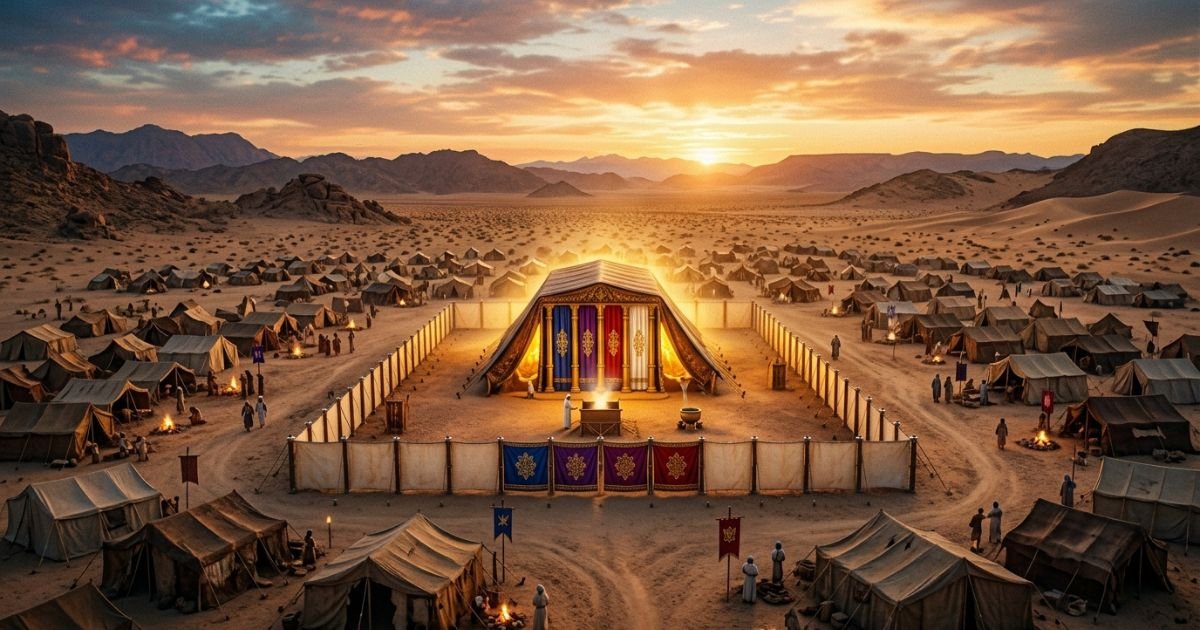
When God gave Moses the instructions for building the Tabernacle, the sacred dwelling place He would share with His people in the wilderness, He wove the number 4 into its very construction. Every detail of the Tabernacle carried meaning, and the pattern of four runs through it like a thread of gold.
“And let them make me a sanctuary; that I may dwell among them.” (Exodus 25:8, KJV)
The four primary materials used in the Tabernacle’s construction were gold, silver, bronze, and wood. Each material carried its own symbolic weight. Gold spoke of divinity and glory. Silver pointed to redemption. Bronze represented judgment and strength. Wood, being from the earth, symbolized humanity. Together, these four materials told the story of a God who was both holy and near, both judge and redeemer.
The curtains and fabrics of the Tabernacle used four distinct colors: white linen, blue, purple, and scarlet. These colors were not chosen for aesthetic reasons alone. White linen spoke of purity and righteousness. Blue echoed heaven and the divine. Purple declared royalty and kingship. Scarlet carried the weight of sacrifice and blood. Together, these four colors formed a visual theology, a complete picture of who Jesus would one day be: pure, heavenly, royal, and sacrificial.
“Moreover thou shalt make the tabernacle with ten curtains of fine twined linen, and blue, and purple, and scarlet.” (Exodus 26:1, KJV)
The courtyard of the Tabernacle had four sides. The altar of burnt offering had four horns at its corners. Even the four coverings layered over the Tabernacle, fine linen, goat hair, rams’ skins dyed red, and badger skins, formed a progression from inner beauty to outer protection. The Tabernacle was a building shaped by fours, because it was meant to represent something complete: the full presence of God dwelling among His people.
The Twelve Tribes of Israel: Four Camps Around God’s Presence
There is something quietly breathtaking about the way God organized the twelve tribes of Israel in their wilderness journey. During those forty years of wandering, God did not leave the arrangement of His people to chance or custom. He gave detailed instructions about exactly where each tribe should camp.
Numbers chapter 2 lays it all out. The twelve tribes were divided into four groups of three, positioned at the four compass points around the Tabernacle. Judah, Issachar, and Zebulun camped to the east. Reuben, Simeon, and Gad camped to the south. Ephraim, Manasseh, and Benjamin camped to the west. Dan, Asher, and Naphtali camped to the north.
At the center of all four camps was the Tabernacle, the place where God dwelt. When you picture the entire arrangement from above, the shape that emerges is a cross. Long before Jesus stretched out His arms on Calvary, the camp of Israel was already living inside that shape, surrounding the presence of God from every direction.
This arrangement was not simply about military strategy or crowd management, though it served those purposes well. It was a living sermon. God’s people encircling His presence, coming to Him from north and south, east and west. Four directions. Complete access. No tribe was too far. No one was left in the corners.
Also READ: 120 Powerful KJV Bible Verses About Repentance
Proverbs Chapter 30: Wisdom Written in Fours
Proverbs 30 is one of the most fascinating chapters in all of wisdom literature, and one of the reasons is the way it uses the number 4 as a literary and spiritual device. The author, Agur son of Jakeh, structures his observations about life using a repeated three-plus-one pattern, listing three things and then a fourth that completes or climaxes the thought.
This technique is intentional. The fourth item in each list carries special weight, a kind of final note that brings everything into focus. And throughout the chapter, the number four keeps appearing as the marker of completeness in human experience.
Four Things That Are Never Satisfied
Agur begins by listing four things that never say enough: the grave, the barren womb, parched earth, and fire. Each of these represents a kind of insatiable hunger that is built into the fabric of creation. The grave always receives more. The barren womb aches with longing. The dry earth always needs more rain. Fire always wants more fuel.
“There are three things that are never satisfied, yea, four things say not, It is enough: The grave; and the barren womb; the earth that is not filled with water; and the fire that saith not, It is enough.” (Proverbs 30:15-16, KJV)
This list teaches humility. Some desires and needs are simply part of the created order, and no human effort can fully satisfy them. Only God can fill what creation cannot. It is a gentle pointer toward our need for Him.
Four Things Too Wonderful to Understand
Then Agur marvels at four mysteries: the way of an eagle in the air, the way of a serpent on a rock, the way of a ship in the sea, and the way of a man with a woman. What these four share is that they leave no trace. The eagle cuts through the air that closes behind it. The serpent crosses the rock that bears no footprint. The ship moves through water that erases its path. And love, human love, is just as mysterious and just as real.
“There be three things which are too wonderful for me, yea, four which I know not: The way of an eagle in the air; the way of a serpent upon a rock; the way of a ship in the midst of the sea; and the way of a man with a maid.” (Proverbs 30:18-19, KJV)
These four wonders invite us into a posture of awe. Not everything is meant to be fully explained or controlled. Some things are meant to be experienced, and the wisdom of Proverbs says that is perfectly okay.
Four Things That Shake the Earth
Agur then lists four situations that create social upheaval and instability: a servant who becomes a king, a fool who gets wealthy, an unloved woman who gets married, and a maidservant who inherits from her mistress. Each scenario describes someone out of their proper place, and Agur says the earth cannot bear it.
The lesson here is one of wisdom and order. Power, wealth, and position require the character to carry them well. When they do not, the ripple effects touch everyone around. The four examples create a complete picture of social wisdom.
Four Small But Remarkably Wise Creatures
This may be the most beloved of Agur’s lists. He points to four small, seemingly powerless creatures and calls them exceeding wise: the ant, the rock badger, the locust, and the spider. The ant stores food in summer without anyone telling it to. The rock badger builds its home in rocky crags for safety rather than strength. Locusts move in coordinated swarms without any king to lead them. And the spider, tiny and fragile, finds its way into the palaces of kings.
“There be four things which are little upon the earth, but they are exceeding wise: The ants are a people not strong, yet they prepare their meat in the summer; The conies are but a feeble folk, yet make they their houses in the rocks; The locusts have no king, yet go they forth all of them by bands; The spider taketh hold with her hands, and is in kings’ palaces.” (Proverbs 30:24-28, KJV)
What a comfort this list is for anyone who has ever felt small, overlooked, or underestimated. God is not impressed by size or strength. He honors wisdom, preparation, cooperation, and persistence. These four tiny creatures model exactly what it looks like to live wisely in a big world.
Four Things That Move with Grace and Authority
Agur closes his lists with four examples of creatures and a king that move with natural confidence and dignity: the lion, the greyhound, the he-goat, and a king at the head of his army. Each moves without hesitation, without looking over its shoulder. Four images of purposeful, dignified movement complete this beautiful chapter.
The Angel Number 4 in the Bible: Cherubim, Visions, and Heavenly Creatures
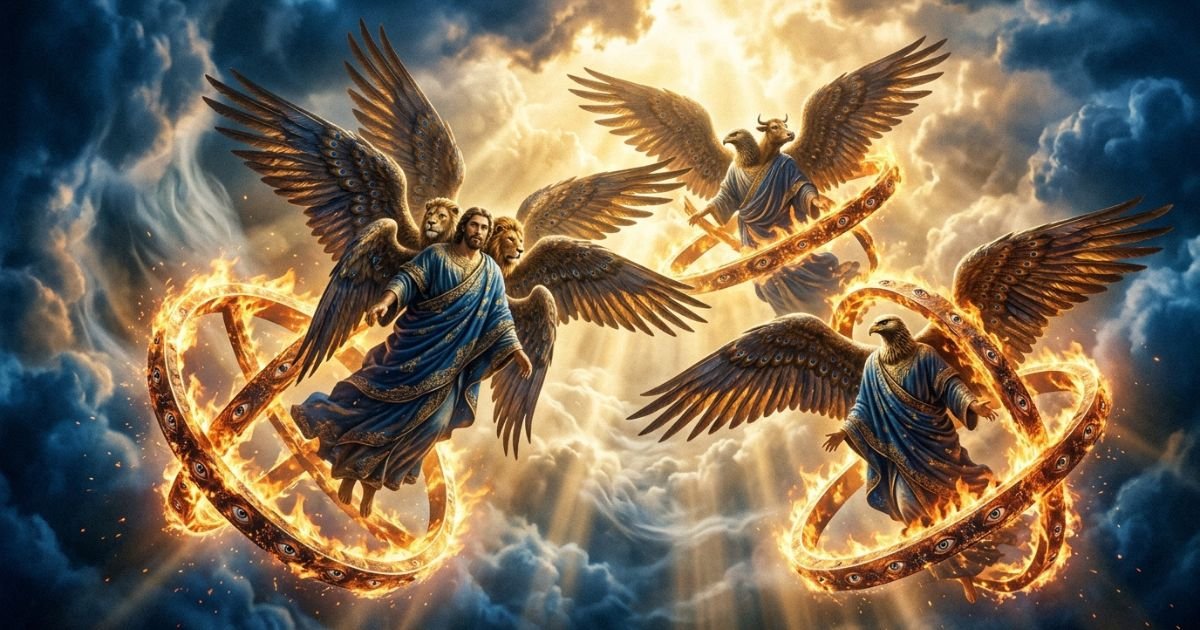
When Ezekiel the prophet was carried into a vision of God’s glory beside the Chebar River, he saw something that defied ordinary description. He saw four living creatures, cherubim, beings of such extraordinary complexity that he struggled to find words adequate to the vision.
“Also out of the midst thereof came the likeness of four living creatures. And this was their appearance; they had the likeness of a man. And every one had four faces, and every one had four wings.” (Ezekiel 1:5-6, KJV)
Each cherub had four faces: the face of a man, the face of a lion, the face of an ox, and the face of an eagle. These four faces were not random. They have been understood by theologians across centuries as representing the fullness of creation. The man represents intelligence and dignity. The lion represents strength and courage. The ox represents service and sacrifice. The eagle represents vision and heavenly perspective.
“As for the likeness of their faces, they four had the face of a man, and the face of a lion, on the right side: and they four had the face of an ox on the left side; they four also had the face of an eagle.” (Ezekiel 1:10, KJV)
Four faces. Every dimension of created existence, represented and worships God simultaneously. When you stand before God, the Bible suggests, all of creation stands with you.
Now, a word about what some people today call angel numbers. You may have heard about the significance of seeing the number 444, with claims that angels send messages through repeated number sequences on clocks or license plates. This teaching is not found in Scripture. The biblical meaning of number 4 is rich and deep, but it is revealed through God’s Word, not through digits on a digital display. If you feel drawn to know what God is saying, open your Bible. That is where His voice is clearest.
Also READ: 95+ Bible Verses For A Sister
Daniel’s Prophetic Vision: Four Beasts and the Flow of World History
The Book of Daniel is one of the most dramatic and prophetically rich books in all of Scripture. And when God gave Daniel his great vision of the future, He used four as the organizing number of world history.
In Daniel chapter 7, the prophet saw four enormous beasts rising from a churning sea. Each beast was different from the others, and each represented a great world empire.
“And four great beasts came up from the sea, different from one another.” (Daniel 7:3, NKJV)
The first beast looked like a lion with eagle’s wings, widely understood to represent the Babylonian Empire under Nebuchadnezzar. The second resembled a bear with three ribs in its mouth, pointing to the Medo-Persian Empire. The third looked like a leopard with four wings and four heads, representing the Greek Empire under Alexander the Great and his successors. The fourth was the most terrifying of all, an unnamed beast of iron and destruction, generally understood to represent the Roman Empire.
“These great beasts, which are four, are four kings, which shall arise out of the earth.” (Daniel 7:17, KJV)
Four empires. Four complete chapters in the story of human civilization before the coming of God’s eternal kingdom. The number 4 here signals totality. Not a partial history. Not a selective overview. The complete arc of earthly power, from Babylon to Rome.
What is profoundly comforting about this vision is its implication. If God knew the entire sweep of world empires before they rose, and if He revealed it to Daniel centuries in advance, then nothing in your lifetime has caught Him off guard either. He sees the end from the beginning. He is not scrambling. He is not surprised. He reigns over every king and every season.
The Four Gospels: A Complete Portrait of Jesus Christ
Of all the places the number 4 appears in the New Testament, perhaps none is more beautiful or more significant than the four Gospels. God could have given us one biography of Jesus. He gave us four. And there is a reason.
Matthew, Mark, Luke, and John each tell the story of Jesus, but they tell it from a different angle, for a different audience, highlighting different dimensions of who He is.
Matthew writes primarily for a Jewish audience, emphasizing Jesus as the long-promised Messiah and King. His Gospel is thick with fulfilled prophecy, tracing the royal lineage of Jesus back to Abraham and David. The symbol often associated with Matthew is the lion, representing royalty.
Mark writes with breathless speed and urgency, showing Jesus constantly in motion, healing, serving, acting. This is the Gospel of the Servant, and the symbol associated with it is the ox, the animal of tireless labor and sacrifice.
Luke, a physician, writes the most detailed human portrait of Jesus. He traces His genealogy all the way back to Adam, making the point that Jesus belongs to all of humanity. Luke’s Gospel is rich with compassion, with stories of the lost and the found, the poor and the forgotten. The symbol associated with Luke is the face of a man.
John soars above the others in his opening line: In the beginning was the Word, and the Word was with God, and the Word was God. John’s Gospel is a meditation on the divine nature of Jesus, and its symbol is the eagle, the creature that sees from the highest heights.
Four perspectives. Four audiences. Four dimensions of Christ’s identity. Together, these four Gospels give us a complete picture of who Jesus truly is: King, Servant, perfect Man, and eternal God. You need all four to see Him fully. Remove one, and the portrait loses something irreplaceable.
The early church father Irenaeus, writing around 180 AD, made exactly this argument when critics questioned why there were four Gospels instead of one. He pointed to the four zones of the world, the four winds, and the four living creatures of Ezekiel and Revelation as evidence that four was not arbitrary. Four was fitting. Four was complete.
The Number 4 in the Book of Revelation: Heaven’s Complete Worship
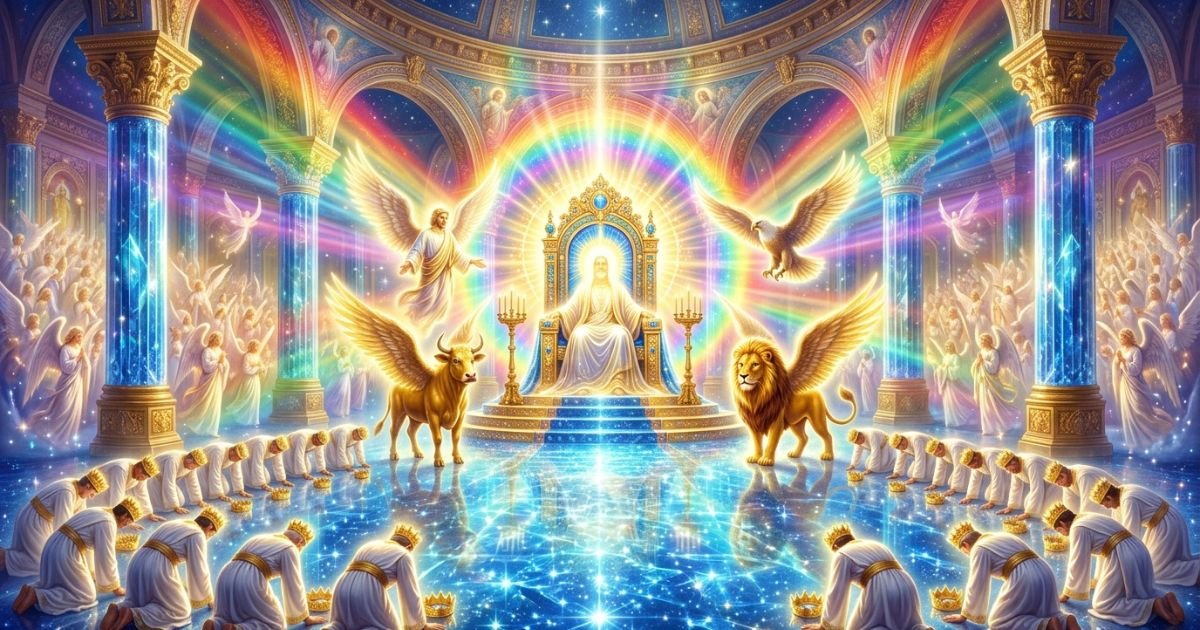
When the Apostle John received his vision of heaven in the Book of Revelation, he saw a throne room that took his breath away. And surrounding the throne of God were four living creatures, worshiping without ceasing, day and night, never stopping.
“And before the throne there was a sea of glass like unto crystal: and in the midst of the throne, and round about the throne, were four beasts full of eyes before and behind. And the first beast was like a lion, and the second beast like a calf, and the third beast had a face as a man, and the fourth beast was like a flying eagle.” (Revelation 4:6-7, KJV)
Four living creatures. The same fourfold pattern from Ezekiel now appears in John’s vision of eternity. A lion, a calf, a man, an eagle: the full spectrum of created life, represented and worshiping the Creator.
Their song never stops: Holy, holy, holy, Lord God Almighty, which was, and is, and is to come. Complete holiness is declared completely by creatures representing all of creation.
The Four Horsemen of the Apocalypse
As the seals of judgment begin to open in Revelation chapter 6, four horsemen ride out one by one. A white horse carrying conquest. A red horse bringing war. A black horse trailing famine. A pale horse followed by death. These four riders do not represent partial judgment. They represent complete tribulation, touching every category of human suffering that results from rebellion against God.
Power was given unto them over the fourth part of the earth. Even in judgment, the number 4 signals totality. God’s sovereignty extends to every corner.
Four Angels at the Four Corners of the Earth
In Revelation 7:1, John sees four angels standing at the four corners of the earth, holding back the four winds. These angels restrain destruction until God’s servants are sealed and protected. God’s protection, like His creation, is comprehensive. North, south, east, west, every direction covered.
“And after these things I saw four angels standing on the four corners of the earth, holding the four winds of the earth.” (Revelation 7:1, KJV)
The Fourfold Reach of Redemption
One of the most stirring uses of four in Revelation comes in chapter 5, where heaven sings a new song about the Lamb who was slain. He has redeemed people out of every kindred, and tongue, and people, and nation. Four categories. Every tribe. Every language. Every ethnicity. Every political nation. The blood of Jesus reaches all four corners of human identity. No one is outside its reach.
The Foursquare City of the New Jerusalem
Revelation 21 describes the New Jerusalem, the eternal city that descends from heaven at the end of all things. It lies foursquare. Its length, breadth, and height are equal. Perfect symmetry. A cube of glory, with twelve gates, three on each of its four sides, so that people can enter from every direction.
The Holy of Holies in Solomon’s Temple was also a perfect cube. The New Jerusalem will be the ultimate Holy of Holies, the place where God and humanity finally dwell together without any veil between them. And it is built in fours.
Also READ: 100+ Bible Verses About Liars and Manipulators
The Number 40: When Four Meets Testing
No discussion of the number 4 in Scripture would be complete without at least touching on the number 40, which is 4 multiplied by 10. Ten in biblical numerology often represents ordinal completeness, a complete set or cycle. When you multiply the earthly completeness of 4 by the ordinal completeness of 10, you get 40, and in the Bible, 40 almost always marks a period of complete testing or complete preparation.
Noah’s flood lasted 40 days and 40 nights. Moses spent 40 years in the wilderness before leading Israel out of Egypt, and then 40 days on Mount Sinai receiving the Law. The Israelites wandered 40 years in the desert before entering the Promised Land. Goliath taunted Israel for 40 days before David arrived. Jonah gave Nineveh 40 days to repent. And Jesus fasted for 40 days in the wilderness before beginning His public ministry.
In every case, the 40-day or 40-year period is not random. It is a complete season of testing, preparation, and transformation. The number 4 is embedded in each of these stories, quietly reminding us that God is thorough. When He prepares someone, He does not rush. He does not cut corners. He completes the work.
The Number 4 in Jewish and Christian Tradition
The significance of four did not go unnoticed by the Jewish and Christian communities across history. It shows up in some of the most beloved traditions in both faiths.
In the Jewish Passover Seder, one of the most sacred family celebrations in the world, four cups of wine are shared throughout the evening. These four cups correspond to the four promises of redemption God made to Israel in Exodus 6:6-7: I will bring you out, I will deliver you, I will redeem you, and I will take you as my people. Four promises. Four cups. Complete redemption is honored every year around the Passover table.
The Passover Seder also features four questions, traditionally asked by the youngest child at the table, and the teaching of four types of sons: the wise, the wicked, the simple, and the one who does not know how to ask. These four sons represent the full range of human responses to faith, and the Passover tradition addresses all four with patience and love.
In Christian tradition, the cross itself carries the symbolism of four. Four arms extending in four directions, reaching to the four corners of the earth. When Jesus stretched out His arms in sacrifice, that sacrifice was meant for everyone, everywhere, in every direction. Christian architecture has reflected this symbolism for centuries, and it continues to speak to believers today.
What the Number 4 Really Tells Us About God

After walking through all of these passages together, it is worth stepping back and asking: what does all of this actually tell us about God? What is He communicating through this pattern?
The number 4, taken as a whole in Scripture, says something simple and profound. God is thorough. God is complete. God does not do things halfway or leave corners uncovered. When He creates, He creates completely. When He redeems, He redeems comprehensively. When He promises, He fulfills His promise in every direction.
The four rivers of Eden flow to every part of the world. The four Gospels cover every dimension of Jesus’s identity. The four living creatures represent all of creation in worship. The four angels stand at every corner of the earth. The fourfold reach of redemption includes every kindred, tongue, people, and nation. Everywhere the number 4 appears, it whispers the same truth: God leaves nothing out.
That is a deeply comforting message for anyone who has ever wondered whether they were somehow beyond God’s reach. Whether the corner of the world you live in, or the corner of your heart that feels most broken, is somehow outside His attention. The answer Scripture gives, through this quiet pattern woven from Genesis to Revelation, is a resounding no.
You are not in a forgotten corner. God’s design includes you.
How Understanding the Number 4 Can Deepen Your Faith
Studying biblical numerology is not about finding hidden codes or mystical secrets. It is about learning to read Scripture with greater richness and depth, to notice the patterns that God’s own Spirit guided human authors to embed in the text over thousands of years.
When you read Genesis and see those four rivers flowing out of Eden, you can pause and reflect on the completeness of God’s provision. When you read the Gospels and notice that there are exactly four of them, you can appreciate that God gave us multiple vantage points to see Jesus fully. When you encounter the four living creatures in Revelation, you can feel the weight of all creation joining together in worship.
These patterns do not replace the plain meaning of Scripture. They enrich it. They help you see connections between the Old and New Testaments, between prophecy and fulfillment, between heaven and earth. They remind you that the Bible is not a collection of disconnected writings. It is one coherent story, told by one Author, with remarkable intentionality on every page.
One practical suggestion: the next time you come across the number 4 in your Bible reading, stop for a moment. Ask yourself what is being described. Is it creation? Completeness? Universal scope? Ask God what He might be showing you in that passage. Let the pattern become a doorway into deeper reflection.
A Word of Wisdom: Biblical Numerology vs. New Age Number Mysticism
It is worth being honest about a distinction that matters a great deal for followers of Jesus. There is a world of difference between studying the symbolic use of numbers within Scripture and adopting the New Age practice of looking for angel numbers in everyday life.
Biblical numerology is grounded in the text of Scripture itself. It asks, how does the Bible use this number consistently across its pages? What theological meaning does it carry in context? It is a reading practice, not a predictive system.
New Age angel number teachings, by contrast, claim that seeing repeated numbers on clocks, license plates, or phone screens carries spiritual messages from angels or the universe. This is not what the Bible teaches. Scripture consistently directs us to hear God’s voice through His Word, through prayer, through the community of faith, and through the Holy Spirit. Not through digital displays.
The remarkable meaning of number 4 in the Bible is genuinely remarkable precisely because it is woven into Scripture itself, appearing in creation, in the law, in prophecy, in the Gospels, and in the heavenly vision of Revelation. That pattern is worth studying, celebrating, and drawing closer to God through. But the study belongs to the text, not to the clock on your wall.
Frequently Asked Questions
What does the number four symbolize biblically?
Biblically, the number 4 symbolizes earthly completeness and God’s creative order. It represents the physical world God designed with perfect intention, seen in four directions, four seasons, four Gospels, and four living creatures around His throne.
Why is the number 4 important?
The number 4 is important because it appears consistently throughout Scripture from Genesis to Revelation, always pointing to completeness in creation. God used it in the Tabernacle, the tribal camps of Israel, Daniel’s prophecies, and the heavenly throne room.
What does 4 signify spiritually?
Spiritually, 4 signifies that God’s presence and provision reach every corner of creation. It is the number of the physical world touched by divine order, reminding believers that nothing in God’s design is incomplete or overlooked.
What is the prophetic number 4?
In Bible prophecy, 4 represents the complete scope of earthly kingdoms and divine judgment. Daniel’s four beasts symbolized four world empires, and Revelation’s four horsemen represent comprehensive tribulation covering every dimension of human suffering.
What is the number 4 in God?
In relation to God, the number 4 represents how His divine nature reaches into the created world completely. While 3 reflects the Trinity, 4 shows God’s creative work touching every direction, season, and dimension of physical existence.
Conclusion
From the four rivers of Eden to the foursquare New Jerusalem, from the four faces of the cherubim to the four Gospels of Jesus Christ, the number 4 has been quietly threading its way through God’s Word since the very beginning. It is not a coincidence. It is a signature.
God is a God of order. He is a God of completeness. He is a God who covers every direction, touches every season, speaks to every kind of person, and redeems every kindred and tongue and people and nation. The number 4 in Scripture is His way of reminding us, again and again, that He does not do things by halves.
If you are reading this today and there is a corner of your life that feels forgotten, a season that feels incomplete, a wound that feels untouched by grace, take heart. The same God who built four seasons into the year and four rivers into Eden and four Gospels into His Word is the same God who sees exactly where you are and reaches toward you with thoroughness and love.
Nothing in your life is outside His design. Nothing in your story is beyond His reach. His grace is not partial. His love is not limited. And His eye, like those four living creatures full of eyes in Revelation, misses nothing.
That is the remarkable meaning of the number 4 in the Bible. And it is a meaning that never grows old.

Welcome to Blessing Bloom. I’m Ahsan Ali, founder of BlessingBloom.com a faith-based website dedicated to sharing prayers, blessings, and heartfelt wishes. Based in Islamabad, Pakistan, I created Blessing Bloom to help people find the right words during life’s most meaningful moments. With a background in Information Technology, I combine a passion for digital content with a genuine love for faith-inspired writing.