


Standing in front of a grieving family is one of the hardest things a pastor or minister will ever do. Words feel impossibly small when someone’s world has just been shattered. But the right funeral sermon rooted in Scripture, soaked in compassion, and shaped by real human understanding, can bring a kind of peace that nothing else can. These 20 funeral sermon outlines to provide comfort are designed to help you do exactly that: meet hurting hearts right where they are, point them toward hope, and remind them that God has not abandoned them in their darkest hour.
Why a Good Funeral Sermon Matters More Than You Think
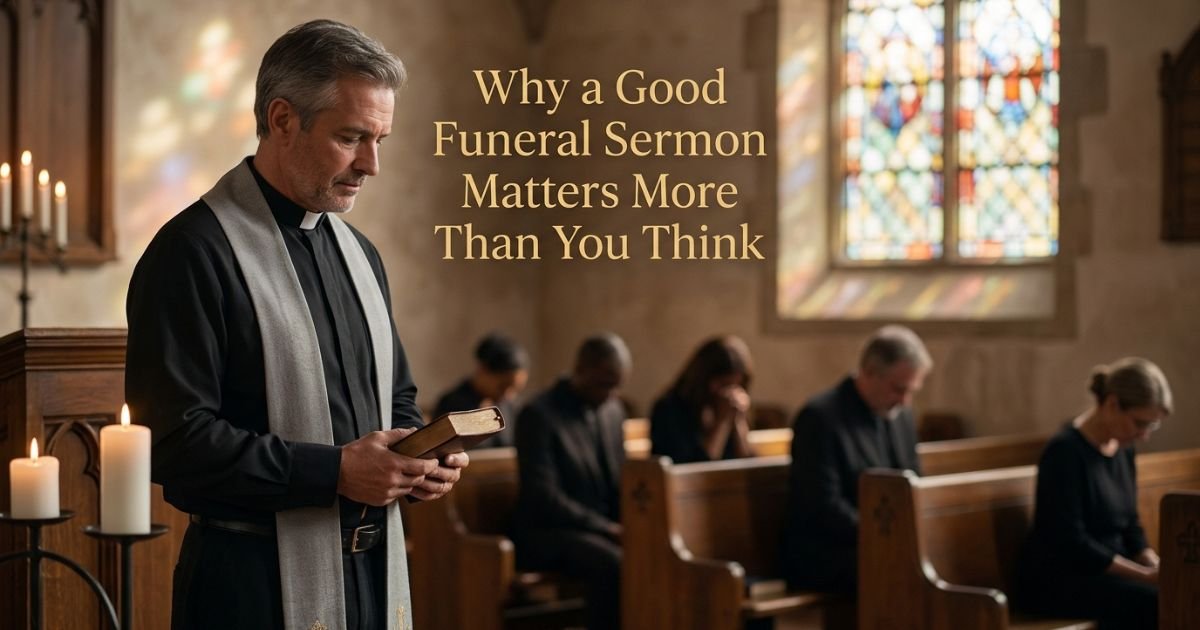
People don’t always remember the exact words spoken at a graveside service. But they remember how they felt. They remember whether the message felt real, whether it reached inside the grief and offered something solid to hold onto.
A thoughtfully prepared funeral sermon does more than fill time at a service. It validates grief. It opens space for tears. And in that space, it gently points mourners toward the unchanging promises of God. Whether you’re a seasoned pastor who has preached hundreds of memorial services or a minister stepping up to this calling for the first time, having a clear, compassionate outline makes the difference between a message that comforts and one that simply passes by.
The 20 outlines below cover a wide range of themes from resurrection hope and God’s presence in suffering, to the eternal home awaiting believers and the legacy of a faithful life. Each outline includes a key theme, a central Scripture, a message focus, and a sample sermon you can adapt and personalize. Feel free to take what fits, adjust the language to honor the person being remembered, and speak from the heart.
Outline 1: Walking Through the Valley Together
Theme: God walks beside us through every shadow of grief.
Key Verse: Psalm 23:4 “Even though I walk through the darkest valley, I will fear no evil, for you are with me; your rod and your staff, they comfort me.”
Message Focus: Grief feels like a valley with no visible end. But Psalm 23 doesn’t promise we’ll bypass the valley, it promises we won’t walk it alone. The Good Shepherd is right there, every step, every tear, every sleepless night.
Sample Sermon:
There is no avoiding valleys in this life. Scripture doesn’t pretend otherwise. The psalmist doesn’t say if we walk through the darkest valley, he says, though. Loss is part of what it means to be human. And right now, every person in this room is feeling the weight of that truth.
But here is the word that changes everything: with me. “I will fear no evil, for you are with me.”
You are not alone in this. That’s not a greeting card sentiment. It’s a promise made by the God who created you, who has known you before you drew your first breath, and who has never once looked away from your life. He is with you in this room today. He was with [Name] in their final moments. And He will be with you when you wake up tomorrow morning, wondering how to face another day without them.
The shepherd’s rod and staff weren’t decorative. They were tools of protection and guidance used when the sheep wandered, when predators drew close, when the path grew uncertain. God uses the same care with us. He guards us. He guides us. He does not let the valley become our grave.
[Name] walked with the Shepherd. They knew His voice. They trusted His care. And now they have passed through the valley into the green pastures of God’s eternal presence. They are not lost. They are home.
For those of us still in the valley, take courage. The Shepherd has not left. The path through is real. And on the other side, there is light.
Outline 2: God Sees Every Tear
Theme: No tear, no sorrow, no silent suffering goes unnoticed by God.
Key Verse: Psalm 56:8 “You keep track of all my sorrows. You have collected all my tears in your bottle. You have recorded each one in your book.”
Message Focus: Grief can feel invisible. People move on. The world keeps spinning. But God records every tear. He is intimately acquainted with the weight of this loss and with the weight in your heart right now.
Sample Sermon:
Have you ever cried alone? When everyone else had gone home, when the house grew quiet, when the grief finally spilled over, and there was no one there to see it? Maybe that’s where some of you have been this week.
But Psalm 56:8 tells us something that changes the ache of that loneliness. God keeps a bottle. He collects your tears. Every one of them. He doesn’t just observe your grief from a distance. He holds it. He keeps a record of every sorrow, every sleepless night, every moment your heart broke open.
That means your pain matters to Him. Not in some vague, theological way. Personally. Specifically. Every tear you have cried over [Name], God has seen it. Every night you couldn’t sleep. Every moment you reached for the phone to call them, and then remembered. He was there for all of it.
This is the kind of God we serve. Not distant, not unmoved, not simply tolerating our grief while waiting for us to pull ourselves together. He is the God who wept at Lazarus’s tomb. He is the God who collects tears in a bottle because every tear represents someone He loves.
You are not invisible in your pain. You are seen, fully and completely, by the One who made you. And that changes everything about how we grieve.
Outline 3: The Resurrection and the Life
Theme: Jesus is the only true answer to death’s question.
Key Verse: John 11:25-26 “I am the resurrection and the life. The one who believes in me will live, even though they die; and whoever lives by believing in me will never die.”
Message Focus: At every funeral, death raises the same question: Is this the end? Jesus answers it directly and personally. Not with theology. With Himself.
Sample Sermon:
When Mary came running to Jesus after her brother had been in the tomb for four days, she wasn’t looking for a sermon. She was looking for Him. “Lord,” she said, “if you had been here, my brother would not have died.” Grief that raw doesn’t need a lecture. It needs a presence.
And Jesus gave her one. He wept with her. He stood at the tomb. And then He spoke words that changed everything: “I am the resurrection and the life.”
Not, “there is a resurrection.” Not, “resurrection is possible.” I am. Present tense. Personal. Right here.
[Name] believed in that resurrection. Their faith was placed in the One who walked out of His own grave on the third day, the One who proved, once and for all, that death does not have the final word. Because Jesus lives, [Name] lives. It is not wishful thinking. It is the central claim of the Christian faith, tested and proven by the empty tomb.
For everyone in this room who is struggling today, you are not mourning without hope. You are mourning as people who know that this is not the end of the story. Jesus said, “Whoever lives by believing in me will never die.” That promise belongs to your loved one today. And it belongs to you as well, if you put your trust in Him.
Death is real. Grief is real. But so is the resurrection. And the resurrection is stronger than both.
Outline 4: He Gives Rest to the Weary
Theme: Death is not a defeat. For believers, it is the rest they have always longed for.
Key Verse: Matthew 11:28 “Come to me, all you who are weary and burdened, and I will give you rest.”
Message Focus: Life is hard. Often harder than anyone lets on. And when a believer finally passes from this world, they have entered the rest that Christ always promised, not earned, not deserved, but freely given.
Sample Sermon:
Think about the last time you were truly exhausted. Not just tired. Completely spent. The kind of bone-deep weariness where you could barely lift your head. Most of us have been there. And in those moments, what you want more than anything is rest. Real rest. Not just sleep. Peace.
Jesus made a stunning invitation in Matthew 11: Come to me, all you who are weary and burdened, and I will give you rest. He didn’t say, “figure it out.” He didn’t say, “push through.” He said, ” Come. And He promised something that the world cannot manufacture: genuine rest for the soul.
[Name] knew weariness. They carried burdens, the ones we knew about, and probably more that they carried quietly. But they also knew Jesus. And the same invitation that reached them in their hardest moments on earth has now been fulfilled in the most complete way imaginable.
They have come. And they have found rest.
For those of us still in the weariness of life, this invitation still stands. Bring your grief to Him today. Bring your exhaustion, your confusion, your anger, your sadness. Jesus doesn’t require you to have it together before you approach Him. He invites you exactly as you are.
And for [Name], the burden has been lifted. The rest is complete. The peace they sought is now fully theirs.
Outline 5: Anchored in Hope
Theme: In Christ, grief cannot sweep us away. Our hope is anchored.
Key Verse: Hebrews 6:19 “We have this hope as an anchor for the soul, firm and secure.”
Message Focus: Grief crashes like waves. But hope in Christ is an anchor, not a feeling, not a wish, but a firm and secure spiritual reality. We do not drift, because we are held.
Sample Sermon:
Every sailor knows the difference between a ship with a good anchor and a ship that’s drifting. In calm seas, it doesn’t matter much. But when the storm hits, when the winds howl, and the waves swell, the anchor is everything.
Today, many of us feel like we’ve been hit by a storm. The loss of [Name] has shaken the ground beneath our feet. We feel the pull of grief, like a current trying to drag us somewhere dark. And in those moments, we need something that holds.
Hebrews 6:19 tells us we have exactly that. “We have this hope as an anchor for the soul, firm and secure.” Not a fragile hope. Not a hopeful guess. An anchor. Planted deep in the promises of God, rooted in the resurrection of Jesus Christ, secured in something that cannot be moved by any storm this life can bring.
[Name] lived anchored to that hope. When hard seasons came, and they did come, they didn’t drift. They held fast. And that’s why today, even with tears in our eyes, we can say with confidence that they are safe. The anchor held. It always holds.
If you feel yourself drifting today, reach for the anchor. Jesus Christ is not moved by your storm. He is not surprised by your grief. And the hope He offers is strong enough to hold you right now, in the middle of the waves.
Outline 6: God’s Peace Beyond Understanding

Theme: Amid the chaos of loss, God offers a peace that doesn’t make logical sense. And that’s exactly the point.
Key Verse: Philippians 4:7 “And the peace of God, which transcends all understanding, will guard your hearts and your minds in Christ Jesus.”
Message Focus: The peace God gives is not the absence of grief. It is a guarding presence within grief, something that protects the heart and mind even when circumstances haven’t changed at all.
Sample Sermon:
There’s a kind of peace the world offers that depends on circumstances. If things are going well, you feel at peace. If things fall apart, the peace disappears. That peace is real, but it’s fragile. It can’t survive a funeral.
The peace Paul describes in Philippians 4 is different. He wrote those words from prison. His circumstances were not peaceful. Yet he had experienced something that transcended his surroundings, a peace that guarded his heart and mind like a soldier standing watch.
That’s the word he uses: guard. This peace stands at the door of your heart and says, “grief may enter here, but despair does not live here.” It cannot be explained by logic. It doesn’t come from understanding why this happened. It comes simply from Jesus, and it is available to every person in this room today.
Some of you have already felt it this week, in a quiet moment, in a prayer, in an unexpected sense of calm in the middle of a storm. That wasn’t a coincidence. That was God keeping His promise.
In Christ, you can grieve and still have peace. You can cry and still feel held. You can not understand anything, and still trust in Someone who understands everything. Bring your broken heart to Jesus today. His peace is waiting for you.
Read More: 25 Heartfelt Sermons for Seniors to Uplift Faith
Outline 7: Precious in His Sight: A Homecoming
Theme: From heaven’s perspective, the death of a believer is a celebration of arrival.
Key Verse: Psalm 116:15 “Precious in the sight of the Lord is the death of his faithful servants.”
Message Focus: We experience departure. Heaven experiences a homecoming. Both are true. But when we understand how God sees this moment, our grief begins to soften around the edges.
Sample Sermon:
When you send a child off to school for the first time, you may cry at the door. But the teacher is waiting with a smile, ready to welcome them in. What feels like a goodbye on one side of the door is a hello on the other.
Psalm 116:15 gives us a glimpse through the door. “Precious in the sight of the Lord is the death of his faithful servants.” Precious. Valued. Treasured. God doesn’t use those words lightly. He uses them to describe this very moment, the moment a believer passes from this world into His presence.
We are standing on our side of the door, and we are weeping. That’s right, real and honest. But on the other side, there was a welcome. The Father’s arms opened. The angels rejoiced. And [Name], who had trusted God through every season of their life, finally saw the face they had been moving toward all along.
This doesn’t make the loss smaller. But it makes it bearable. Because what we experience as absence, [Name] experiences as arrival. What we feel as goodbye, they feel as home.
We will grieve today. But we also celebrate. Because a soul we love is precisely where they were always meant to be.
Outline 8: Held by the Everlasting Arms
Theme: When grief knocks us off our feet, God’s eternal arms are already underneath us.
Key Verse: Deuteronomy 33:27 “The eternal God is your refuge, and underneath are the everlasting arms.”
Message Focus: You cannot fall beyond God’s reach. No depth of grief, no weight of sorrow, no moment of despair puts you outside the strength of His arms.
Sample Sermon:
One of the most frightening feelings in the world is the sense of free-falling, when the ground disappears, and there’s nothing to grab hold of. Grief can feel exactly like that. Especially in the first days and weeks after a loss, when the shock begins to wear off, and the full weight of it lands.
But Deuteronomy 33:27 holds a truth that reaches into that freefall: underneath are the everlasting arms.
Before you hit bottom, God is there. His arms are not waiting down at some distant floor, they are already underneath you, in the moment of falling, ready to hold what you cannot hold yourself. These are not weak arms. These are the arms that spoke the universe into existence, that parted the Red Sea, that raised Jesus from the dead. And they are holding you right now, in your grief, in your exhaustion, in your confusion.
[Name] knew the refuge of those arms. When life got hard, and it did, they leaned into God and found that He didn’t give way. Those everlasting arms never do.
Today, you don’t have to be strong. You don’t have to hold yourself together. You just have to let yourself be held. And I promise you, the arms that are underneath you right now will not let you go.
Outline 9: New Every Morning: Grace for the Grief Ahead
Theme: Grief comes in waves, but God’s mercies come fresh every single morning.
Key Verse: Lamentations 3:22-23 “Because of the Lord’s great love we are not consumed, for his compassions never fail. They are new every morning; great is your faithfulness.”
Message Focus: Grief is not linear. It circles back. It shows up on ordinary Tuesdays and quiet Sunday mornings. But so does God’s mercy, new, fresh, specifically for whatever that day requires.
Sample Sermon:
Lamentations is one of the most raw books in the Bible. It was written in the middle of devastating loss, an entire city in ruins, a people shattered. And right in the middle of that grief, the writer says something extraordinary: His compassion never fails. They are new every morning.
Not at the end of the grief. Not after everything gets better. Right in the middle of it. New. Every morning.
Grief doesn’t follow a schedule. Some of you will feel okay tomorrow and fall apart next month on [Name]’s birthday. You’ll be fine for weeks, and then a song will come on the radio, and it will level you completely. That’s not a weakness. That’s love. Grief is what love looks like when it has nowhere to go.
And for every one of those mornings, the hard ones, the unexpected ones, the anniversaries, the ordinary Tuesdays that somehow feel impossible, God’s mercies will be there. Not leftovers from yesterday. New ones. Specifically for that day.
Great is His faithfulness. Not sometimes. Not when it’s convenient. Always. That’s the promise that gets us from today to tomorrow, and from tomorrow to the day after that.
Outline 10: The Holy Spirit: Your Comforter Has Come
Theme: The Holy Spirit is not a distant concept He is a present, active Comforter in grief.
Key Verse: John 14:16-17 “I will ask the Father, and he will give you another advocate to help you and be with you forever, the Spirit of truth.”
Message Focus: Jesus did not leave us to grieve alone. He sent the Holy Spirit as a Comforter, literally one who comes alongside. In grief, the Spirit intercedes, sustains, and guides in ways that words cannot.
Sample Sermon:
Jesus said these words on the night before He died, the same night His disciples were about to face their own version of grief. He knew what was coming. He knew they would feel abandoned, confused, and shattered. And He made a promise: I will not leave you as orphans. I will ask the Father, and He will send you a Comforter.
The word Jesus used, paraclete, means someone called to come alongside. An advocate. A helper. A presence that doesn’t observe from a distance but gets in close, stands right next to you, and stays.
That is the Holy Spirit. And He is here today.
When grief makes it impossible to pray, the Spirit prays for us, Romans tells us, with groanings that words cannot express. When we are too exhausted to reach out to God, He reaches in. When the night feels too long and too quiet, He is there in the silence, sustaining something in us that we couldn’t sustain ourselves.
[Name] walked by the Spirit’s guidance. They knew His comfort in hard times. And now they are in the presence of God Himself, beyond comfort’s need.
But for those of us who remain, the Comforter has come. He is not elsewhere. He is right here, as close as breath, as near as prayer. Open your heart to Him today.
Outline 11: Beauty from Ashes
Theme: God does not waste our grief. He transforms it into something that glorifies Him.
Key Verse: Isaiah 61:3 “To bestow on them a crown of beauty instead of ashes, the oil of joy instead of mourning, and a garment of praise instead of a spirit of despair.”
Message Focus: In the ancient world, ashes represented mourning and devastation. But God specializes in transformation. He doesn’t just remove the ashes. He replaces them with a crown.
Sample Sermon:
In ancient times, mourners would sit in ashes. They would cover themselves, pour ash over their heads. It was a visible symbol of what grief feels like on the inside gray, cold, reduced. The fullness of life burned down to something small and powerless.
But Isaiah 61 announces something radical. God comes not just to comfort. He comes to exchange. He takes the ashes and gives a crown. He takes the mourning and offers the oil of joy. He takes the spirit of despair and drapes us in garments of praise.
This doesn’t happen all at once. Transformation never does. But it does happen, because God says it will, and He keeps His word.
Some of you are sitting in ashes right now. That is real and right. You are allowed to sit there for a while. But God’s intention is not to leave you there. He is already at work, even when you can’t feel it, preparing the beauty that will one day replace what you’ve lost, not erasing the love, but redeeming the grief.
[Name]’s life itself was a testimony to this exchange. They knew the ashes of hard seasons. They also wore the crown of God’s grace. Now they wear it forever, free from every trace of sorrow.
And one day, in ways you cannot yet imagine, He will do the same for you.
Outline 12: The Shepherd Who Carries His Lambs
Theme: When grief leaves us unable to walk, God the Shepherd carries us close to His heart.
Key Verse: Isaiah 40:11 “He tends his flock like a shepherd: He gathers the lambs in his arms and carries them close to his heart.”
Message Focus: A good shepherd doesn’t demand that weak lambs keep pace. He picks them up. God meets us in our weakness, not with expectations, but with arms that carry us when we have no strength left to walk.
Sample Sermon:
A shepherd who truly loves his flock knows each sheep by name. He knows which ones tend to stray, which ones are skittish, which ones are young and need extra care. And when a lamb is too small or too weak to keep up with the flock, he doesn’t leave it behind.
He picks it up. He holds it against his chest, close to his heartbeat. And he carries it.
Isaiah 40:11 is one of the most tender images of God in all of Scripture. He gathers. He carries. He holds close to His heart. This isn’t a distant, powerful God standing at the top of a mountain demanding that you climb. This is a Shepherd who comes down to where you are, kneels, and picks you up.
Grief makes us weak. There’s no shame in that. Some mornings you won’t be able to carry yourself. Some days, the weight of missing [Name] will be heavier than anything you’ve ever carried. And on those days, you don’t have to be strong. You just have to be willing to be carried.
God’s arms are not tired. His heart is not impatient. He will carry you every step of the way through the grief, through the questions, through the long and quiet nights, until you find your footing again. Let Him hold you today.
Outline 13: Hope Beyond the Grave: The Promise of Resurrection
Theme: Death is not the final word for those who belong to Christ.
Key Verse: 1 Corinthians 15:52-54 “The dead will be raised imperishable, and we will be changed… Death has been swallowed up in victory.”
Message Focus: The resurrection is not mythology. It is the cornerstone of Christian faith, and it is the one truth that transforms funerals from endings into transitions.
Sample Sermon:
Every culture in the world has had to answer the question that death asks. Is this it? Is this the end? The answers have ranged from reincarnation to oblivion, from wishful mythology to grim resignation.
Christianity has a different answer. A specific answer. An answer backed by an empty tomb on a Sunday morning two thousand years ago.
1 Corinthians 15 is Paul’s great declaration of resurrection reality. The dead will be raised imperishable. The corruption of this body, the weakness and limitation, and decay were swallowed up forever by the victory of Jesus Christ. Death itself is consumed by life.
This is what [Name] believed. Not because it was comforting, though it is. But because the evidence demanded it. Jesus rose. And His resurrection is the firstfruit, the guarantee, the down payment on the resurrection of everyone who belongs to Him.
We don’t just hope [Name] is okay somewhere. We know that because of Jesus, death could not hold them. The same power that rolled away the stone has already claimed their life as its own.
As you leave this service today, you carry grief in your arms. But carry this truth with it: death has been swallowed up in victory. The grave does not have the last word. Jesus does.
Outline 14: Songs in the Night

Theme: God meets us with hope and melody even in the darkest seasons of grief.
Key Verse: Psalm 42:8 “By day the Lord directs his love, at night his song is with me a prayer to the God of my life.”
Message Focus: Grief is often a season of night. But God does not leave us in silence. He gives us a song, a reminder of His presence, His love, and His faithfulness, even when we cannot see clearly.
Sample Sermon:
There is a particular silence that comes after loss. When the visitors have gone home, when the house is quiet, when you are left alone with the absence. The nights can be long in grief. Longer than they have any right to be.
The psalmist knew that kind of night. In Psalm 42, he’s overwhelmed, downcast, struggling to remember what it felt like to praise. But even there, he holds onto something: at night, His song is with me.
God gives us songs in the dark. Not because everything is fine. Not because the pain has disappeared. But because His presence is louder than our circumstances, if we have ears to hear it.
Sometimes the song comes through the words of a hymn that suddenly mean something new. Sometimes it comes in a conversation that reaches right into the ache. Sometimes it comes in a moment of unexpected peace at two in the morning when nothing should feel peaceful. That’s God singing over you.
[Name] found this truth in their own dark nights. They could tell you about moments when God’s presence broke through in ways they hadn’t expected. And that song that sustained them through life, they’re singing it now fully, without grief, without limitation, in the presence of the One who gave it.
Tonight may be long. But you won’t be alone in it. Listen. He is singing over you.
Outline 15: The God Who Finishes What He Starts
Theme: [Name]’s life was not cut short. It was completed according to God’s perfect design.
Key Verse: Philippians 1:6 “He who began a good work in you will carry it on to completion until the day of Christ Jesus.”
Message Focus: We tend to see death as an interruption. God sees completion. He does not leave His work unfinished. Every life committed to Him is carried through to exactly the conclusion He intended.
Sample Sermon:
We use the word “lost” to describe someone who has died. “We lost them.” And I understand why. Because it feels that way. It feels like something has been taken before it was finished.
But Philippians 1:6 offers a different frame entirely: God completes what He begins.
He who started a good work in [Name] in their faith, their character, their love, their journey, carried it through to completion. The word Paul uses means brought to its intended end. It’s a full and proper conclusion. Not a tragedy, not a mistake, not an interruption. A completion.
That’s hard to feel today. I know it is. The grief is too fresh, the absence too sharp. But even now, even in the middle of tears, this truth is true: God was not finished by surprise. He was not caught off guard. And the work He did in [Name], that work is now complete, perfect, exactly as He intended it to be.
Think of a song reaching its final note. We don’t say the song was cut off. We say it ended. And that last note is often the most beautiful of all. [Name]’s final note was heard in heaven, and it was beautiful.
For those of us still in the middle of our song, He is still working. Be patient with yourselves. The work is not done. But the Author is faithful.
Outline 16: Strength for Each Difficult Day
Theme: God gives us what we need for today, not all at once, but faithfully, one morning at a time.
Key Verse: Isaiah 40:31 “Those who hope in the Lord will renew their strength. They will soar on wings like eagles; they will run and not grow weary, they will walk and not be faint.”
Message Focus: Grief is a long road. But God doesn’t give grace in bulk. He gives it fresh, daily, specifically tailored to what that day requires. His strength is renewed, not recycled.
Sample Sermon:
Nobody runs a marathon on the first day of grief. And honestly, nobody expects you to. Grief is not a sprint. It is a long, winding road, with hard days and harder days and then, gradually, with God’s help, less hard days.
Isaiah 40:31 describes three different paces. Soaring like eagles, those moments when faith is strong, and we feel carried. Running without weariness, the days when we can move forward, even when it’s hard. Walking without fainting, just putting one foot in front of the other, not gracefully, but faithfully.
All three are valid. All three are honored by God. You don’t have to be soaring to be standing in His strength. Some days, the greatest act of faith is simply getting out of bed and trusting that He will meet you before noon.
And He will. That is the promise. Those who wait on the Lord, not those who have it together, not those who have all the answers, but those who simply wait on Him, will have their strength renewed. Not because they earned it. Because He gives it.
[Name] knew what it meant to wait on the Lord and find strength there. Some of you have seen that firsthand. Let their example encourage you today: lean into God. Don’t rush the grief. Wait on Him. He will renew your strength for every mile of the road ahead.
Outline 17: A Seed Planted for Eternal Life
Theme: Death is not the end of a life. In God’s economy, it is a planting.
Key Verse: John 12:24 “Very truly I tell you, unless a kernel of wheat falls to the ground and dies, it remains only a single seed. But if it dies, it produces many seeds.”
Message Focus: Jesus taught that dying and rising are inseparable. What looks like a loss to us, God sees as multiplication. The life planted in faith produces a harvest that goes on long beyond what we can see.
Sample Sermon:
Jesus had a way of taking the most terrifying things and turning them over to reveal something beautiful underneath. In John 12, He talks about a seed. On the surface, planting a seed looks like a loss. You take something with potential, and you put it in the ground. You cover it with dirt. It disappears.
But the seed doesn’t disappear. It transforms. And what comes up is exponentially more than what went down.
[Name]’s life was a seed. Their faith, their love, the kindness they showed, the prayers they prayed, the example they lived, all of it has been planted now in the ground of eternity. And the harvest it produces will be greater than we can measure from where we’re standing.
Their influence continues in the lives they shaped. Their prayers continue to bear fruit. The love they gave out is still moving through this room, through these relationships, through every person they touched. That seed is producing even now.
And [Name] themselves, transformed. What was planted in weakness is raised in glory, as Paul says. What was planted in limitation is raised in fullness. The seed has become what it was always meant to be.
As you walk out of here today, carry the fruit of their life with you. Let their faith take root in yours. Let the seed keep multiplying. That’s the harvest they would have wanted.
Outline 18: The Room Prepared: Our Eternal Home
Theme: Believers are not headed toward nothingness. They are headed home.
Key Verse: John 14:2-3 “My Father’s house has many rooms… I am going there to prepare a place for you. And if I go and prepare a place for you, I will come back and take you to be with me.”
Message Focus: Jesus did not leave the afterlife vague. He spoke of it in terms of home, of preparation, of personal invitation. [Name] has been taken to a place that was specifically prepared for them.
Sample Sermon:
Jesus spoke these words on the night before His death, to a roomful of people who were afraid. They could feel something was ending. They could sense a separation coming. And Jesus, knowing their fear, gave them the most intimate promise He could.
“My Father’s house has many rooms. I am going to prepare a place for you.”
Not a general place. Not a vague somewhere. A place. Specifically prepared. By Jesus Himself.
[Name] is in that place today. The home that was being prepared for them, through every day of their faith, every step of their journey, is now theirs. Jesus made the promise, and Jesus kept it. He came and took them home.
There’s a reason the language Jesus uses is home. Home is where you are fully known and fully loved. Home is where you are safe. Home is where you belong. And for believers, that’s exactly what awaits, the experience of belonging completely and forever in the presence of God.
This doesn’t take away the grief. There is a real and painful vacancy left in our lives by the departure of someone we love. But it gives the grief a frame. They are not lost in the unknown. They are home. And one day, Jesus will come and take us home as well.
The house has many rooms. There’s room for us all.
Outline 19: Mourning with Hope: We Do Not Grieve as Those Without It
Theme: Christian grief is real, but it is never hopeless.
Key Verse: 1 Thessalonians 4:13 “Brothers and sisters, we do not want you to be uninformed about those who sleep in death, so that you do not grieve like the rest of mankind, who have no hope.”
Message Focus: Paul doesn’t say we won’t grieve. He says we grieve differently. Our grief is held within the framework of resurrection hope and the promise of reunion, and that changes everything about its texture and weight.
Sample Sermon:
Paul is not telling the Thessalonians not to cry. He’s not suggesting that grief is a sign of weak faith. He is simply describing a distinction, a difference in the kind of grief that belongs to those who know Jesus.
The world grieves with finality. With the heaviness of a door that has permanently closed. With no answer to the darkness that death brings. And that grief is genuinely crushing, because it carries no counterweight.
Our grief is different. Not lighter, necessarily. Not shorter. But different in its nature, because it is surrounded on all sides by hope. The hope of resurrection. The hope of reunion. The hope that what we believe about Jesus, that He conquered death, is not a metaphor, but reality.
That means we can cry fully today and still know that the story isn’t over. We can miss [Name] with everything in us and still trust that we will see them again. We can stand at a grave and still believe in a morning.
[Name] is not gone in the way that despair tells us. They are ahead of us. In the same way that someone who has traveled ahead on a road is not lost, they’re just further along. And we are moving toward them, one faithful day at a time.
Grieve today. Grieve fully and without shame. But let the hope of Jesus hold your grief from underneath. You are not mourning without an anchor. You are mourning as people who know how the story ends.
Outline 20: A Life Written in God’s Heart

Theme: No faithful life is forgotten. God keeps a record of every act of love and every moment of faith.
Key Verse: Malachi 3:16 “Then those who feared the Lord talked with each other, and the Lord listened and heard. A scroll of remembrance was written in his presence concerning those who feared the Lord and honored his name.”
Message Focus: Human memory fades. But God’s does not. Every act of kindness, every prayer, every moment [Name] honored God, it is written. It is remembered. It is treasured before Him forever.
Sample Sermon:
There’s something about a life ending that makes us reach for memories for stories, for photographs, for the moments that meant something. We want to hold onto them. We want to make sure they aren’t forgotten.
Malachi tells us that God does not forget.
There is a scroll of remembrance. Written in His presence. Concerning those who feared the Lord and honored His name. Every time [Name] chose faith over fear, every prayer they prayed in a quiet moment, every act of kindness that no one else saw, every time they leaned on God when they had nothing left, it’s recorded. All of it. Permanently.
Human memory is imperfect. Time blurs faces and voices. The sharpest stories grow softer at the edges. But God’s remembrance has no erosion. [Name] is not a fading photograph in the mind of God. They are a living, complete, fully-remembered person in His presence, known exactly as they were and loved exactly as they are.
That gives us the deepest kind of comfort. Not just that [Name] is alive and with God. But that they are known by God fully, tenderly, and permanently. Every part of their story that mattered to them, and to us, matters eternally to Him.
Go ahead and tell the stories today. Share the memories. Laugh and cry and remember together. But rest in this: you are not the only one remembering. The God who created them, who walked with them, who called them His own, He is remembering too. And His remembrance never fades.
How to Use These Funeral Sermon Outlines Effectively
A good outline is a starting point, not a script. The most powerful funeral sermons are the ones that take a solid Biblical framework and then fill it with the specific details of the person being honored.
Here are a few things to keep in mind as you prepare:
Personalize where you can. The outlines above use [Name] intentionally as a placeholder for the real person whose life you’re honoring. The more you know about them, the more specific you can be. Did they love fishing? Did they have a particular verse that was meaningful to them? Did they have a habit of serving quietly behind the scenes? Those details make the sermon feel like it belongs to this day, this family, this loss.
Match the tone to the room. Some funerals feel solemn and quiet. Others are more celebratory, especially for someone who lived a long and full life. Let the energy of the room guide how you deliver the message, not what you change about the truth, but how tenderly or joyfully you lean into it.
Don’t rush the silence. Some of the most powerful moments in a funeral sermon aren’t words. There are pauses. Give people room to feel. Let Scripture settle. Don’t sprint past the emotion.
Keep the focus on Christ. Every outline here points back to Jesus, His promises, His resurrection, His presence. That’s not accidental. Grief can open the hearts of people who would not otherwise be listening. A funeral is holy ground. Speak the truth of the gospel with compassion and clarity.
Invite a response at the close. You don’t need an altar call to offer an invitation. A simple, gentle closing prayer, one that opens space for people to bring their own grief to God, can be among the most powerful things you do.
A Word to Those Who Are Grieving
If you found this article because you’re hurting, not because you’re preparing a sermon, but because you lost someone you love, please know that these words were written for you, too.
The God described in every one of these outlines is real. The promises are real. His arms are strong enough to hold you through what you are carrying right now. You don’t have to have the right words, or the right amount of faith, or the right theology. You just have to come.
Bring your grief to Him. He will not turn you away.
Frequently Asked Questions
What are the words of comfort sermon at a funeral?
Words of comfort at a funeral are gentle, faith-based messages that acknowledge grief while pointing to hope in God. They often include Scripture, reassurance of God’s presence, and the promise of eternal life.
What is the scripture of comfort at a funeral?
Common scriptures include Psalm 23, John 14:1-3, and Revelation 21:4. These verses focus on God’s presence, peace, and the promise of no more pain or death.
What is Psalm 46 for a funeral?
Psalm 46 reminds us that God is our refuge and strength in times of trouble. At a funeral, it brings comfort by assuring mourners that God is present even in chaos and sorrow.
What is the most comforting thing to say at a funeral?
The most comforting words acknowledge the pain but offer hope, such as reminding families they are not alone and that God is close to the brokenhearted. Simple sincerity often matters most.
What is the most comforting quote for the death of a loved one?
A widely comforting message is: “Those we love don’t go away, they walk beside us in God’s care.” It reflects hope, remembrance, and faith in eternal life.
Conclusion
Standing in front of a room full of mourners is a sacred responsibility. These 20 funeral sermon outlines to provide comfort are offered with the hope that they give you a place to start a solid Biblical foundation from which to speak truth and grace into some of the hardest moments a human being will ever face.
Grief is not the enemy of faith. It is the proof of love. And God, who knows love better than anyone, meets us exactly there, in the loss, in the tears, in the long and quiet nights, and speaks His unfailing promises into every crack of the broken heart.
Preach with compassion. Speak with honesty. And trust that the Holy Spirit, who was promised as our Comforter, is already at work in every heart in that room, even before a single word leaves your lips. He is faithful. His word does not return empty. And the comfort He brings through a simple, Scripture-rooted message of hope is something the world cannot manufacture, and grief cannot extinguish.
May every service you lead bring glory to God and genuine comfort to the grieving. And may every family you serve know, in the deepest possible way, that they are not alone.