


There are moments in life when you need more than encouragement. You need a promise. Something solid to hold onto when the road gets hard, the trials pile up, or you wonder if any of it really matters. That is exactly what the 7 crowns in the Bible verses offer: a picture of what God sees when He looks at your faithfulness, your endurance, and your love for Him. These are not just ancient symbols. They are personal. They were written for people like you.
What Are the 7 Crowns in the Bible?
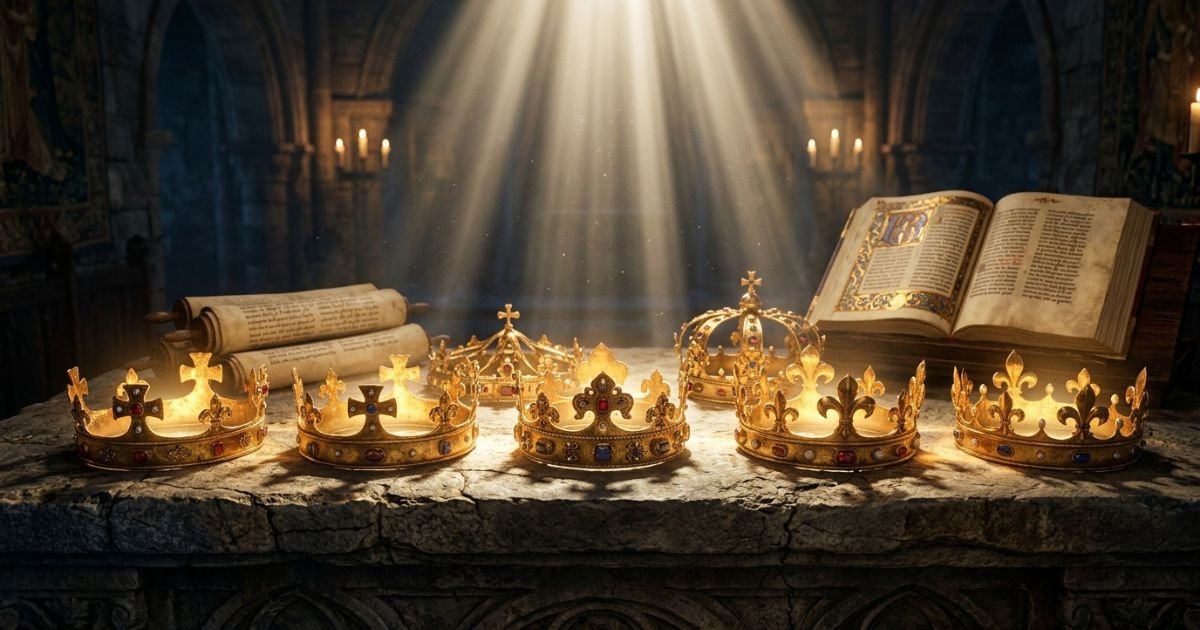
If you have ever wondered whether God notices your quiet sacrifices, your daily faithfulness, or the battles you have fought in private, the crowns in the Bible give you a clear and beautiful answer. He does. He always has.
The Bible describes several distinct crowns that God promises to His people. These are not crowns in the earthly sense, like royalty wears. In the original Greek, two words are used. The first is Stephanos, the victor’s wreath placed on the head of an athlete or champion. The second is the diadema, the crown of a ruling king. Most of the rewards promised to believers use Stephanos, signaling that these are trophies of victory, earned through faith and perseverance in the race of life.
Understanding the difference between these two types of crowns matters. When you read about the crowns given to faithful believers, you are reading about God honoring your spiritual victories, not just your position. That is deeply personal. That is the language of a Father who is proud of His children.
The seven crowns recognized in Scripture are:
- The Crown of Life (the martyr’s crown)
- The Incorruptible Crown (the victor’s crown)
- The Crown of Righteousness
- The Crown of Glory (the shepherd’s crown)
- The Crown of Rejoicing (the soul-winner’s crown)
- The Crown of Gold (worn by the heavenly elders)
- The Crowns on the Returned Christ (many diadems)
Each one tells a story. Each one speaks to a different way God honors faithfulness. Let’s walk through them together.
The Crown of Life: God’s Promise to Those Who Endure
Some seasons feel impossibly heavy. You might be walking through loss, illness, betrayal, or a trial that stretches on longer than you ever imagined. The Crown of Life was written for exactly that kind of moment.
James 1:12 puts it plainly: “Blessed is the one who perseveres under trial because, having stood the test, that person will receive the crown of life, which the Lord has promised to those who love him.”
Notice what that verse does not say. It does not say “blessed is the one who had it easy.” It does not say “blessed is the one who never doubted.” It says blessed is the one who perseveres. There is deep honor in simply not giving up.
Revelation 2:10 adds another layer: “Be faithful, even to the point of death, and I will give you life as your victor’s crown.” Jesus spoke those words to a church facing real persecution. Real imprisonment. Real danger. And yet His word to them was not “avoid suffering.” It was “be faithful in the middle of it.”
This crown is sometimes called the martyr’s crown, given in recognition of ultimate faithfulness. But it is not only for those who died for their faith. Commentators throughout church history have understood it more broadly, as God’s reward for anyone who loved Him enough to keep holding on when everything in them wanted to let go.
If you are in a hard season right now, this crown was written for you. God sees what you are carrying. He has not forgotten.
The Incorruptible Crown: Running the Race That Really Matters
There is something Paul loved about the imagery of an athlete. He returned to it again and again, and for good reason. Every person alive understands the feeling of training, striving, pushing toward something. The Incorruptible Crown, sometimes called the Victor’s Crown, speaks directly to that part of the human heart.
In 1 Corinthians 9:25-27, Paul writes: “Everyone who competes in the games goes into strict training. They do it to get a crown that will not last, but we do it to get a crown that will last forever. Therefore, I do not run like someone running aimlessly; I do not fight like a boxer beating the air. No, I strike a blow to my body and make it my slave so that after I have preached to others, I myself will not be disqualified for the prize.”
Paul’s honesty here is striking. He admits that even he, the great apostle, felt the weight of spiritual discipline. He understood that the Christian life requires intentionality. You do not drift into faithfulness. You choose it, over and over again.
The crown awaiting those who run with purpose is incorruptible. It cannot decay, fade, or be taken away. Every earthly trophy eventually tarnishes. Every athletic record eventually gets broken. But the reward God holds for His faithful is untouchable by time.
This is not a crown for perfect people. It is a crown for people who keep getting back up.
The Crown of Righteousness: For Everyone Longing for His Return

There is a certain kind of believer who lives with a quiet, constant awareness. A longing that this world is not home. They notice the brokenness around them and groan for the day when Jesus sets everything right. The Crown of Righteousness belongs to those people.
Near the end of his life, facing execution, Paul wrote these words in 2 Timothy 4:7-8: “I have fought the good fight, I have finished the race, I have kept the faith. Now there is in store for me the crown of righteousness, which the Lord, the righteous Judge, will award to me on that day, and not only to me, but also to all who have longed for his appearing.”
That phrase, all who have longed for his appearing, is extraordinary. Paul is not narrowing this crown to apostles, missionaries, or pastors. He is opening it wide to every believer who has ever looked at this world and whispered, Come, Lord Jesus.
If you live with that longing, you are one of the ones Paul was writing about. The Crown of Righteousness is already being held for you.
This crown also carries a note about justice. Paul calls God “the righteous Judge” before naming the reward. That is not an accident. For everyone who has been treated unjustly, overlooked, or misunderstood, there is a day coming when the righteous Judge will make all things right. Your faithfulness has been recorded. It will be rewarded.
The Crown of Glory: An Honor for Those Who Serve God’s People
If you have ever poured yourself out caring for others, teaching, shepherding, counseling, leading, or simply showing up when someone needed someone, you need to know about this crown.
Peter writes in 1 Peter 5:2-4: “Be shepherds of God’s flock that is under your care, watching over them, not because you must, but because you are willing, as God wants you to be; not pursuing dishonest gain, but eager to serve; not lording it over those entrusted to you, but being examples to the flock. And when the Chief Shepherd appears, you will receive the crown of glory that will never fade away.”
The Crown of Glory is specifically connected to faithful spiritual leadership. Pastors, elders, teachers, small group leaders, mentors, and anyone who has served God’s people with a pure heart and a willing spirit falls inside the promise of this verse. But it is worth noticing what kind of service Peter is describing. Not the showy kind. Not service done for recognition or gain. The kind done willingly, humbly, with love.
The world rarely applauds that kind of giving. It often goes unseen. But the Chief Shepherd sees every hour you gave, every person you helped carry, every night you stayed when it would have been easier to leave. And when He appears, the crown He places on the heads of faithful servants will never, not ever, fade.
The Crown of Rejoicing: The Joy of Seeing Others Come Home
There is a particular kind of joy that is unlike anything else. It is the joy of watching someone you love come to faith. Seeing a friend understand the gospel for the first time. Watching a family member return to God after years away. That joy is what the Crown of Rejoicing is all about.
Paul writes to the Thessalonians in 1 Thessalonians 2:19-20: “For what is our hope, our joy, or the crown in which we will glory in the presence of our Lord Jesus when he comes? Is it not you? Indeed, you are our glory and joy.”
He calls the people themselves his crown. Not a program. Not a number. People. The ones he walked beside, prayed for, wrote to, and wept over.
Philippians 4:1 echoes this: “Therefore, my brothers and sisters, you whom I love and long for, my joy and crown, stand firm in the Lord in this way, dear friends!”
Sometimes called the soul-winner’s crown, this reward is for those who invest in people, who share their faith, disciple others, pray for the lost, and celebrate when even one person comes home to God. The angels do too, after all. Jesus said in Luke 15:7 that there is more joy in heaven over one sinner who repents than over ninety-nine who need no repentance.
If you have ever introduced someone to Jesus, even awkwardly, even imperfectly, that moment matters eternally. And one day you may find yourself standing before God with that person beside you, understanding fully what Paul meant when he called them his crown.
The Crown of Gold: Worship That Returns Everything to God
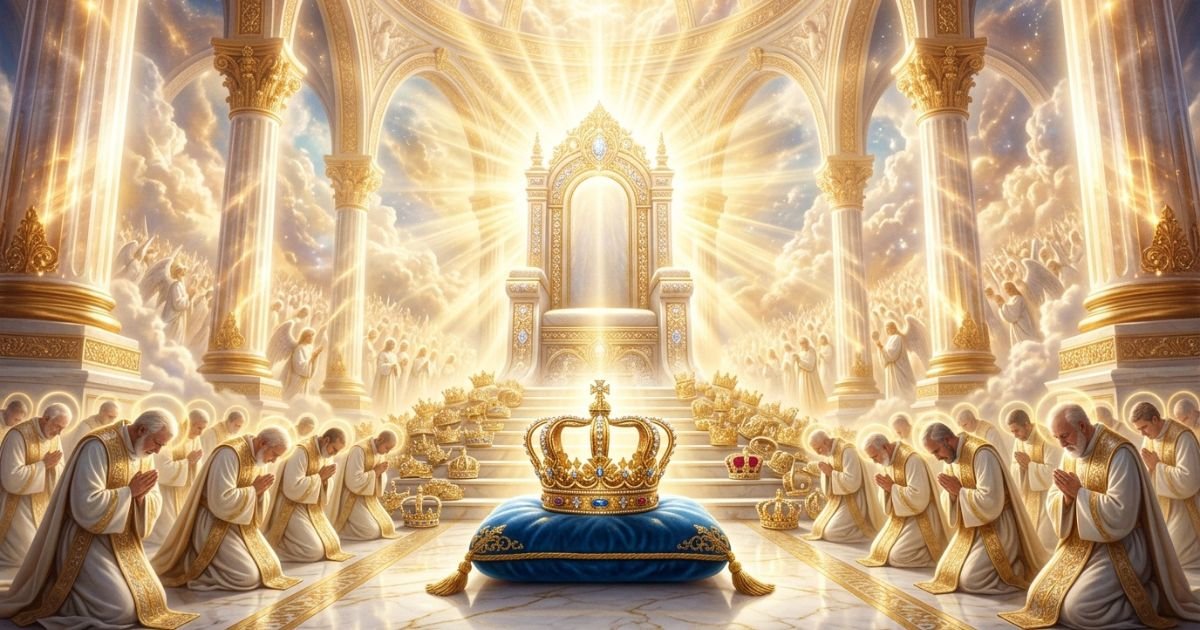
One of the most stunning scenes in all of Scripture appears in Revelation 4. The apostle John is caught up into heaven and sees twenty-four elders seated on thrones around the throne of God. They are clothed in white, and on their heads are crowns of gold.
Revelation 4:4 describes the scene: “Around the throne were twenty-four other thrones, and seated on them were twenty-four elders. They were dressed in white and had crowns of gold on their heads.”
These elders represent the redeemed people of God, honored, robed, and crowned. But what happens next changes the picture entirely. Revelation 4:10-11 tells us: “The twenty-four elders fall down before him who sits on the throne and worship him who lives forever and ever. They lay their crowns before the throne and say: ‘You are worthy, our Lord and God, to receive glory and honor and power, for you created all things, and by your will they were created and have their being.'”
They cast their crowns before the throne. Every reward, every honor, every crown given by God, returned to Him in worship. This is the final destination of every crown: not our glory, but His.
This is one of the most theologically beautiful passages in the New Testament. God rewards His people generously. And His people, finally face to face with Him, understand in an instant that everything they were and everything they received came from Him. Their crowns become acts of praise.
This pattern shapes how believers are meant to hold their rewards now, too. Loosely, humbly, always ready to return the glory to the One who gave it.
Crowns in Revelation: Not All Crowns Are Rewards
It is important to understand that not every crown mentioned in Revelation is a symbol of blessing. The book of Revelation uses crown imagery in at least three darker contexts, and understanding them helps the rewards shine brighter by contrast.
The Locusts with Crowns Like Gold
Revelation 9:7 describes terrifying creatures in John’s apocalyptic vision: “The locusts looked like horses prepared for battle. On their heads they wore something like crowns of gold, and their faces resembled human faces.”
These are not real crowns. The Greeks say they appeared as if they were golden crowns, an imitation. These locusts represent demonic forces permitted to torment during God’s judgment, but their crowns are counterfeit. It is a sobering reminder that evil mimics the appearance of authority without possessing its substance.
The Seven Crowns of the Great Red Dragon
In Revelation 12:3, John sees “an enormous red dragon with seven heads and ten horns and seven crowns on its heads.” This is Satan. The seven crowns (diadems) represent his claim to earthly authority and his position as the ruler of this world’s broken systems.
But the critical word is claim. His authority is real in a limited sense. He is called the prince of the power of the air in Ephesians 2:2, but it is borrowed, temporary, and already defeated. The war in Revelation 12:7-9 ends with Satan cast down, his power broken. His crowns are temporary; Christ’s are eternal.
The Beast with Ten Crowns
Revelation 13:1 describes a beast rising from the sea with ten crowns on its horns. This figure, widely understood to represent anti-Christian political power, wears the diadems of worldly authority. But again, they are temporary. They will be stripped away at the return of Christ.
These three uses of crown imagery in Revelation serve a purpose: they show that earthly power, even when it looks crowned, is not the final word. The real crowns, the ones that last forever, are given by God alone.
The Many Crowns of the Returning Christ
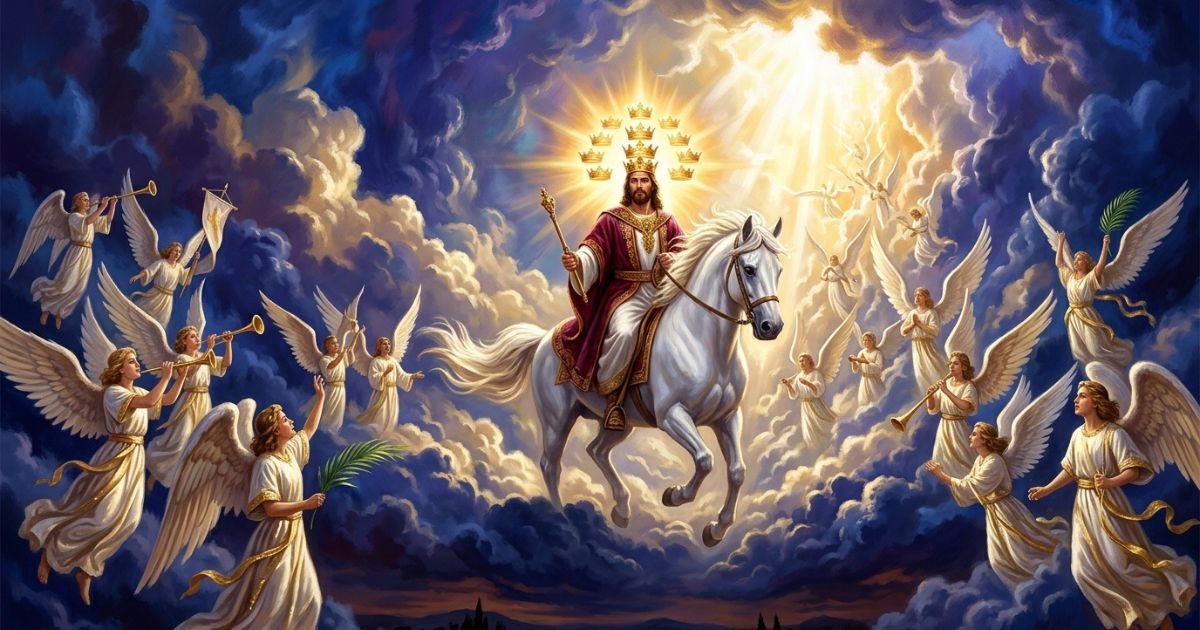
Everything in Scripture points toward a single, glorious moment. And when it comes, there will be no confusion about who holds ultimate authority.
Revelation 19:11-12 describes it like this: “I saw heaven standing open and there before me was a white horse, whose rider is called Faithful and True. With justice, he judges and wages war. His eyes are like blazing fire, and on his head are many crowns.”
Many crowns. Not one. Not seven. Many. The Greek word used here is diadema, the crown of a reigning king. Christ returns wearing the diadems of every kingdom, every authority, every power that ever existed. Revelation 19:16 completes the picture: on His robe is written “KING OF KINGS AND LORD OF LORDS.”
This is not a gentle shepherd moment. This is the moment of full, unveiled sovereignty. Every crown ever worn by a ruler, every diadem ever placed on the head of a king, they all belong to Him. He wears them all at once because He earned them all.
For the believer, this image is not terrifying. It is the best possible news. The One who died for you, who promised you a crown, who is holding your reward, He is the King of everything. His promise to you is backed by unlimited power and absolute authority.
Will We Actually Receive These Crowns? What the Bible Says
This is a question many believers quietly wonder about. Are these crowns literal, symbolic, or both? And what exactly is the “judgment seat of Christ” where these rewards are given?
2 Corinthians 5:10 tells us: “For we must all appear before the judgment seat of Christ, so that each of us may receive what is due us for the things done while in the body, whether good or bad.”
This judgment is not about salvation. That question is already settled for believers in Christ. It is about reward. The Greek word for “judgment seat” here is bema, which was the raised platform in a Roman arena where the victors came to receive their prizes after a race. Paul’s readers would have pictured an athletic award ceremony.
Whether the crowns are literal objects or spiritually real experiences may be a question we cannot fully answer this side of heaven. What is certain is that they represent genuine divine recognition of how you lived. God does not forget faithfulness. He does not overlook love. He does not miss the sacrifice made in His name.
Every quiet act of obedience, every persevered trial, every soul pointed toward Jesus, every faithful hour of shepherding, it is all being recorded by a God who keeps perfect accounts.
How These Crowns Can Change the Way You Live Right Now
Understanding the 7 crowns in the Bible is not meant to make you fixated on future reward. It is meant to give your present faithfulness a sense of eternal weight.
When you are tempted to give up on someone you are discipling, remember the Crown of Rejoicing. When the suffering stretches long, and the relief does not come, remember the Crown of Life. When you are serving quietly behind the scenes and nobody notices, remember the Crown of Glory. When you feel the deep ache for Jesus to come back and make things right, remember the Crown of Righteousness.
These are not motivational slogans. They are God’s own words, written to real people in real hardship, promising that faithfulness has an eternal future.
And perhaps the most beautiful thing of all? When the elders finally receive their crowns and then lay them at the feet of Jesus, we see what the crowns were really for all along. Not to lift us up, but to give us something worthy to offer back to God. Something that came from our own lives, our own choices, our own love for Him.
That is the full story of the 7 crowns in the Bible. They begin with God’s grace. They are earned through human faithfulness. And they end as worship.
Frequently Asked Questions
What does 7 crowns mean?
In the Bible, the 7 crowns represent God’s eternal rewards for faithful believers, each crown honoring a different aspect of Christian life, like endurance, righteousness, and service.
Are there 5 or 7 crowns in heaven?
Most Bible teachers identify 5 crowns promised to believers, including the Crown of Life, Righteousness, Glory, Rejoicing, and the Incorruptible Crown, while 7 crowns appear when you also include the Crown of Gold and the many crowns of Christ in Revelation.
What do 7’s mean spiritually?
In the Bible, the number 7 represents completeness and divine perfection, seen throughout Scripture in 7 days of creation, 7 seals, and 7 crowns, signaling that God’s plan is whole and complete.
What is the Crown of Life in the Bible?
The Crown of Life is God’s eternal reward promised to believers who endure trials and remain faithful through suffering, described in James 1:12 and Revelation 2:10.
Will believers actually receive crowns in heaven?
Yes, the Bible teaches that believers will receive crowns at the judgment seat of Christ, known as the bema seat, where God personally rewards every act of faithful service and love done in His name.
Conclusion
Maybe you came to this article because you are tired. Because the race feels long. Because you have been faithful for a while now, and you are wondering if it matters.
It does. Every bit of it.
The God who promised a crown to those who endure is the same God who numbers every tear, who knows every sacrifice you have made, and who calls you by name. He is not forgetful. He is not unaware. He is holding something for you that no earthly reward can touch, something that will not fade, will not rust, and will never be taken away.
Keep running. Keep loving. Keep serving. Keep looking up.
The Chief Shepherd is coming back. And He comes with crowns in His hands for everyone who held on.